

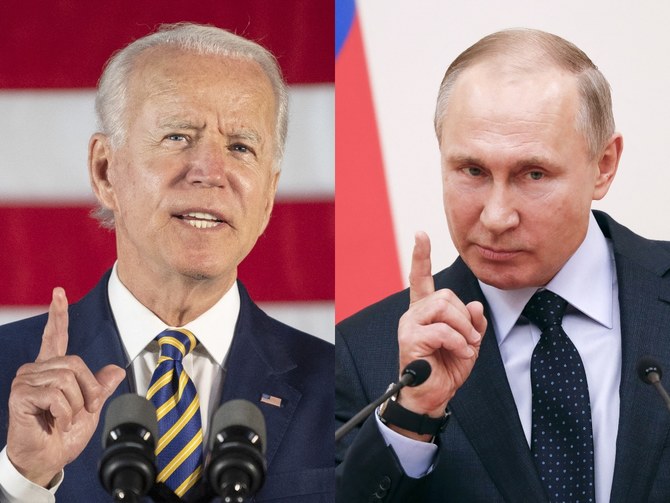

MOSCOW: The US and Russian presidents have tentatively agreed to meet in a last-ditch diplomatic effort to stave Moscow’s invasion of Ukraine as heavy shelling continued Monday in a conflict in eastern Ukraine that is feared will spark the Russian offensive.
French President Emmanuel Macron sought to broker a possible meeting between US President Joe Biden and Russian President Vladimir Putin in a series of phone calls that dragged into the night.
Macron’s office said both leaders had both “accepted the principle of such a summit,” to be followed by a broader summit meeting also involving other “relevant stakeholders to discuss security and strategic stability in Europe.” It added that the meetings “can only be held on the condition that Russia does not invade Ukraine.”
White House press secretary Jen Psaki, said the administration has been clear that “we are committed to pursuing diplomacy until the moment an invasion begins.” She noted that “currently, Russia appears to be continuing preparations for a full-scale assault on Ukraine very soon.”
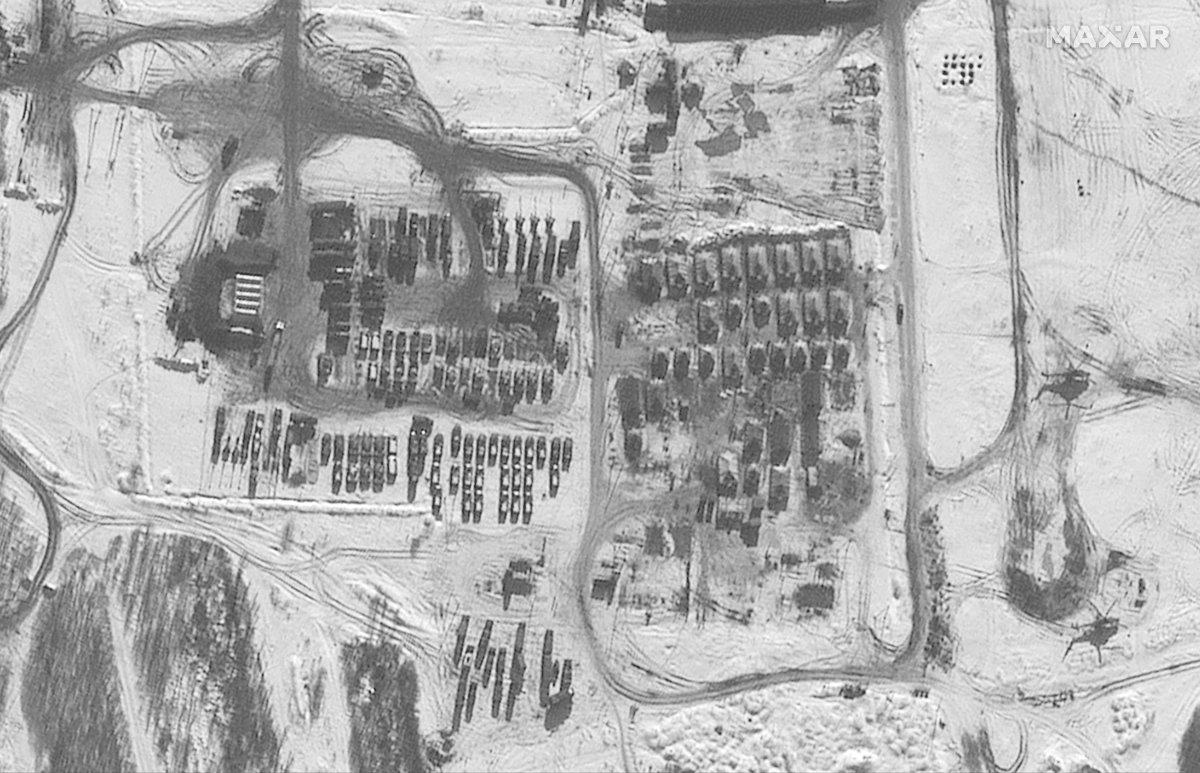
Satellite image taken on Feb. 15, 2022 shows battle group deployment and troop tents at Valuyki, Russia, 27 km east of the border with Ukraine. (Maxar Technologies via AFP)
Macron’s office said that US Secretary of State Antony Blinken and Russian Foreign Minister Sergey Lavrov are set to lay the groundwork for the summit when they meet Thursday.
It followed a flurry of calls by Macron to Putin, Biden and also British Prime Minister Boris Johnson and Ukrainian President Volodymyr Zelenskyy.
The Kremlin hasn’t yet commented on the announcement of a possible Putin-Biden summit, but it has said all along that Putin is always open for such a meeting.
The prospective meeting offers new hope of averting a Russian invasion that US officials said could begin any moment with an estimated 150,000 Russian troops amassed near Ukraine.
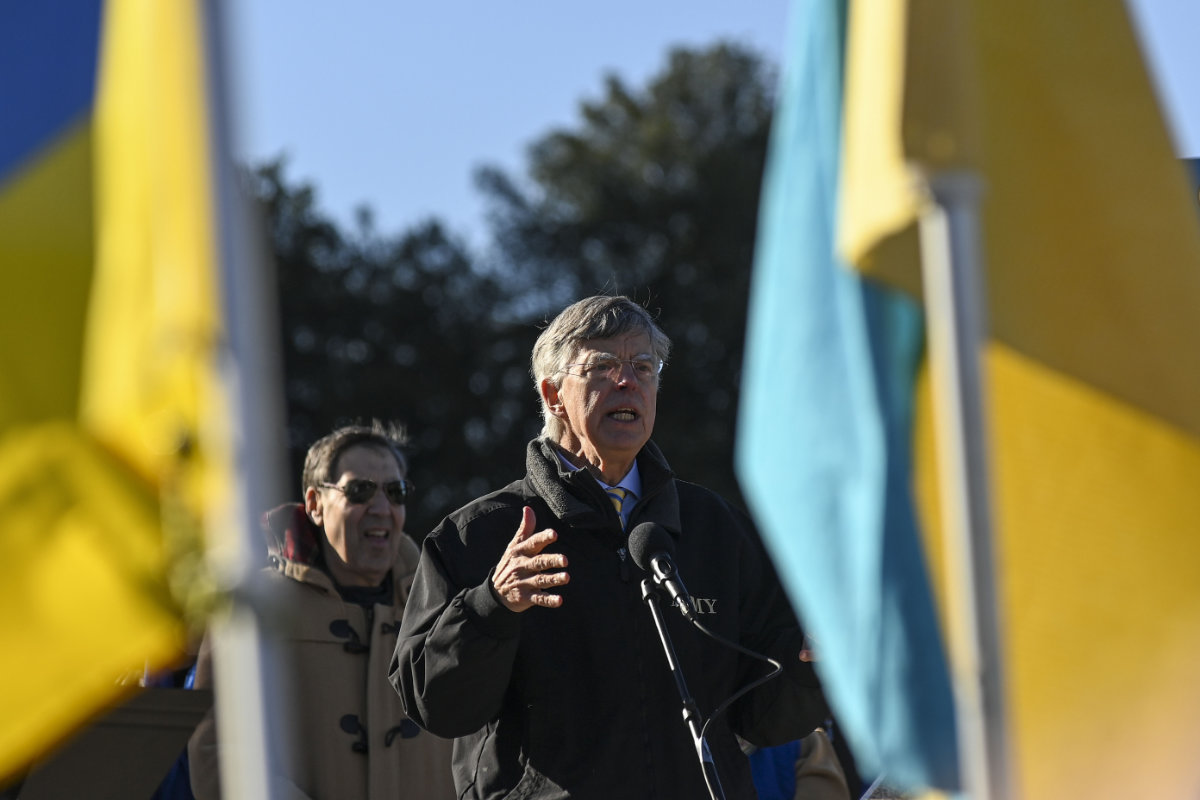
Activists rally on Feb. 20, 2022 in Washington urging US President Joe Biden to take a stronger stance on deterring Russia from invading Ukraine. (Getty Images/AFP)
Adding to fears of an imminent invasion, Russia and its ally Belarus announced Sunday that they were extending massive war games on Belarusian territory that offers a convenient bridgehead for an attack on the Ukrainian capital, Kyiv, located just 75 kilometers (less than 50 miles) south of the border with Belarus.
Starting Thursday, shelling also spiked along the tense line of contact between Ukrainian forces and Russian-backed separatist rebels in Ukraine’s eastern industrial heartland, Donbas, where over 14,000 people have been killed since conflict erupted in 2014 shortly after Moscow’s annexation of Ukraine’s Crimean Peninsula.
Ukraine and the rebels have traded blame for massive cease-fire violations with hundreds of explosions recorded daily.
On Friday, separatist officials announced the evacuation of civilians and military mobilization in the face of what they described as an imminent Ukrainian offensive on the rebel regions. Ukrainian officials have strongly denied any plans to launch such an attack and described the evacuation order as part of Russian provocations intended to set the stage for an invasion.
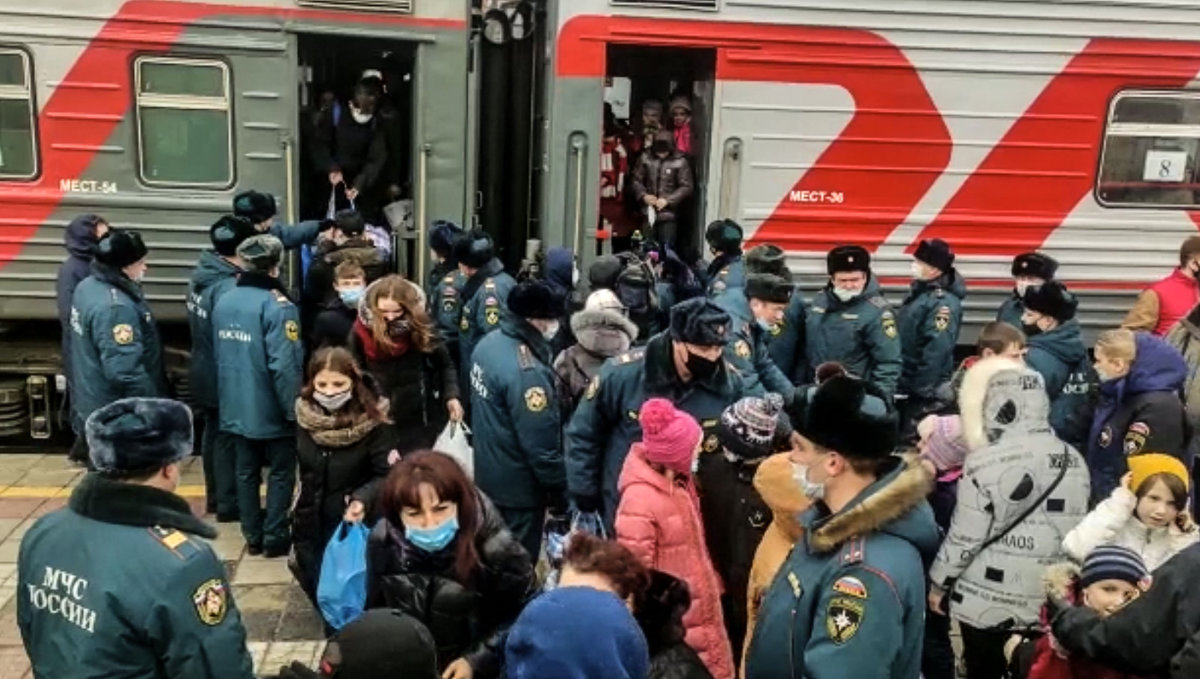
People are evacuated from the self-proclaimed Donetsk People's Republic arriving to the railway station in the city of Voronezh. (Russian Emergency Situations Ministry " handout via AFP)
The separatist authorities said Monday that at least four civilians were killed by Ukrainian shelling over the past 24 hours and several others were injured. Ukraine’s military said a Ukrainian soldier was wounded, saying that the separatists were “cynically firing from residential areas using civilians as shields” and insisting that the Ukrainian forces weren’t returning fire.
Moscow denies any plans to invade Ukraine, but wants Western guarantees that NATO won’t allow Ukraine and other former Soviet countries to join as members. It also urges the alliance to halt weapons deployments to Ukraine and roll back its forces from Eastern Europe — demands flatly rejected by the West.
Russian officials have shrugged off Western calls to deescalate by pulling back troops, arguing that Moscow is free to deploy troops and conduct drills wherever it likes on its territory. Last week, Western officials dismissed Russian statements about some of the troops returning to their bases, saying that Moscow was actually beefing up its forces around Ukraine.
A US official said Sunday that Biden’s assertion last week that Putin has made the decision to roll Russian forces into Ukraine was based on intelligence that Russian front-line commanders have been given orders to begin final preparations for an attack. The official spoke on condition of anonymity to describe the sensitive intelligence.
Russia also upped the ante Saturday with sweeping nuclear drills that included multiple practice launches of intercontinental ballistic missiles and cruise missiles that Putin personally oversaw.
Ukraine’s president reaffirmed his call for a quick meeting with Putin to help defuse tensions, but there was no response from the Kremlin.
The European Union’s top diplomat, foreign policy chief Josep Borrell, welcomed the prospect of a Biden-Putin summit but said that should diplomacy fail the 27-nation bloc has finalized its package of sanctions for use if Putin orders an invasion.
“The work is done. We are ready,” said Borrell, who is chairing a meeting of EU foreign ministers. He did not say what kind of red line would trigger the measures, but said that he would call an urgent meeting of foreign ministers when it was crossed “and I will present the sanctions at the right moment.”
Borrell was tasked with drawing up a list of people in Russia to be hit with asset freezes and travel bans. He provided no details about who might be targeted.
The European Commission has prepared other sanctions to “limit the access to financial markets for the Russian economy and (impose) export controls that will stop the possibility for Russia to modernize and diversify its economy,” its president, Ursula von der Leyen, said over the weekend.
In the Ukrainian capital, people prayed for peace as war fears loomed.
Katerina Spanchak, who fled the separatist-controlled east, was among worshippers crowded into the capital’s St. Michael’s monastery, smoky with the candles burned by the faithful, to pray that Ukraine be spared.
“We all love life, and we are all united by our love of life,” Spanchak said, pausing to compose herself. “We should appreciate it every day. That’s why I think everything will be fine.”


