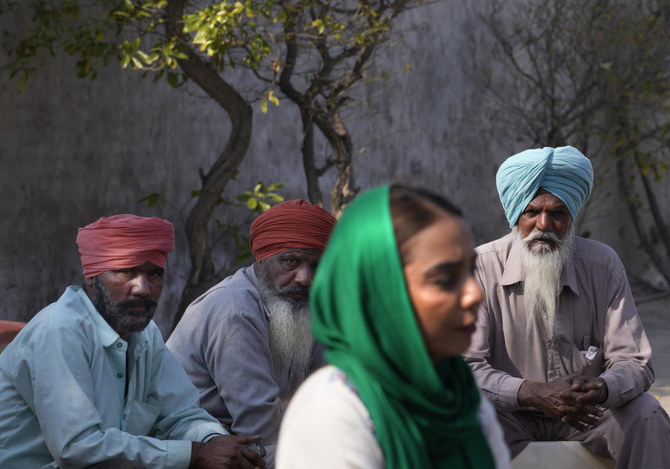
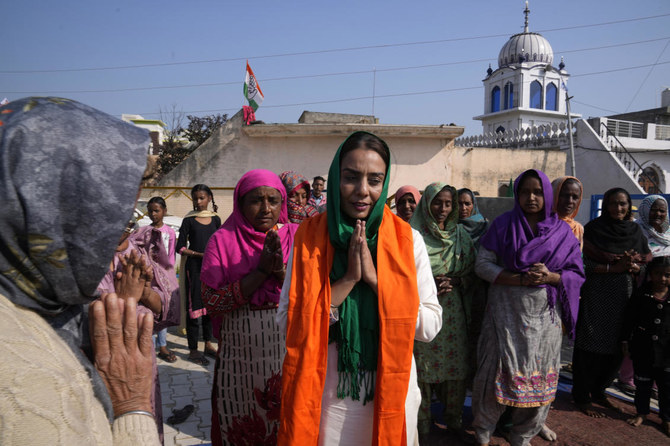
FATEHGARH SAHIB, India: Amandeep Kaur Dholewal rose from a traditional Indian cot and began speaking to a small gathering of men and women who sat cross-legged in a park opposite a white-domed gurdwara, a place of worship for Sikhs.
The 37-year-old doctor was flanked by a dozen of supporters, mainly drawn from the protesters who last year hunkered on the edges of the Indian capital and demonstrated against farm laws pushed by Prime Minister Narendra Modi, which they feared would decimate their income.
“We have already defeated Modi once. Let’s defeat him again.” Her voice bellowed from a loudspeaker attached to an auto rickshaw, displaying none of the flamboyance of a seasoned politician but drawing bursting applause from the audience.
The scene underscored the changing electoral landscape in India’s Punjab state, where more than 21 million voters cast ballots on Sunday in polls that are seen as a barometer of Modi and his party’s popularity ahead of general elections in 2024. The polls will indicate whether riding the crest of the yearlong protests that forced Modi to make a rare retreat and repel the farm laws could be enough to prevent his party from making inroads in a state considered the “grain bowl” of India.
Political newbies like Dholewal are pinning their hopes on this very formula. They are vying to convert the farmers’ anger into votes, arguing that a new party is the only path to change.
“People are asking me, ‘Why are you late? We were waiting for you,’” said Dholewal, who ran a medical camp at one of the protest sites last year. She is now a candidate for Sanyukt Samaj Morcha, a newly minted political party that includes some of the farm unions that organized the protests.
“People know their rights now," she said.
Modi’s Bharatiya Janata Party rammed the farm laws through Parliament without consultation in September 2020, using its executive powers. His administration billed them as necessary reforms, but farmers feared the laws signaled the government was moving away from a system in which they sold their harvest only in government-sanctioned marketplaces. They worried this would leave them poorer and at the mercy of private corporations.
The laws triggered a year of protests as farmers — most of them Sikhs from Punjab state — camped on the outskirts of New Delhi through a harsh winter and devastating coronavirus surge. Modi withdrew the laws in November, just three months ahead of the crucial polls in Punjab and four other states. The election results will be announced on March 10.
Modi’s BJP has a relatively small footprint in Punjab but hopes to form a government there with a regional ally and strengthen its fledgling voter base among farmers, one of the largest voting blocs in India. Punjab, where people are deeply proud of their state's religious syncretism, also represents a test for his party's Hindu nationalist reach, which has flourished in most of northern India since 2014.
Meanwhile, the BJP is running its campaign by trying to frame the incumbent Congress party state government as corrupt. It is also making grand promises to create more jobs, provide farm subsidies and free electricity for farmers, and eradicate the drug menace that has ailed the state for years.
The anger against the government, however, runs deep.
More than 700 farmers died during the protests as they weathered brutal cold, record rains and sweltering heat, according to Samyukt Kisan Morcha, or the United Farmers Front, the umbrella group of farm unions that organized the agitation. Dozens also died by suicide.
But in December last year, Agriculture Minister Narendra Singh Tomar told Parliament that his government had no record of the farmers’ deaths. This caused widespread outrage among the families of the deceased, many of whom are small or landless farmers who constitute the lowest rung of India’s agricultural community.
“Where did those 700-750 farmers go then? The Modi government is responsible for their deaths,” said Amarjeet Singh, choking back tears in his family home in Kaler Ghuman village, some 40 kilometers (24 miles) from Amritsar, the state’s capital.
Singh’s father, Sudagar Singh, died on a sweltering September afternoon from cardiac arrest, according to his death certificate. At the time of his death, he was accompanied by his friend Charan Singh, the village head, who said the 72-year-old collapsed while returning home after spending weeks at the protests.
“Even though we won in the end, those laws only brought misery to our lives. Do you think we would forget that?” said Singh, pointing to a framed portrait of his friend.
Scarred by the death, Sudagar Singh’s younger brother fell into depression, the family said. He stopped eating and working on his farm. Three months later, he too died.
In some cases, the Punjab government has announced jobs and funds for the families of the deceased, but farmers say the elections are an opportunity to turn their anger into meaningful change.
“That’s why you don’t see flags of any political party flying atop our homes,” said Singh, the village head. “We don’t trust them anymore.”
Among those seeking to consolidate their political dominance through the election is the Aam Aadmi Party, which was formed in 2013 to eliminate corruption and has since ruled Delhi for two consecutive terms.
Its campaign plan in Punjab, however, is not limited to just the farmers’ anger. The party hopes to ride on reemerged fault lines that were blurred during the demonstrations.
At its peak, the protest drew support from Punjab’s rural and urban populations. Now, those protests find very little resonance among city voters who say the farmers’ issues should take a backseat since the laws have been withdrawn.
“The youth want education, health, employment and an end to corruption. That’s what people want. They want a change,” said Avinash Jolly, a businessman.
On a recent afternoon, Harbhajan Singh, one of the Aam Aadmi Party's candidates, stopped near a public park and talked to supporters about chipping away at the entrenched political system. A band of young men followed him on motorbikes waving flags brandishing the party symbol — a broom to sweep out corruption.
To resounding applause, he ended his speech with a call to the crowd: “Will you teach a lesson to those leaders who have ruined this sacred land and humiliated our farmers?”
The young men, in unison, chanted “Yes!”


![]()
![]()
![]()

Farmer anger will test Modi as India's ‘grain bowl’ votes

Short Url
https://arab.news/v2mnf
Farmer anger will test Modi as India's ‘grain bowl’ votes
- More than 21 million voters cast ballots in Punjab on Sunday in polls
- The polls are seen as a barometer of Modi and his party’s popularity ahead of general elections in 2024


Latest updates


© 2026 SAUDI RESEARCH & PUBLISHING COMPANY, All Rights Reserved And subject to Terms of Use Agreement.