

WWE superstars show Saudi students how to wrestle with bullying

The students and the wrestlers coming together for activities in the anti-bullying campaign, ‘Be A Star,’ at King Abdullah Sports City Stadium. (Supplied)
Short Url
Updated 20 February 2022
Follow

WWE superstars show Saudi students how to wrestle with bullying

  • ‘Up to us’ to teach people how to deal with things, says Titus O’Neil

JEDDAH: WWE superstars on Friday showed Saudi students how to wrestle with bullying as part of their “Be A Star” campaign.

Around 60 girls and boys, from grades three to nine from Dar Al-Fikr School in Jeddah, got the chance to learn about loneliness and struggles from some of the toughest-looking people in the world.
The students arrived at King Abdullah Sports City Stadium and were greeted by a voice that perhaps every WWE fan would recognize in a heartbeat — Mike Rome, the announcer for wrestling bouts.
The superstars sharing their experiences were: Titus O’Neil, Natalya, Drew McIntyre, Bianca Belair, Liv Morgan, Nikki A.S.H, and Riddle.
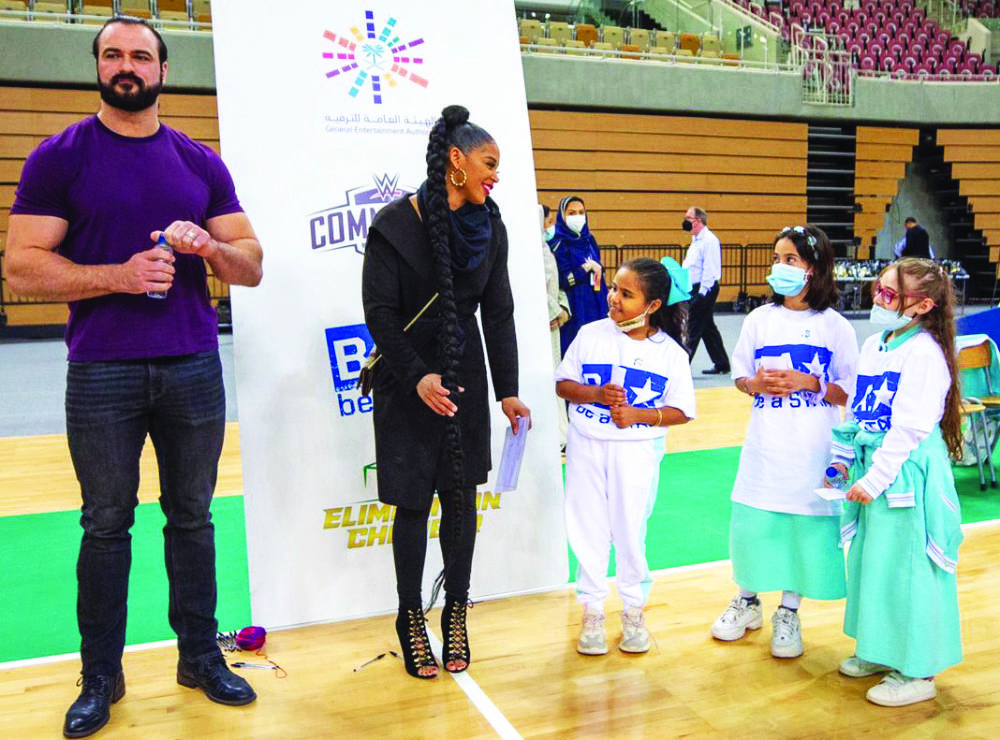
Rome welcomed the wrestlers and the students, dividing them into three groups with two superstars each. The team had activities planned but these were not just for fun, they were there to teach children about different things and help them understand bigger themes in life.
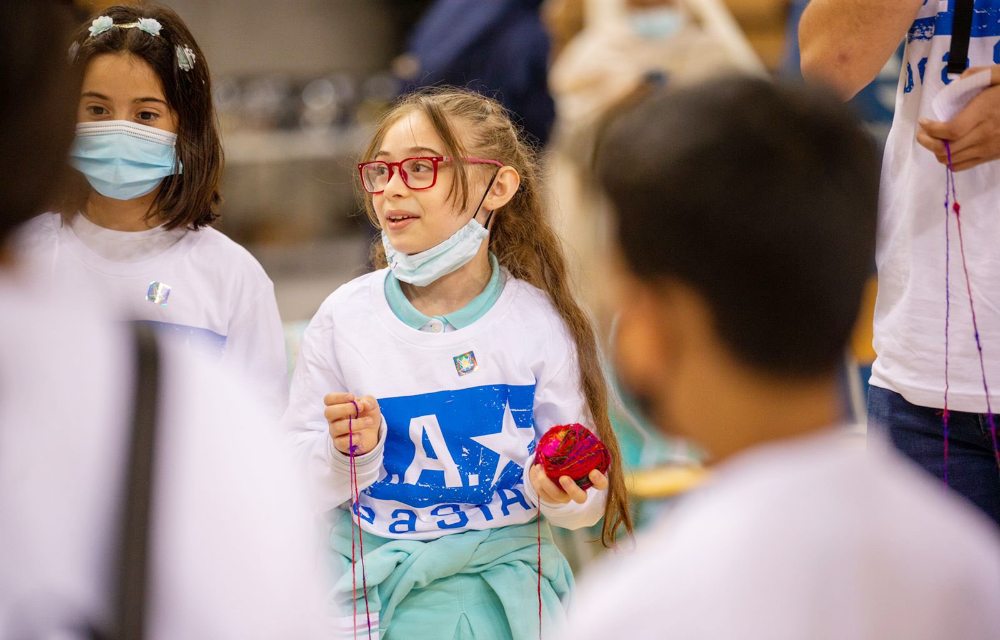
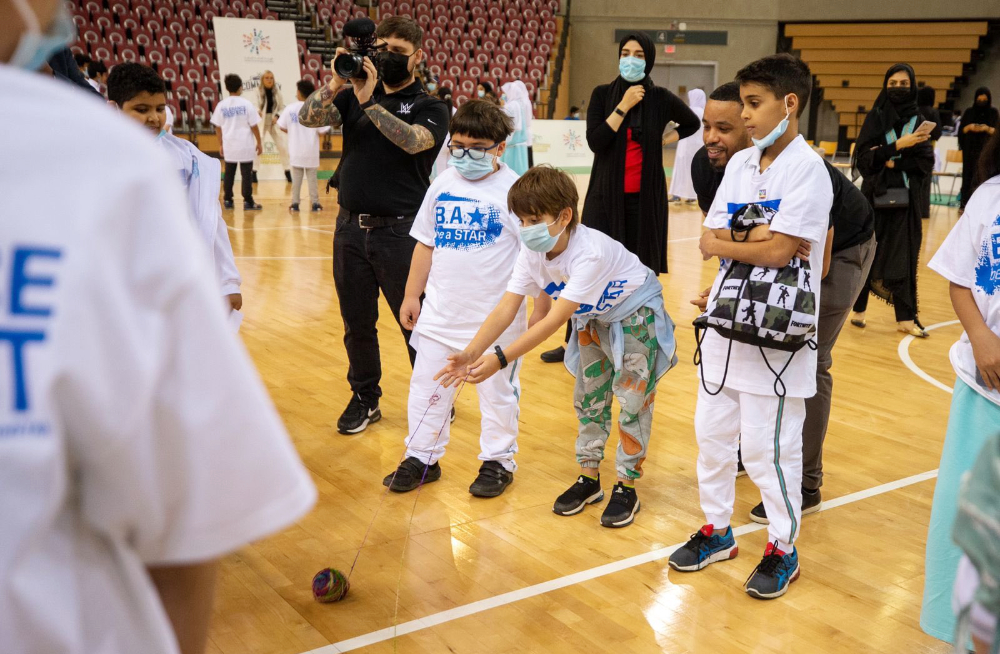
The activities included team members introducing themselves and naming something they enjoyed when a ball of yarn was thrown at them. They would then pass it on to another student in the circle while holding on to the thread. By the end of the exercise they were all connected together, despite their different personalities.

HIGHLIGHTS

• Around 60 girls and boys, from grades three to nine from Dar Al-Fikr School in Jeddah, got the chance to learn about loneliness and struggles from some of the toughest-looking people in the world. 

• The superstars sharing their experiences were: Titus O’Neil, Natalya, Drew McIntyre, Bianca Belair, Liv Morgan, Nikki A.S.H, and Riddle.

After the activities, the WWE stars took turns in sharing their own personal struggles and how to deal with them.
They mentioned cyberbullying, what made them different and how being different was not a bad thing, how to deal with their negative emotions, and what to do if someone else was experiencing problems.
“Especially with cyberbullying, it doesn’t matter if you are in Jeddah or Texas there are people online that are saying and doing mean things,” O’Neil told Arab News. “It is up to us, people with a platform, to teach everyone how to deal with these things, how to manage their emotions.
“I always tell people, ‘Don’t take it personally if they don’t know you personally.’ There are a lot of people that would say stuff about you that is negative but they don’t even know you, they just know the television character, your name, or your social media handle.”
Nicola Glencross, who wrestles under the ring name Nikki A.S.H, shared her story with the students. “I had to deal with a lot of cyberbullying, people hated the mask I wore and the costume. If someone is bullying you there is always something you can do, you can talk to an adult, you can mute them.”
She also explained the psychology of the bully: “People need a response and I don’t give it to them, I am a superhero. I don’t need to deal with that.”
Rome asked who in the crowd was bullied. Some students raised their hands but all of the wrestlers did, showing the children that, despite the massive difference between them and their talent, there were similarities as well.
Natalya, whose real name is Natalie Katherine Neidhart-Wilson, told Arab News: “It’s important for the kids to see that we are all connected, we are really all alike. They may see us on television, and you know WWE is a global company and we are all around the world in 180 different countries and 30 different languages. For the kids to see us and see that they are on TV every week and they are just like us, it’s a very grounding experience for them to realize we are all relatable.”
She said that they had all been through hardships, bullying, and adversity. Another thing that Natalya wanted to help the children with was to regulate their emotions and deal with the problems they may face on their social media so they felt more equipped to combat the issues. “We want them to be able to stand up for themselves, to be strong and positive.”
The children left the venue feeling stronger and more positive than before. And, as for the stars themselves, they were buzzing with excitement for the upcoming event and for being back in Jeddah.
O’Neil said: “Jeddah is the place that made me famous. People here are so nice and kind. Coming here for the first time was a really eye-opening experience for me because you see all those stereotypical things on the news and then you actually come here and it is the exact opposite.”
Natalya said that she was honored to be part of one of the three women’s fights taking place in Saudi Arabia. “It’s a huge honor to be able to do that as a woman in WWE.”


Healthcare must be ‘proactive’ says Hevolution exec

Updated 20 December 2025
Follow

Healthcare must be ‘proactive’ says Hevolution exec

  • Princess Dr. Haya bint Khaled bin Bandar Al-Saud spoke to Arab News at a presentation of its second Global Healthspan Report

RIYADH: Healthcare needs to shift to a global model that targets preventing disease rather than treating it, a senior executive from the Saudi-funded Hevolution Foundation told Arab News.

The senior vice president of research of Hevolution, Princess Dr. Haya bint Khaled bin Bandar Al-Saud, spoke to Arab News at a presentation of its second Global Healthspan Report at the nonprofit’s headquarters in Riyadh’s KAFD on Wednesday.

“People have to be aware, healthcare has to change its way of thinking, because it’s a must,” she said. “We cannot be reactive anymore, we have to be proactive.

“And this has to start earlier in the education of health professionals, and third, someone needs to take this to the global agenda. The general public needs to know that this is a reality.” 

Launching its report, Hevolution called for urgent global action to treat healthy aging as an economic imperative, where prevention, not disease, drives prosperity.

The organization focuses on healthspan research, or extending the healthy human lifespan.

The findings of the report centered around five main areas; rising awareness and public demand, breakthrough science and new therapies, AI and data revolution, investment momentum and gaps and economic and policy imperatives.

The report detailed the momentum of a new healthspan era where science, technology and public awareness are converging, but momentum alone is not enough.

Al-Saud explained that achieving equitable and evidence-based progress would require coordinated leadership from scientists, policymakers and investors alike.

“Today, science and societal cause has to be integrated, meaning the public needs to know that everything that we are investing in is for the general population, not just on a local level but on a global level,” she said.

The report surveyed 23 countries on the awareness of healthspan, which found that two-thirds of healthcare professionals now receive patient inquiries about healthspan interventions at least once a month, with one-third reporting them weekly.

Al-Saud highlighted that the report also found that 80 per cent of citizens believed governments should fund preventive care programs, while 39 per cent expressed concern about inequality in access.

“Awareness is the most important thing. This subject touches every single one of us, every single one of us has a story that this relates to, whether a grandparent, sick parent, or us,” she said.

Under artificial intelligence the report found that 74 per cent of experts believe AI will transform healthspan R&D and healthcare delivery, yet 26–30 per cent remain opposed to AI in diagnostics, reflecting an ongoing trust and ethics gap.

The report detailed that 59 per cent of investors cite lack of awareness as the top barrier while 46 per cent point to limited experts, unclear evidence and weak regulatory frameworks.

“Between 2022 and 2024 the investments in healthspan has doubled, it’s estimated to be $7 billion invested in finding interventions in healthspan globally,” Al-Saud said.

Investment in healthspan reached $7.33 billion in 2024, up from $3.48 billion the previous year. The average deal size has grown 77 per cent since 2020, signaling maturing confidence in the sector.

“Hevolution Foundation remains the world’s largest philanthropic backer of aging biology and healthspan science, with $400 million allocated in over 230 grants, 25 partnerships, and four biotech ventures,” Al-Saud said.

According to a report from Hevolution, expanding could deliver up to $220 billion annually in productivity gains, and every $1 invested in prevention could yield $16 in returns.

“We always want to support scientists but the end-consumer is the general public,” Al-Saud said.

Hevolution has remained true to its mission since its foundation; to extend healthy human lifespan for all, mobilizing the science, innovation and investment needed to make healthier longer lives a shared global reality.

Established by royal decree in 2018 and launched in 2021, Hevolution Foundation is a non-profit organization that focuses on accelerating independent research and entrepreneurship in the emerging field of healthspan science.

Headquartered in Riyadh, Saudi Arabia, with a North American hub in Boston, the foundation says it has plans for further international expansion, and has set key goals and targets to advance its vision and mission.