US defense chief: Russia ‘uncoiling and poised to strike’

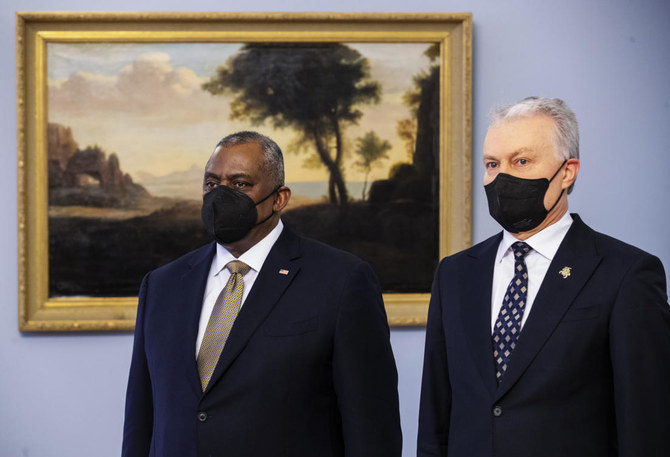
US Defense Secretary Lloyd J. Austin III and Lithuania’s President Gitanas Nauseda at the President’s palace in Vilnius on Saturday. (AP)
Short Url
Updated 19 February 2022
Follow

US defense chief: Russia ‘uncoiling and poised to strike’

  • Austin was in Lithuania as a massive Russian troop buildup and other actions have Western officials saying that Moscow could invade Ukraine at any time
  • “The battle for Ukraine is a battle for Europe. If Putin is not stopped there, he will go further," Lithuanian Foreign Minister Gabrielius Landsbergis said

VILNIUS, Lithuania: US Secretary of Defense Lloyd Austin assured the three Baltic nations Saturday that they would not be on their own if faced with security threats from Russia.
But he stopped short of promising a permanent deployment of American troops in the former Soviet republics.
Austin was in Lithuania as a massive Russian troop buildup and other actions have Western officials saying that Moscow could invade Ukraine at any time, although Russia has denied planning an invasion.
“They are uncoiling and are now poised to strike,” Austin said Saturday about the readiness of Russia’s troops to attack Ukraine.
Lithuanian officials voiced concerns that Russian President Vladimir Putin’s alleged ambitions could expand to the entire region.
“The battle for Ukraine is a battle for Europe. If Putin is not stopped there, he will go further,” Lithuanian Foreign Minister Gabrielius Landsbergis said during a joint news conference with Austin. “They are choosing the way that is based on force. We need to send a very clear and unambiguous message that it would be faced by a very clear and swift response.”
In an interview with The Associated Press on Saturday, Lithuanian Prime Minister Ingrida Simonyte noted that some European political leaders a few years ago spoke of NATO being “irrelevant.”
“Putin must be surprised now by the unity of the West, which is much stronger than ever,” Simonyte told The AP. ” Now we see how relevant NATO is and how important it is that we have absolute unity of NATO and the European Union. And the most important message to Mr. Putin is that there will be no decisions on countries behind the countries’ back. This is what he wants to achieve.”
She scolded Western nations for not taking signals coming from Moscow seriously enough in the past years. Moscow annexed Crimea from Ukraine in 2014 and began backing separatist rebels in eastern Ukraine, including the Donbas region, that same year.
“If the threat from Russia would have been taken seriously by the West, there would have been no Crimea and no Donbas. A lot in the future will depend on how strong the Western reaction will be if Russia invades Ukraine,” Simonyte said. “Bad peace is better than a good war. Diplomacy should be given a chance, but there will be no trust (in Russia) anymore and I do not see how it can be restored.”
The three Baltic nations — Lithuania, Latvia and Estonia — joined NATO on the same day in March 2004, and the alliance operates under the principle that an attack on one member is an attack on them all. Lithuania, a nation of 2.8 million, borders Russian ally Belarus and Russia’s Kaliningrad exclave.
“I want everyone in Lithuania, Estonia and Latvia to know — and I want President Putin and the Kremlin to know — that the United States of America stands with our allies,” Austin said during the news conference in Vilnius, the Lithuanian capital.
Austin also met with Simonyte, Lithuanian President Gitanas Nauseda and the defense ministers of Latvia and Estonia on his two-day visit to Lithuania.
Nauseda asked Washington for a permanent deployment of a rotating battalion in the Baltics, emphasizing that the situation in Eastern Europe continues to deteriorate.
“Russia’s military buildup on NATO’s eastern border changes the overall security situation. Therefore, the decision to reinforce security in the region with additional troops from the United States and to accelerate collaboration on military acquisitions is critical,” Nauseda said.
Austin did not comment on the request. United States has deployed regular rotations of battle groups of about 500 soldiers and armored vehicles since 2019.
Germany and The Netherlands said this month that they would increase the number of troops by several hundred soldiers in NATO’s battlegroup in Lithuania. The Dutch force is part of NATO’ German-led battlegroup deployed in Lithuania since 2017.


Trump says Iran ‘want to negotiate’ after reports of hundreds killed in protests

Updated 4 sec ago
Follow

Trump says Iran ‘want to negotiate’ after reports of hundreds killed in protests

  • US President Donald Trump said Sunday that Iran’s leadership had called him seeking “to negotiate” after he repeatedly threatened to intervene militarily if Tehran killed protesters
WASHINGTON: US President Donald Trump said Sunday that Iran’s leadership had called him seeking “to negotiate” after he repeatedly threatened to intervene militarily if Tehran killed protesters.
For two weeks, Iran has been rocked by a protest movement that has swelled in spite of a crackdown rights groups warn has become a “massacre.”
Initially sparked by anger over the rising cost of living, the demonstrations have evolved into a serious challenge of the theocratic system in place since the 1979 revolution.
Information has continued to trickle out of Iran despite a days-long Internet shutdown, with videos filtering out of capital Tehran and other cities over the past three nights showing large demonstrations.
As reports emerge of a growing protest death toll, and images show bodies piled outside a morgue, Trump said Tehran indicated its willingness to talk.
“The leaders of Iran called” yesterday, Trump told reporters aboard Air Force One, adding that “a meeting is being set up... They want to negotiate.”
He added, however, that “we may have to act before a meeting.”
The US-based Center for Human Rights in Iran (CHRI) said it had received “eyewitness accounts and credible reports indicating that hundreds of protesters have been killed across Iran during the current Internet shutdown.”
“A massacre is unfolding,” it said.
The Norway-based NGO Iran Human Rights (IHR) said it confirmed the killing of at least 192 protesters but that the actual toll could be much higher.
“Unverified reports indicate that at least several hundreds, and according to some sources, more than 2,000 people may have been killed,” said IHR.
More than 2,600 protesters have been arrested, IHR estimates.
A video circulating on Sunday showed dozens of bodies accumulating outside a morgue south of Tehran.
The footage, geolocated by AFP to Kahrizak, showed bodies wrapped in black bags, with what appeared to be grieving relatives searching for loved ones.
- Near paralysis -
In Tehran, an AFP journalist described a city in a state of near paralysis.
The price of meat has nearly doubled since the start of the protests, and many shops are closed. Those that do open must close at around 4:00 or 5:00 pm, when security forces deploy en masse.
There were fewer videos showing protests on social media Sunday, but it was not clear to what extent that was due to the Internet shutdown.
One widely shared video showed protesters again gathering in the Pounak district of Tehran shouting slogans in favor of the ousted monarchy.
The protests have become one of the biggest challenges to the rule of supreme leader Ayatollah Ali Khamenei, 86, coming in the wake of Israel’s 12-day war against the Islamic republic in June, which was backed by the United States.
State TV has aired images of burning buildings, including a mosque, as well as funeral processions for security personnel.
But after three days of mass actions, state outlets were at pains to present a picture of calm returning, broadcasting images of smooth-flowing traffic on Sunday. Tehran Governor Mohammad-Sadegh Motamedian insisted in televised comments that “the number of protests is decreasing.”
The Iranian government on Sunday declared three days of national mourning for “martyrs” including members of the security forces killed.
President Masoud Pezeshkian also urged Iranians to join a “national resistance march” Monday to denounce the violence.
In response to Trump’s repeated threats to intervene, Iran’s parliament speaker Mohammad Bagher Ghalibaf said Iran would hit back, calling US military and shipping “legitimate targets” in comments broadcast by state TV.
- ‘Stand with the people’ -
Reza Pahlavi, the US-based son of Iran’s ousted shah, who has emerged as an anti-government figurehead, said he was prepared to return to the country and lead a democratic transition.
“I’m already planning on that,” he told Fox News on Sunday.
He later urged Iran’s security forces and government workers to join the demonstrators.
“Employees of state institutions, as well as members of the armed and security forces, have a choice: stand with the people and become allies of the nation, or choose complicity with the murderers of the people,” he said in a social media post.
He also urged protesters to replace the flags outside of Iranian embassies.
“The time has come for them to be adorned with Iran’s national flag,” he said.
The ceremonial, pre-revolution flag has become an emblem of the global rallies that have mushroomed in support of Iran’s demonstrators.
In London, protesters managed over the weekend to swap out the Iranian embassy flag, hoisting in its place the tri-colored banner used under the last shah.