

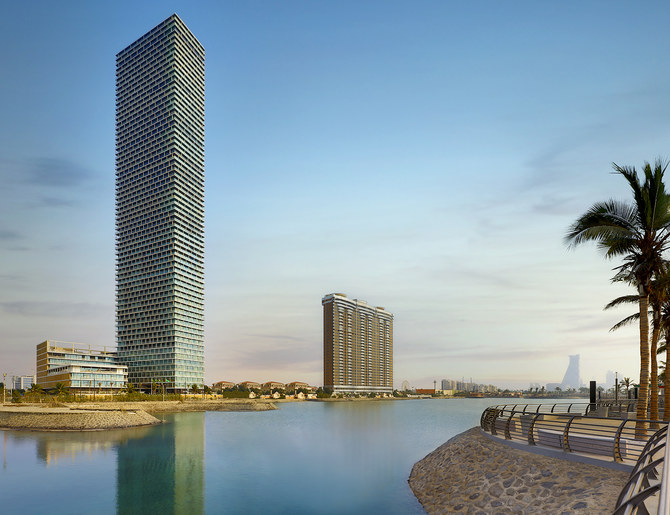
Luxury global hospitality brands open up on Saudi Red Sea coastline in flurry of announcements

Shangri-La Jeddah (Supplied)
Short Url
Updated 18 February 2022
Follow

Luxury global hospitality brands open up on Saudi Red Sea coastline in flurry of announcements

RIYADH: Three luxury hospitality brands have announced plans to open new hotels on the Red Sea Coastline in a boost for the Saudi tourism industry.
 
Business hotel Four Points by Sheraton and luxury brand Shangri-La will cut the ribbon on new locations in Jeddah this week, while Kempinski will open a five-star hotel on the coast of Al Muhar Island, part of the coastal city of Yanbu.
 
The three resorts offer direct access to the Red Sea waterfront. 
 
These ventures fall in line with Vision 2030, aiming at promoting tourism and hospitality on the Saudi Red Sea, which is known as one of the last untouched coastlines in the world. 
 
Harnessing the tourism industry is one way for the Kingdom to diversify its revenue base.  
 
Bernold Schroeder, CEO and chairman of Kempinski Group, said: “We are impressed with the Kingdom’s Vision 2030 and strategic planning, which aims to create a hub for international trade linking East and West. Expanding our portfolio in Saudi Arabia is a crucial and important step for Kempinski.”
 
The Red Sea project plans to attract 1 million tourists a year by 2030, and add $4 billion to the Kingdom’s gross domestic product per annum. It will also generate 35,000 jobs, under plans outlined in 2017
 
In an analysis published on Thursday, Karen Smith Diwan from the Arab Gulf States Institute in Washington said the project was part of Saudi Arabia’s “ambitious” economic diversification plans.

“If fully realized, this new tourism infrastructure will form an alternate economic platform that greatly expands Saudi Arabia’s traditional focus on religious tourism and has the potential to reshape the social and political contours of the long-predominant oil economy,” she wrote.


Saudi stock market opens its doors to foreign investors

Updated 06 January 2026
Follow

Saudi stock market opens its doors to foreign investors

RIYADH: Foreigners will be able to invest directly in Saudi Arabia’s stock market from Feb. 1, the Kingdom’s Capital Market Authority has announced.

The CMA’s board has approved a regulatory change which will mean the capital market, across all its segments, will be accessible to investors from around the world for direct participation.

According to a statement, the approved amendments aim to expand and diversify the base of those permitted to invest in the Main Market, thereby supporting investment inflows and enhancing market liquidity.

International investors' ownership in the capital market exceeded SR590 billion ($157.32 billion) by the end of the third quarter of 2025, while international investments in the main market reached approximately SR519 billion during the same period — an annual rise of 4 percent.

“The approved amendments eliminated the concept of the Qualified Foreign Investor in the Main Market, thereby allowing all categories of foreign investors to access the market without the need to meet qualification requirements,” said the CMA, adding: “It also eliminated the regulatory framework governing swap agreements, which were used as an option to enable non-resident foreign investors to obtain economic benefits only from listed securities, and the allowance of direct investment in shares listed on the Main Market.”

In July, the CMA approved measures to simplify the procedures for opening and operating investment accounts for certain categories of investors. These included natural foreign investors residing in one of the Gulf Cooperation Council countries, as well as those who had previously resided in the Kingdom or in any GCC country. 

This step represented an interim phase leading up to the decision announced today, with the aim of increasing confidence among participants in the Main Market and supporting the local economy.

Saudi Arabia, which ‌is more than halfway ‍through an economic plan ‍to reduce its dependence on oil, ‍has been trying to attract foreign investors, including by establishing exchange-traded funds with Asian partners in Japan and Hong Kong.