

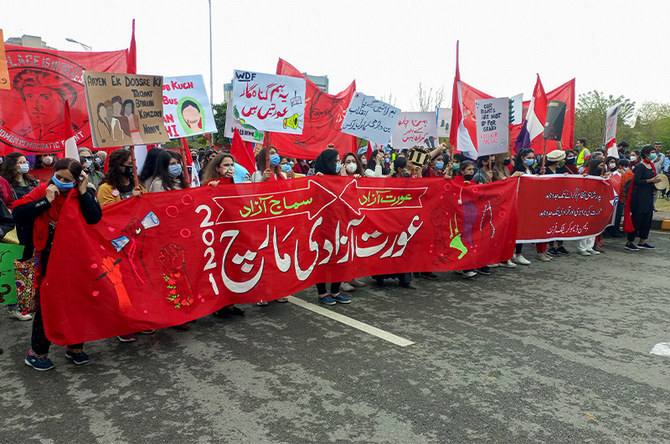

ISLAMABAD: Pakistan’s Religious Affairs Minister Noorul Haq Qadri on Friday denied he had called for a ban on Aurat March, the country’s largest women’s rights event, asking organizers to not make it ‘controversial.’
The countrywide event, known as Aurat March, using the Urdu word for women, has been attended by tens of thousands over the last three years to mark the International Women’s Day on March 8.
In the past, the march has been threatened by the Pakistani Taliban and there has been an uproar in conservative circles over slogans used at the past three events, including “My body, my choice”, “My body is not your battleground” and “Stop being menstrual phobic”.
While opponents say the event has an agenda to spread “vulgarity” and is anti-Islam, organizers say they try to highlight “real issues” faced by women such as violence and sexual exploitation, and have faced a backlash, including murder and rape threats.
On Thursday, a letter dated February 9 went viral on Twitter in which Qadri called on Prime Minister Imran Khan to declare March 8 ‘International Hijab Day’ in Pakistan, which was widely interpreted as a call to ban the event.
Qadri denied calling for a ban on the march, but maintained the occasion had previously been used to “ridicule religion and societal values.”
“Certain slogans of the march in the past few years created a very tense atmosphere within different segments of the society,” the minister told Arab News. “I have asked to stop and ban such practices that make this march controversial and create unnecessary tension in different segments, especially extremely religious and ultra-liberal classes, of the society.”
Instead of making women’s day contentious with “controversial slogans and posters,” Qadri said the day should be used to create awareness about “real” women’s problems.
“I would like the civil societies to highlight real women’s issues like their right in property, education, job opportunities, forced marriages, domestic violence and harassment at the workplace on this women’s day during their gatherings and marches,” the minister said.
He said the rights of women were equally protected in Islam and the constitution of Pakistan, and events like Aurat March should not be used to “spread obscenity and create a rift” in the society.
The minister said his letter to the prime minister was taken “out of context” and “misinterpreted.”
“I wrote this letter to Prime Minister Imran Khan on February 9 and as a religious affairs minister, advised him that Aurat March, on the occasion of International Women’s Day, should be made meaningful and conducted peacefully without instigating any controversy like the previous years,” the minister said.
Explaining his rationale for proposing International Hijab Day, Qadri said: “Muslim girls in India are being psychologically and physically tortured, stopped from going to educational institutions for wearing hijab, and in order to express solidarity with them, I proposed marking the International Women’s Day as Hijab Day.”
He said this day should be used to develop international pressure against those who were forcefully stopping Muslim women from wearing the head scarf in India.
In response to Qadri, Nighat Dad, a Pakistani rights activist associated with Aurat March, said the event was used by women to “talk about their rights and demands.”
“We are not stopping them from observing Hijab Day, they should proceed with it, but others should also have freedom to observe the day according to their choice,” Dad said. “Freedom of expression and assembly is our constitutional right and on the recommendation of the religious affairs minister, the prime minister cannot take this constitutional right away from us.”
“The slogans they [religious groups] object to also talk about the real issues faced by women. They talk about their personal space and demand that they have right on their own personal space and the slogan (Mera Jism Meri Marzi) covered all those crimes again women like honor killing, rape, sexual and workplace harassment, torture and murder,” Dad added.
“These are all against the integrity of the woman’s body so what’s wrong in this slogan?” the activist said. “This society is evolving and will not go on with the same politics of respectability for the next 100 years.”


