

‘Encouraged’ by Pakistan’s commitment to polio eradication, Bill Gates says after first ever visit

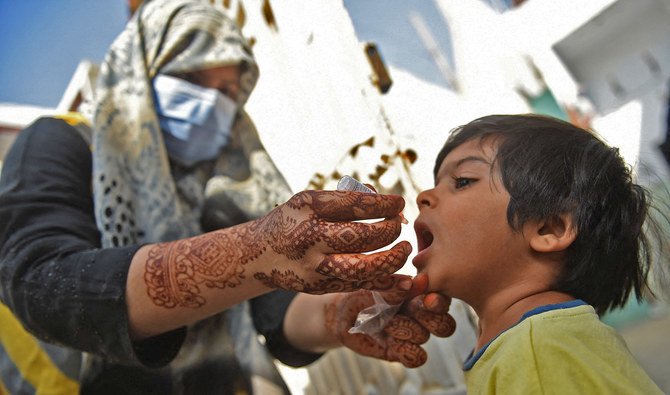
A health worker administers polio vaccine drops to a child during a polio vaccination campaign in Karachi, Pakistan, on December 13, 2021. (AFP/File)
Short Url
Updated 18 February 2022
Follow

‘Encouraged’ by Pakistan’s commitment to polio eradication, Bill Gates says after first ever visit

  • Says polio eradication could be possible in the coming years in Pakistan
  • Pakistan and Afghanistan only two countries globally where polio remains endemic

Islamabad: Microsoft Corp. co-founder turned philanthropist Bill Gates said on Friday after a visit to Pakistan that he was ‘encouraged’ by the country’s commitment to polio eradication
The Bill & Melinda Gates Foundation, of which Gates is co-chair, is part of the Global Polio Eradication Initiative (GPEI), a major project between governments and international organizations.
Pakistan, along with neighboring Afghanistan, is one of two countries in the world where polio continues to circulate. No children have been paralyzed by wild polio in Pakistan in more than a year, according to the Gates Foundation, but the virus was detected in December in sewerage samples in Khyber Pakhtunkhwa province.
Four wild polio cases were reported in Afghanistan in 2021 and one this year.
“I’m encouraged by the country’s commitment to eradication and am optimistic that if everyone remains vigilant, we can #endpolio,” Gates said on Twitter after departing from Islamabad.

Earlier in the day, after a meeting with Prime Minister Imran Khan, Gates told reporters polio eradication could be possible in the coming years in one of the last two countries of the world where the virus is endemic.
“We’re not done but we’re certainly in by far the best situation we’ve ever been in,” Gates said, adding that Pakistan and Afghanistan’s polio eradication efforts were interlinked.
There was a real possibility of eliminating polio in practice in the next few years, but the outcome was uncertain, particularly given the situation in Afghanistan where the Taliban took control in August, the philanthropist said.
“I think the steps taken in Pakistan during 2022 will probably set us up to finish polio eradication,” Gates said. “Afghanistan is a little bit of a question mark because that’s a more complex situation,” he said, adding that vaccination rates had gone up this year after dropping off since 2018, though they needed to be higher.


Pakistan finance chief calls for change to population-based revenue-sharing formula

Updated 14 February 2026
Follow

Pakistan finance chief calls for change to population-based revenue-sharing formula

  • Muhammad Aurangzeb criticizes current NFC formula, says it is holding back development
  • Minister says Pakistan to repay $1.3 billion debt in April as economic indicators improve

ISLAMABAD: Pakistan’s Finance Minister Muhammad Aurangzeb said on Saturday the country’s revenue-sharing formula between the federal and provincial governments “has to change,” arguing that allocating the bulk of funds on the basis of population was holding back long-term development.

The revenue-sharing is done under the National Finance Commission (NFC) Award that determines how federally collected taxes are divided between the center and the provinces. Under the current formula, much of the distribution weight is based on population, with smaller weightages assigned to factors such as poverty, revenue generation and inverse population density.

“Under the NFC award, 82 percent allocation is done on the basis of population,” Aurangzeb said while addressing the Federation of Pakistan Chambers of Commerce & Industry’s regional office in Lahore. “This has to change. This is one area which is going to hold us back from realizing the full potential of this country.”

Economists and policy analysts have long suggested broadening the NFC criteria to give greater weight to tax effort, human development indicators and environmental risk, though any change would require political consensus among provinces, making reform politically sensitive.

Aurangzeb also highlighted the economic achievements of the country in recent years, saying Pakistan’s import cover had improved from roughly two weeks just a few years ago to about 2.5 months currently, adding that the government had repaid a $500 million Eurobond last year.

“The next repayment is of $1.3 billion in April,” he continued, adding that “we will pay these obligations, which are the obligations of Pakistan, as we go forward.”

The minister also noted that unlike in 2022, when devastating floods forced Pakistan to seek international pledges at a Geneva conference, the government did not issue an international appeal during more recent flooding, arguing that fiscal buffers had strengthened.

“This time, the prime minister and the cabinet decided that we do not need to go for international appeal because we have the means,” he said.

He reiterated the government was pursuing export-led growth to avoid repeating past boom-and-bust cycles driven by import-led expansion that quickly depleted foreign exchange reserves and pushed Pakistan back into International Monetary Fund programs.