‘Encouraged’ by Pakistan’s commitment to polio eradication, Bill Gates says after first ever visit

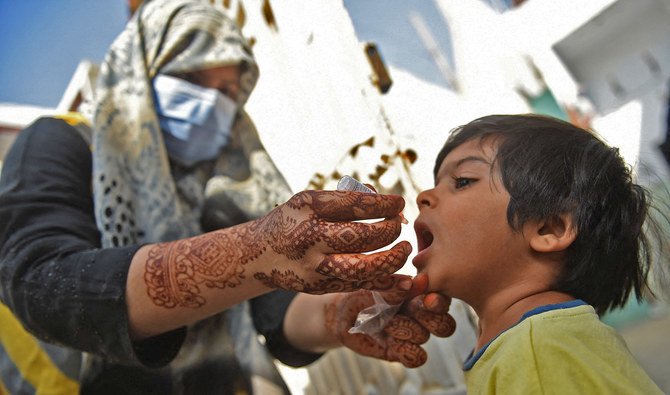
A health worker administers polio vaccine drops to a child during a polio vaccination campaign in Karachi, Pakistan, on December 13, 2021. (AFP/File)
Short Url
Updated 18 February 2022
Follow

‘Encouraged’ by Pakistan’s commitment to polio eradication, Bill Gates says after first ever visit

  • Says polio eradication could be possible in the coming years in Pakistan
  • Pakistan and Afghanistan only two countries globally where polio remains endemic

Islamabad: Microsoft Corp. co-founder turned philanthropist Bill Gates said on Friday after a visit to Pakistan that he was ‘encouraged’ by the country’s commitment to polio eradication
The Bill & Melinda Gates Foundation, of which Gates is co-chair, is part of the Global Polio Eradication Initiative (GPEI), a major project between governments and international organizations.
Pakistan, along with neighboring Afghanistan, is one of two countries in the world where polio continues to circulate. No children have been paralyzed by wild polio in Pakistan in more than a year, according to the Gates Foundation, but the virus was detected in December in sewerage samples in Khyber Pakhtunkhwa province.
Four wild polio cases were reported in Afghanistan in 2021 and one this year.
“I’m encouraged by the country’s commitment to eradication and am optimistic that if everyone remains vigilant, we can #endpolio,” Gates said on Twitter after departing from Islamabad.

Earlier in the day, after a meeting with Prime Minister Imran Khan, Gates told reporters polio eradication could be possible in the coming years in one of the last two countries of the world where the virus is endemic.
“We’re not done but we’re certainly in by far the best situation we’ve ever been in,” Gates said, adding that Pakistan and Afghanistan’s polio eradication efforts were interlinked.
There was a real possibility of eliminating polio in practice in the next few years, but the outcome was uncertain, particularly given the situation in Afghanistan where the Taliban took control in August, the philanthropist said.
“I think the steps taken in Pakistan during 2022 will probably set us up to finish polio eradication,” Gates said. “Afghanistan is a little bit of a question mark because that’s a more complex situation,” he said, adding that vaccination rates had gone up this year after dropping off since 2018, though they needed to be higher.


Pakistan to begin first phase of Hajj 2026 trainings from today

Updated 31 December 2025
Follow

Pakistan to begin first phase of Hajj 2026 trainings from today

  • Training programs to be held in phases across Pakistan till February, says religion ministry
  • Saudi Arabia allocated Pakistan a total quota of 179,210 pilgrims for Hajj 2026

ISLAMABAD: Pakistan’s religious affairs ministry has said that it will begin the first phase of mandatory Hajj 2026 training for pilgrims intending to perform the pilgrimage from today, Thursday.

The one-day Hajj training programs will be held in phases across the country at the tehsil level until February. The ministry directed intending pilgrims to bring their original identity cards and the computerized receipt of their Hajj application to attend the training sessions.

“Pilgrims should attend the one-day training program according to their scheduled date,” Pakistan’s Ministry of Religious Affairs (MoRA) said in a statement.

The ministry said training schedules are being shared through the government’s Pak Hajj 2026 mobile application as well as via SMS. It added that details of the schedule are also available on its website.

According to the ministry, training programs will be held in Abbottabad on Jan. 2; Ghotki, Thatta and Kotli on Jan. 3; and Tando Muhammad Khan and Khairpur on Jan. 4.

Hajj training sessions will be held in Rawalakot, Badin and Naushahro Feroze on Jan. 5, while pilgrims in Fateh Jang, Dadu and Tharparkar will receive the training on Jan. 6.

The ministry said training programs will be conducted in Umerkot and Larkana on Jan. 7, followed by sessions in Mirpurkhas, Shahdadkot and Mansehra on Jan. 8.

Pakistan’s religious affairs ministry has previously said these trainings will be conducted by experienced trainers and scholars using multimedia.

It said the training has been made mandatory to ensure that intending pilgrims are fully aware of Hajj rituals and administrative procedures.

Saudi Arabia has allocated Pakistan a quota of 179,210 pilgrims for Hajj 2026, of which around 118,000 seats have been reserved under the government scheme, while the remainder will be allocated to private tour operators.

Under Pakistan’s Hajj scheme, the estimated cost of the government package ranges from Rs1,150,000 to Rs1,250,000 ($4,049.93 to $4,236), subject to final agreements with service providers.