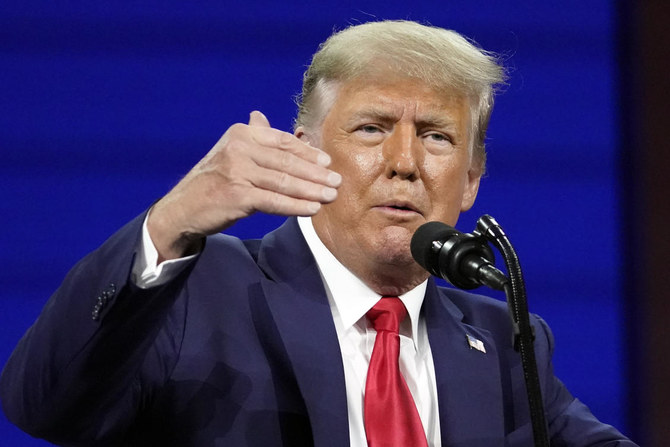
NEW YORK: Former President Donald Trump must answer questions under oath in New York state’s civil investigation into his business practices, a judge ruled Thursday.
Judge Arthur Engoron ordered Trump and his two eldest children, Ivanka and Donald Trump Jr., to comply with subpoenas issued in December by New York Attorney General Letitia James.
Trump and his two children must sit for a deposition within 21 days, Engoron said.
Engoron issued the ruling after a two-hour hearing with lawyers for the Trumps and James’ office.
“In the final analysis, a State Attorney General commences investigating a business entity, uncovers copious evidence of possible financial fraud, and wants to question, under oath, several of the entities’ principals, including its namesake. She has the clear right to do so.” Engoron wrote in his decision.
The ruling is almost certain to be appealed, but if upheld it could force the former president into a tough decision about whether to answer questions, or stay silent, citing his Fifth Amendment right against self incrimination.
Spokespeople for Trump did not immediately respond to a request for comment on the ruling.
James, a Democrat, said her investigation has uncovered evidence Trump’s company used “fraudulent or misleading” valuations of assets like golf courses and skyscrapers to get loans and tax benefits.
Trump’s lawyers told Engoron during the hearing that having him sit for a civil deposition now, while his company is also the subject of a parallel criminal investigation, is an improper attempt to get around a state law barring prosecutors from calling someone to testify before a criminal grand jury without giving them immunity.
“If she wants sworn testimony from my client, he’s entitled to immunity. He gets immunity for what he says, or he says nothing,” Trump’s criminal defense lawyer, Ronald Fischetti, said in the hearing, which was conducted by video conference.
If Trump were to testify in the civil probe, anything he says could be used against him in the criminal investigation being overseen by the Manhattan district attorney’s office.
Trump could invoke his Fifth Amendment right to remain silent in a deposition — something he’s criticized others for doing in the past. But Fischetti said if Trump did so, it could still hurt a potential criminal defense.
“If he goes in and follows my advice, which will be you cannot answer these questions without ... immunity because that’s what the law provides, and take the Fifth Amendment, that’ll be on every front page in the newspaper in the world. And how can I possibly pick a jury in that case?” Fischetti said.
A lawyer for the attorney general’s office, Kevin Wallace, told the judge that it wasn’t unusual to have civil and criminal investigations proceeding at the same time.
“Mr. Trump is a high profile individual, yes. That’s unique,” Wallace said. “It’s unique that so many people are paying attention to a rather dry hearing about subpoena enforcement. But the legal issues that we’re dealing with here are pretty standard.”
Another Trump son, Eric Trump, and the Trump Organization’s finance chief Allen Weisselberg, have previously sat for depositions in the civil investigation — and invoked their Fifth Amendment rights hundreds of times when they were questioned by investigators in 2020.
Another lawyer for Donald Trump, Alina Habba, accused James of trying to use the civil investigation to gather evidence for the criminal probe.
She said the civil investigation should be stayed until the criminal matter is over, claiming James’ office is putting the Trumps “in a position where they either disclose evidence in a civil investigation or they have to invoke the constitutional right not to testify, thereby triggering an adverse inference in the civil action.”
“How is that fair, your Honor? We have to stop one,” she said.
Alan Futerfas, a lawyer for Ivanka and Donald Trump Jr., both of whom have been executives in their family’s Trump Organization, said during the court hearing that so far he had no reason to believe either are targets of the district attorney’s criminal investigation.
In a statement Tuesday, Trump railed against what he called a “sham investigation of a great company that has done a spectacular job for New York and beyond” and a racially motivated “continuation of a Witch Hunt the likes of which has never been seen in this Country before.”
Habba argued at Thursday’s hearing that James’ investigation is “selective prosecution” and that the attorney general is “engaging in viewpoint discrimination” motivated by her political ambitions and disdain for the Republican former president, evinced by comments she made over the years about going after Trump.
“We have an extraordinary rare case where we can prove selective prosecution because she’s put her words out there so much and taken every opportunity to voice her vendetta against Donald Trump and his family to take him down,” Habba said.
Wallace noted the state attorney general’s office was investigating Trump-related matters as far back as 2013, including probes into his charitable foundation and a Trump University real estate training program that started long before James was elected.
In a court filing this week, James included a letter from Trump’s longtime accounting firm advising him to no longer rely on years of financial statements it prepared based on his company’s valuations, given the questions about their accuracy.
Last summer, spurred by evidence uncovered in James’ civil investigation, the Manhattan district attorney’s office charged Weisselberg and the Trump Organization with tax fraud, alleging he collected more than $1.7 million in off-the-books compensation. Weisselberg and the company have pleaded not guilty.
Engoron previously sided with James on other matters relating to the probe, including making Eric Trump testify after his lawyers abruptly canceled a scheduled deposition.

Trump must testify in New York investigation, judge rules
Short Url
https://arab.news/bwfcy
Trump must testify in New York investigation, judge rules
- Judge Arthur Engoron ordered Trump and his two eldest children, Ivanka and Donald Trump Jr., to comply with subpoenas issued in December
- Trump and his two children must sit for a deposition within 21 days
Human rights situation in Colombia is backsliding, UN warns as nation heads into elections
The annual report on Colombia’s human rights situation highlights a surge in attacks on rural communities by rebel groups and drug traffickers
Murders of human rights defenders increased by 9 percent last year
BOGOTA: Colombia is at risk of “reverting to the serious human rights situation” it faced before a peace deal with the nation’s largest rebel group improved security conditions, the United Nations warned Thursday, adding that an uptick of violence in rural areas could also “undermine” the nation’s upcoming elections.
The annual report on Colombia’s human rights situation highlights a surge in attacks on rural communities by rebel groups and drug traffickers as they fight over territory abandoned by the Revolutionary Armed Forces of Colombia following their 2016 peace deal with Colombia’s government.
According to the report, the number of people displaced by violence in Colombia increased by 85 percent in 2025 from the year before, with approximately 94,000 people forced to flee their homes.
Murders of human rights defenders increased by 9 percent last year alongside a 12 percent increase in the number of lockdowns imposed by armed groups on rural communities. During the lockdowns, villagers are banned from hunting or tending to their farms. Schools and businesses are also forced to shut down in small towns, disrupting the livelihoods of civilians.
“This report is an early warning,” said Scott Campbell, the Colombia representative for the United Nations High Commissioner for Human Rights. “There are a number of indicators that we are trying to draw attention to in order to prevent further degradation” of the human rights situation in Colombia.
While human rights violations in Colombia are not as numerous as they were at the height of the nation’s conflict with the FARC rebels — when an average of 300,000 people were displaced by violence each year — the report says that Colombia’s government has to take firmer actions to protect civilians from illegal groups.
One problem that persists is the forced recruitment of children by rebel groups that now use social media platforms to lure kids into their ranks.
Although the UN confirmed 150 cases of forced recruitment in 2025, the report notes this is likely an undercount, because many families are afraid to denounce these cases for fear of retaliation.
The administration of left-wing President Gustavo Petro, a former member of Colombia’s M-19 guerrilla group, has tried to reduce violence in Colombia by staging peace negotiations with the nation’s remaining rebel groups under a strategy known as “total peace.”
But often, the report notes, ceasefires between the Colombian government and rebel groups have failed to reduce attacks on civilians.
“We think it is very important that the government push for remedies to that,” Campbell said.
As Colombia prepares for upcoming elections, the report warns of a risky environment for political candidates. Last year alone, there were 18 murders of political leaders in Colombia and 126 attacks against them.
In June, conservative presidential hopeful Miguel Uribe was shot in the head during a rally in Bogota, marking the first attack against a Colombian presidential candidate in three decades. Uribe died from his injuries two months later.
“Violence and conflict, including the emergence of pre-electoral violence, have generated greater risks for the free and safe exercise of certain civil and political rights” the report said.
On March 8, Colombia will elect a new Senate and House of Representatives, with candidates competing to fill more than 300 congressional seats.
That will be followed up by a presidential election in May, in which at least half a dozen candidates are expected to run.
To improve the human rights situation in Colombia, the report said that the next administration must focus on the full implementation of the 2016 peace pact with FARC rebels.
While some parts of the deal have been implemented — including the FARC’s disarmament and the creation of a transitional justice system — others remain unfulfilled.
One of those is the creation of an agrarian jurisdiction to resolve conflicts over land. Schemes that could lure farmers away from growing coca, the base ingredient for cocaine, also require further implementation.
“It’s crucially important at this juncture ahead of elections to make sure that the current government and the future government take concrete actions to make sure that Colombia moves forward,” Campbell said.
He added that the 2016 peace deal provides a “road map” to a “Colombia of sustainable peace and respect for human rights.”
Murders of human rights defenders increased by 9 percent last year
BOGOTA: Colombia is at risk of “reverting to the serious human rights situation” it faced before a peace deal with the nation’s largest rebel group improved security conditions, the United Nations warned Thursday, adding that an uptick of violence in rural areas could also “undermine” the nation’s upcoming elections.
The annual report on Colombia’s human rights situation highlights a surge in attacks on rural communities by rebel groups and drug traffickers as they fight over territory abandoned by the Revolutionary Armed Forces of Colombia following their 2016 peace deal with Colombia’s government.
According to the report, the number of people displaced by violence in Colombia increased by 85 percent in 2025 from the year before, with approximately 94,000 people forced to flee their homes.
Murders of human rights defenders increased by 9 percent last year alongside a 12 percent increase in the number of lockdowns imposed by armed groups on rural communities. During the lockdowns, villagers are banned from hunting or tending to their farms. Schools and businesses are also forced to shut down in small towns, disrupting the livelihoods of civilians.
“This report is an early warning,” said Scott Campbell, the Colombia representative for the United Nations High Commissioner for Human Rights. “There are a number of indicators that we are trying to draw attention to in order to prevent further degradation” of the human rights situation in Colombia.
While human rights violations in Colombia are not as numerous as they were at the height of the nation’s conflict with the FARC rebels — when an average of 300,000 people were displaced by violence each year — the report says that Colombia’s government has to take firmer actions to protect civilians from illegal groups.
One problem that persists is the forced recruitment of children by rebel groups that now use social media platforms to lure kids into their ranks.
Although the UN confirmed 150 cases of forced recruitment in 2025, the report notes this is likely an undercount, because many families are afraid to denounce these cases for fear of retaliation.
The administration of left-wing President Gustavo Petro, a former member of Colombia’s M-19 guerrilla group, has tried to reduce violence in Colombia by staging peace negotiations with the nation’s remaining rebel groups under a strategy known as “total peace.”
But often, the report notes, ceasefires between the Colombian government and rebel groups have failed to reduce attacks on civilians.
“We think it is very important that the government push for remedies to that,” Campbell said.
As Colombia prepares for upcoming elections, the report warns of a risky environment for political candidates. Last year alone, there were 18 murders of political leaders in Colombia and 126 attacks against them.
In June, conservative presidential hopeful Miguel Uribe was shot in the head during a rally in Bogota, marking the first attack against a Colombian presidential candidate in three decades. Uribe died from his injuries two months later.
“Violence and conflict, including the emergence of pre-electoral violence, have generated greater risks for the free and safe exercise of certain civil and political rights” the report said.
On March 8, Colombia will elect a new Senate and House of Representatives, with candidates competing to fill more than 300 congressional seats.
That will be followed up by a presidential election in May, in which at least half a dozen candidates are expected to run.
To improve the human rights situation in Colombia, the report said that the next administration must focus on the full implementation of the 2016 peace pact with FARC rebels.
While some parts of the deal have been implemented — including the FARC’s disarmament and the creation of a transitional justice system — others remain unfulfilled.
One of those is the creation of an agrarian jurisdiction to resolve conflicts over land. Schemes that could lure farmers away from growing coca, the base ingredient for cocaine, also require further implementation.
“It’s crucially important at this juncture ahead of elections to make sure that the current government and the future government take concrete actions to make sure that Colombia moves forward,” Campbell said.
He added that the 2016 peace deal provides a “road map” to a “Colombia of sustainable peace and respect for human rights.”
© 2026 SAUDI RESEARCH & PUBLISHING COMPANY, All Rights Reserved And subject to Terms of Use Agreement.