

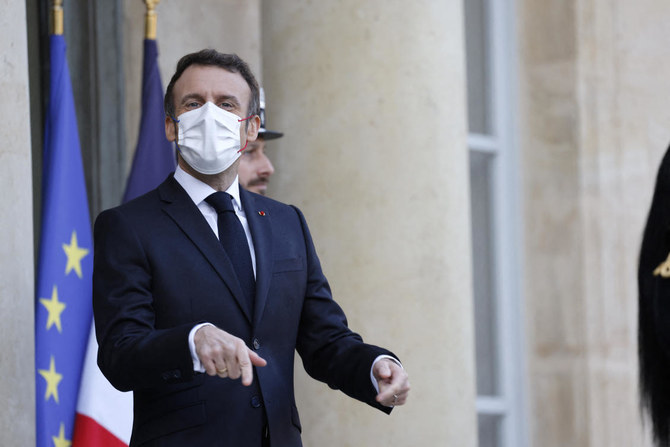

PARIS: France and its allies fighting militants in Mali said on Thursday they would begin their military withdrawal from the country, but French President Emmanuel Macron insisted the pullback did not constitute a failure of its nine-year mission.
Relations between Paris and Bamako have deteriorated since the ruling military junta went back on an agreement to organize an election in February and proposed holding power until 2025.
It has also deployed Russian private military contractors, which some European countries have said is incompatible with their mission.
Leaving Mali, the epicenter for years of the militant threat, has raised concerns of an emboldened insurgency across the Sahel region. But Macron said neighboring Niger had agreed to host European forces fighting extremists.
“The heart of this military operation will no longer be in Mali but in Niger,” Macron told a news conference in Paris.
On whether the French mission had failed he said: “I completely reject this term.”
Macron said the withdrawal from Mali would take four to six months, during which time there would be fewer operations against militants in the Sahel.
Successive coups in Mali, Chad and Burkina Faso — all ex-French colonies — have weakened France’s West African alliances, aided jihadists who control large swathes of territory and opened the door for Russia to fill the vacuum.
Diplomats warn that spiralling violence could give fresh impetus to migration from West Africa to Europe. It also threatens international mining operations and stability in strategic French partners such as Ivory Coast and Senegal.
NIGER TO FILL GAP
“Due to multiple obstructions by the Malian transitional authorities, Canada and the European States operating alongside Operation Barkhane and within the Task Force Takuba deem that the political, operational and legal conditions are no longer met to effectively continue their current military engagement in the fight against terrorism in Mali,” said a joint statement.
It was issued by countries operating with France’s Barkhane counter-terrorism force and the Takuba mission, which includes 14 European nations.
France has had troops in Mali since 2013, when it intervened to drive back militants advancing on the capital. The extremists have since regrouped and are waging an increasingly bloody insurgency across the region.
“At the request of their African partners, and based on discussions on future modalities of joint action, they agreed nonetheless to continue their joint action against terrorism in the Sahel region, including in Niger and in the Gulf of Guinea, and have begun political and military consultations with them with the aim to set out the terms for this shared action by June 2022,” the statement said.
A key question still to be answered will be the futures of the 14,000-strong UN peacekeeping mission (MINUSMA) and the European Union’s EUTM and EUCAP missions. Their fates are in doubt given French forces provide medical, aerial and emergency reinforcement support.
Ghana’s president Nana Akufo-Addo said it was important a UN peacekeeping force continue to operate in Mali.
Akufo-Addo was speaking in Paris after Macron announced the withdrawal of French forces and said more assistance would be provided to Gulf of Guinea countries that were being increasingly targeted by militants.


