

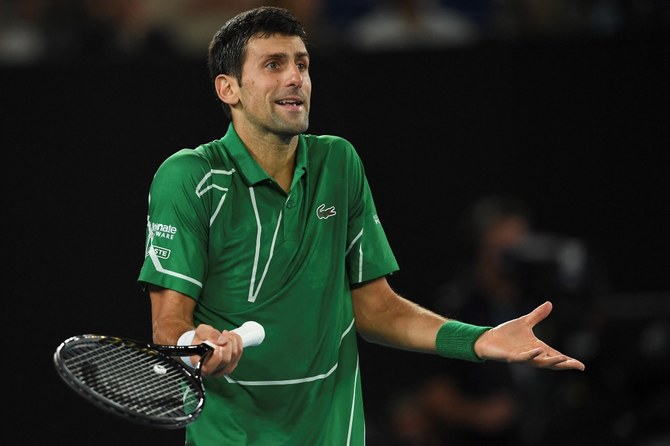
Lengthy Australian asylum detentions highlighted by Djokovic saga

Short Url
Updated 16 February 2022
Follow

Lengthy Australian asylum detentions highlighted by Djokovic saga

  • Human Rights Watch finds average detention rate of 689 days, believed to be the longest among Western nations
  • Report highlights example of Ahwazi Arab held in same building for 2 years with no release date

LONDON: Australia’s immigration detention policy has been slammed by Human Rights Watch, which has used the Novak Djokovic saga to point out that the country holds asylum seekers for an average of 689 days.

The expose comes one month after the Serbian tennis player was held in a detention hotel ahead of the Australian Open championships. 

He was detained for five days in a state-run facility in Melbourne after his visa to challenge for the Australian Open title was retracted because he had not been vaccinated against COVID-19. 

But unlike Djokovic’s brief stay, some detainees are kept in the facility for hundreds of days. 

One Iranian refugee, 24-year-old Mehdi Ali, said: “The residents of this building are desperately in need of freedom.”

Ali belongs to the persecuted Ahwazi Arab minority in Iran, and has been held in the same building for two years with no release date.

Arriving in Australia when he was 15, he has been held by immigration authorities for nine years. 

He said his experience in the hotel was a “real-life nightmare,” and several detainees had suicidal tendencies after years of being held. 

HRW found the average detention duration from a government report in September. It is believed to be the longest average detention rate for a Western nation. 

Australia has a mandatory detention system for those who arrive by boat, with 1,459 people currently detained in the system. There are no limits on how long a person can be held. 

HRW found records of 117 people who had been held for at least five years. Eight people had been kept in detention for over a decade. 

“These statistics shows how completely alone Australia is among like-minded countries, in terms of the indefinite detention of asylum seekers and refugees for years on end,” researcher Sophie McNeill told the BBC.

“Under international law, immigration detention should not be used as punishment, but rather should be an exceptional measure of last resort to carry out a legitimate aim.”

Australia’s rejection of people fleeing persecution violates the rules of the international refugee treaties that it has signed up to.


Rubio says technical talks with Denmark, Greenland officials over Arctic security have begun

Updated 29 January 2026
Follow

Rubio says technical talks with Denmark, Greenland officials over Arctic security have begun

  • US Secretary of State on Wednesday appeared eager to downplay Trump’s rift with Europe over Greenland

WASHINGTON: Technical talks between the US, Denmark and Greenland over hatching an Arctic security deal are now underway, Secretary of State Marco Rubio said on Wednesday.
The foreign ministers of Denmark and Greenland agreed to create a working group aimed at addressing differences with the US during a Washington meeting earlier this month with Vice President JD Vance and Rubio.
The group was created after President Donald Trump’s repeated calls for the US to take over Greenland, a Danish territory, in the name of countering threats from Russia and China — calls that Greenland, Denmark and European allies forcefully rejected.
“It begins today and it will be a regular process,” Rubio said of the working group, as he testified before the Senate Foreign Relations Committee. “We’re going to try to do it in a way that isn’t like a media circus every time these conversations happen, because we think that creates more flexibility on both sides to arrive at a positive outcome.”
The Danish Foreign Ministry said Wednesday’s talks focused on “how we can address US concerns about security in the Arctic while respecting the red lines of the Kingdom.” Red lines refers to the sovereignty of Greenland.
Trump’s renewed threats in recent weeks to annex Greenland, which is a semiautonomous territory of a NATO ally, has roiled US-European relations.
Trump this month announced he would slap new tariffs on Denmark and seven other European countries that opposed his takeover calls, only to abruptly drop his threats after a “framework” for a deal over access to the mineral-rich island was reached, with NATO Secretary-General Mark Rutte’s help. Few details of the agreement have emerged.
After stiff pushback from European allies to his Greenland rhetoric, Trump also announced at the World Economic Forum in Davos, Switzerland, last week that he would take off the table the possibility of using American military force to acquire Greenland.
The president backed off his tariff threats and softened his language after Wall Street suffered its biggest losses in months over concerns that Trump’s Greenland ambitions could spur a trade war and fundamentally rupture NATO, a 32-member transatlantic military alliance that’s been a linchpin of post-World War II security.
Rubio on Wednesday appeared eager to downplay Trump’s rift with Europe over Greenland.
“We’ve got a little bit of work to do, but I think we’re going to wind up in a good place, and I think you’ll hear the same from our colleagues in Europe very shortly,” Rubio said.
Rubio during Wednesday’s hearing also had a pointed exchange with Sen. Tim Kaine, D-Virginia, about Trump repeatedly referring to Greenland as Iceland while at Davos.
“Yeah, he meant to say Greenland, but I think we’re all familiar with presidents that have verbal stumbles,” Rubio said in responding to Kaine’s questions about Trump’s flub — taking a veiled dig at former President Joe Biden. “We’ve had presidents like that before. Some made a lot more than this one.”