LUCKNOW: A dispute over restrictions on the wearing of the hijab by female students in a southern Indian state has now reached India’s most populous state of Uttar Pradesh, with a group of youngsters asking a college to ban the head covering.
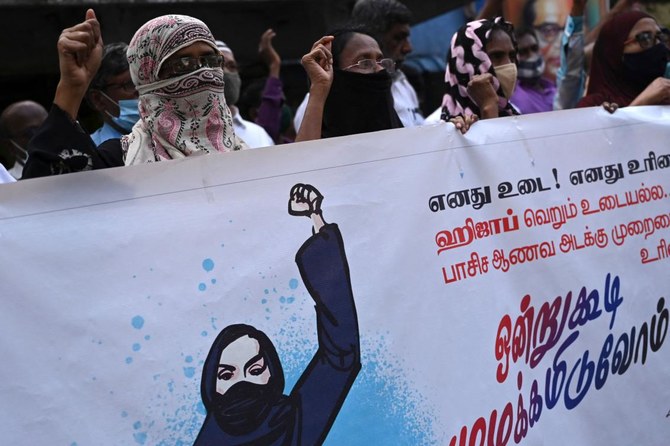
Authorities closed colleges in Karnataka in India’s south last week after a new uniform policy barred students from wearing headscarves in classrooms, leading to protests by Muslim students and counter protests by Hindu students.
Muslims have criticized the ban as another way of marginalizing a community that accounts for about 13 percent of Hindu-majority India’s 1.35 billion people.
In Uttar Pradesh, in the country’s north and bordering New Delhi, a group of more than two dozen young men reached the Dharma Samaj College in Aligarh district on Monday and handed a memorandum to its officials seeking a complete ban on the hijab within its compound.
They had saffron shawls around their necks — typically worn by Hindus — said the college’s chief proctor, Mukesh Bharadwaj, adding he did not recognize the people. Currently, religious garb is not allowed in classrooms, but can be worn elsewhere on campus.
“Two years ago the same issue was raised and it has been raised again. We do not allow any type of religious uniform and we have a civil code of uniform for everyone,” Bharadwaj told Reuters by phone on Tuesday.
“There is a changing room for girls and they can change their dress there before attending class,” he said. “We are investigating the matter.”
Uttar Pradesh, estimated to have as many people as Brazil, is ruled by a Hindu monk from Prime Minister Narendra Modi’s party and is in the midst of a multi-phase election that ends next month. Hindu-Muslim disputes are often used for political gains in the state.
The hijab issue has already reached court in Karnataka. Hearings will resume on Tuesday on whether the hijab should be allowed in class.

India’s hijab dispute reaches its most populous state
https://arab.news/bp3yz
India’s hijab dispute reaches its most populous state

- Authorities closed colleges in Karnataka last week after policy barred students from wearing hijabs in classrooms
- Muslims have criticized the ban as another way of marginalizing minority community
Britain needs ‘AI stress tests’ for financial services, lawmakers say
- Lawmakers urge AI-specific stress tests for financial firms
LONDON: Britain’s financial watchdogs are not doing enough to stop artificial intelligence from harming consumers or destabilising markets, a cross-party group of lawmakers said on Tuesday, urging regulators to move away from what it called a “wait and see” approach.
In a report on AI in financial services, the Treasury Committee said the Financial Conduct Authority and the Bank of England should start running AI-specific stress tests to help firms prepare for market shocks triggered by automated systems.
The committee also called on the FCA to publish detailed guidance by the end of 2026 on how consumer protection rules apply to AI, and on the extent to which senior managers should be expected to understand the systems they oversee.
“Based on the evidence I’ve seen, I do not feel confident that our financial system is prepared if there was a major AI-related incident and that is worrying,” committee chair Meg Hillier said in a statement.
TECHNOLOGY CARRIES ‘SIGNIFICANT RISKS’
A race among banks to adopt agentic AI, which unlike generative AI can make decisions and take autonomous action, runs new risks for retail customers, the FCA told Reuters late last year.
About three-quarters of UK financial firms now use AI. Companies are deploying the technology across core functions, from processing insurance claims to performing credit assessments.
While the report acknowledged the benefits of AI, it warned the technology also carried “significant risks” including opaque credit decisions, the potential exclusion of vulnerable consumers through algorithmic tailoring, fraud, and the spread of unregulated financial advice through AI chatbots.
Experts contributing to the report also highlighted threats to financial stability, pointing to the reliance on a small group of US tech giants for AI and cloud services. Some also noted that AI-driven trading systems may amplify herding behavior in markets, risking a financial crisis in a worst-case scenario.
An FCA spokesperson said the regulator welcomed the focus on AI and would review the report. The regulator has previously indicated it does not favor AI-specific rules due to the pace of technological change.
The BoE did not respond to a request for comment.
Hillier told Reuters that increasingly sophisticated forms of generative AI were influencing financial decisions. “If something has gone wrong in the system, that could have a very big impact on the consumer,” she said.
Separately, Britain’s finance ministry appointed Starling Bank CIO Harriet Rees and Lloyds Banking Group ‘s Rohit Dhawan as “AI Champions” to help steer AI adoption in financial services.


