

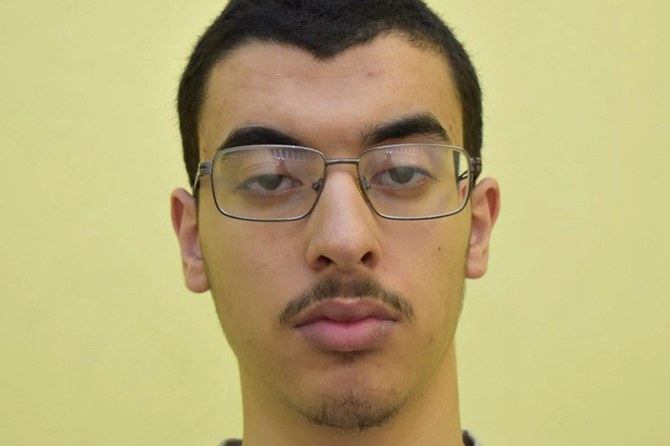
Police took no action over Manchester bomber’s texts to Daesh contact, inquiry hears

The messages, sent to another individual suspected of terrorism offenses, Abdalraouf Abdallah, were not traced to Abedi despite them containing two selfie images and his full name. (File/AFP)
Short Url
Updated 15 February 2022
Follow

Police took no action over Manchester bomber’s texts to Daesh contact, inquiry hears

  • Messages sent by Salman Abedi, identifying him visually and by name, discussed martyrdom
  • Texts sent 3 years before 2017 attack but only passed on to counterterrorism officers afterward

LONDON: An inquiry into the 2017 Manchester Arena bombing has heard that police viewed messages sent by the bomber, Salman Abedi, discussing martyrdom three years before the attack, but that no action was taken.

The messages, sent to another individual suspected of terrorism offenses, Abdalraouf Abdallah, were not traced to Abedi despite them containing two selfie images and his full name, and the phone used to send them being registered to him.

Abedi’s messages were viewed by police as part of Operation Oliban, a 2014 investigation into people suspected of traveling to the Middle East to join Daesh. 

Abdallah was arrested in Manchester as part of the operation, accused of being a key Daesh “facilitator” in the UK, and personal items including his phone were seized. 

Messages on the phone showed the pair discussing topics including martyrdom and what awaited them afterward.

They exchanged over 1,000 messages between Nov. 5 and Nov. 28, 2014, including one in which Abedi wrote: “Pray in supplication to Allah and ask him for martyrdom every day, on every kneeling I ask my Lord for martyrdom.”

The only time the question of Abedi’s identity was raised in relation to the messages was during Abdallah’s trial, by Prosecutor Max Hill QC, who is now England’s director of public prosecutions. 

It was not until after the bombing three years later that police working on Operation Oliban identified Abedi as having sent the messages to Abdallah, as having visited him while he was in prison, and that Abedi had been watched by MI5 just four months before the exchanges took place. The messages were then turned over to counterterrorism police.

At the inquiry, former Detective Inspector Frank Morris, the senior investigating officer for Operation Oliban, was asked if the correspondence between Abedi and Abdallah should have been handed over to specialist officers when first assessed. “At the time I didn’t think it should have been, but with hindsight, yes obviously,” he said.

Paul Greaney QC told the inquiry: “As far as that inquiry is concerned, (Operation Oliban) did not identify that the (phone) number related to Abedi. That was only discovered after the attack.”


Sri Lanka hospital releases 22 rescued Iranian sailors

Updated 08 March 2026
Follow

Sri Lanka hospital releases 22 rescued Iranian sailors

  • Sri Lankan authorities said the survivors from the Dena were being handled according to international humanitarian law

COLOMBO: Sri Lanka discharged from hospital 22 Iranian sailors who were plucked from life rafts after their warship was sunk by a US submarine, officials said Sunday.
The sailors were treated at Karapitiya Hospital in the southern port city of Galle since Wednesday after the IRIS Dena was torpedoed just outside Sri Lanka’s territorial waters.
“Another 10 are still undergoing treatment,” a medical officer at the hospital told AFP.
He said the bodies of 84 Iranians retrieved from the Indian Ocean were also at the hospital.
Those discharged from hospital overnight had been taken to a beach resort in the same district.
Sri Lankan authorities said the survivors from the Dena were being handled according to international humanitarian law, and the government had contacted the International Committee of the Red Cross for assistance.
The island is also providing safe haven for another 219 Iranian sailors from a second ship, the IRIS Bushehr, that was allowed to berth a day after the Dena was sunk.
Sailors from the Bushehr have been moved to a Sri Lanka Navy camp at Welisara, just north of the capital Colombo, and their ship taken over by Sri Lanka’s navy.
Sri Lanka announced it was taking the Bushehr to the north-eastern port of Trincomalee, but an engine failure and other technical and administrative issues had delayed the movement, a navy spokesman said.
Sri Lanka has denied claims that it was under pressure from Washington not to allow the Iranians to return home, and said Colombo will be guided solely by international law and its own domestic legislation.
A US State Department spokesperson said the disposition of the Bushehr crew and Iranian sailors rescued at sea was up to Sri Lanka.
“The United States, of course, respects and recognizes Sri Lanka’s sovereignty in the handling of this situation,” the spokesperson told AFP in Washington.
India, meanwhile, said Saturday that it had allowed a third Iranian warship, the IRIS Lavan, to dock in one of its ports on “humane” grounds after it too reported engine problems.
The three ships were part of a multi-national fleet review held by India before the war in the Middle East started last week.
“I think it was the humane thing to do, and I think we were guided by that principle,” Indian Foreign Minister Subrahmanyam Jaishankar said on Saturday.
The Lavan docked in the south-west Indian port of Kochi on Wednesday.
“A lot of the people on board were young cadets. They have disembarked and are in a nearby facility,” Jaishankar said.