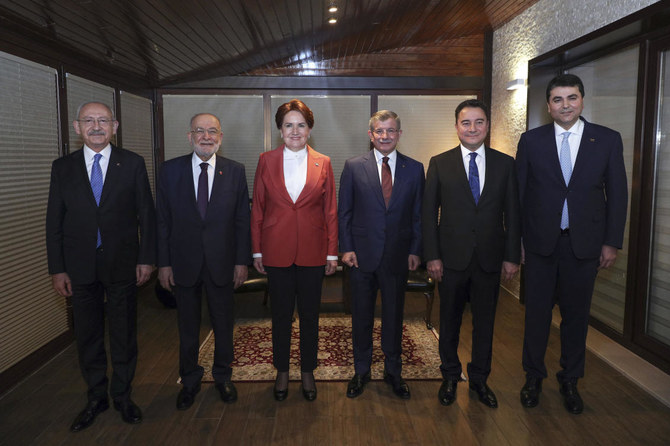
ISTANBUL: The leaders of six opposition parties in Turkey have met to strategize about the future of the country’s governing system — a move that aims to unseat the country’s longtime ruler.
In a statement following the dinner Saturday night, the party leaders said Turkey was experiencing “the deepest political and economic crisis” of its history and blamed it on the executive presidential system. They said their joint goal was to transform Turkey’s governance to a “strengthened parliamentary system.”
They did not mention President Recep Tayyip Erdogan by name, but their clear aim is to find a way to work together to unseat him.
After more than 11 years as Turkey’s prime minister, Erdogan was elected president in 2014. At the time, the position was primarily ceremonial. But in 2017, Turkish voters approved an executive presidential system, greatly expanding Erdogan’s powers at the expense of those of the prime minister and parliament. Erdogan was re-elected the following year. Critics call the system “one-man rule.”
The leaders at the dinner were Kemal Kilicdaroglu, the head of the main opposition Republican People’s Party; Meral Aksener from the nationalist Good Party; Temel Karamollaoglu from the conservative Felicity Party; Gultekin Uysal from the Democrat Party; Democracy and Progress Party’s Ali Babacan; and Future Party’s Ahmet Davutoglu. They had previously conducted bilateral meetings but Saturday’s meeting was their first all together. They are expected to release details of their agreement on Feb. 28.
Davutoglu and Babacan were co-founders of Erdogan’s ruling party and served in top positions but broke away to form their own parties in criticism of Erdogan’s policies.
The second-largest opposition party, the pro-Kurdish Peoples’ Democratic Party, was not at the meeting. The government has attacked that party and many of its members, including its former leaders, have been imprisoned over alleged links to outlawed Kurdish militants. Erdogan has also accused the Republican People’s Party of siding with “terrorists,” claims the party denies.
The next parliamentary and presidential elections in Turkey are scheduled for June 2023.


![]()

Turkish opposition leaders meet to counter Erdogan’s system
Short Url
https://arab.news/6svbs
Turkish opposition leaders meet to counter Erdogan’s system
- Turkish voters approved an executive presidential system, in 2017, which greatly expanded Erdogan’s powers at the expense of those of the prime minister and parliament
- Ahmet Davutoglu and Ali Babacan were co-founders of Erdogan’s ruling party and served in top positions but broke away to form their own parties in criticism of Erdogan’s policies


Latest updates


Recommended


© 2026 SAUDI RESEARCH & PUBLISHING COMPANY, All Rights Reserved And subject to Terms of Use Agreement.