

US editors call for the release of Indian journalist

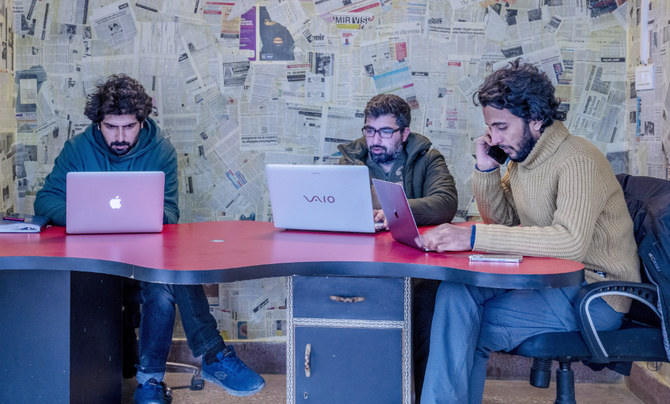
Fahad Shah, right, editor-in-chief of Kashmir Walla, works on his computer inside the newsroom at his office in Srinagar, Indian controlled Kashmir, Friday, Jan. 21, 2022. (AP)
Short Url
Updated 11 February 2022
Follow

US editors call for the release of Indian journalist

  • The two nuclear-armed neighbors have clashed over the territory, and more than 50,000 people died in a revolt that erupted in 1989, according to official figures

LONDON: Two editors of leading US foreign affairs magazines released a joint statement on Friday calling for the release of prominent Indian journalist Fahad Shah, who was arrested last week in Kashmir.

Shah, editor-in-chief of the local news portal Kashmir Walla, was arrested last Friday after being summoned for questioning in the southern district of Pulwama over coverage of a police raid in late January that left four people dead.

“Fahad Shah, an award-winning journalist and editor –and a contributor to our publications – was arrested in the Indian union territory of Jammu and Kashmir last Friday,” said the statement by Ravi Agrawal and Daniel Kurtz-Phelan, editors of Foreign Policy and Foreign Affairs, respectively. “A free press is essential to democracy; using law enforcement to silence journalists is a dangerous abuse of power.

“We urge the authorities in Kashmir to release Shah and to allow journalists in the territory to work freely without being subject to harassment.”

Police said in a statement last week that Shah was arrested for uploading “anti-national content” and had “criminal intention” to create fear among the public. Authorities also said the content amounted to “glorifying terrorist activities.”

Shah’s arrest comes a month after Sajad Gul, a Kashmir Walla contributor, was arrested over social media posts.

Kashmir is divided between India and Pakistan, with both countries claiming the territory in full. The two nuclear-armed neighbors have clashed over the territory, and more than 50,000 people died in a revolt that erupted in 1989, according to official figures. Human rights and separatists put the toll at double that figure.

The media has always been tightly controlled in Indian-administered Kashmir, but its predicament has worsened since 2019. In the past two years alone, journalists in the scenic Himalayan valley have been threatened by militants, blinded by pellet guns fired by security forces, and murdered by unknown assailants.


Study finds nearly half of UK news stories on Muslims show signs of bias

Updated 09 March 2026
Follow

Study finds nearly half of UK news stories on Muslims show signs of bias

  • Centre for Media Monitoring finds 20,000 out of 40,913 articles from 30 major news outlets contain bias and 70% link Muslims to negative behaviors or themes
  • Findings reveal ‘deeply concerning evidence of structural bias’ in portrayal of Muslims by UK press and point to ‘systemic problem’ within the media, says center’s director

LONDON: Nearly half of news articles published in the UK in 2025 that referenced Muslims or Islam contained some degree of bias, according to a report issued on Monday by the Centre for Media Monitoring. It also found that about 70 percent of stories linked Muslims to negative behaviors or themes.

The nonprofit organization, which tracks the ways in which Muslims and Islam are portrayed in the media, examined 40,913 articles from 30 major news outlets and found that about 20,000 showed some form of bias.

The study looked at “structural patterns” in coverage that “shape public narratives” about Muslims amid rising hostility toward the community.

“As the largest study of its kind ever conducted in the UK, this report presents deeply concerning evidence of structural bias in how Muslims are portrayed in the UK press,” said Rizwana Hamid, the director of the organization.

It found that 70 percent of the articles it reviewed highlighted negative aspects related to Muslims, though not all of the stories were biased in themselves. The wider patterns were also troubling: 44 percent of the coverage omitted key context, 17 percent relied on generalizations, and 13 percent included outright misrepresentation.

Taken together, the monitoring center said, the findings amounted to evidence of an “information integrity crisis” that distorts public understanding, and “a deeply concerning trend” in reporting on Muslims.

The research points to a “systemic problem within our media ecosystem,” Hamid said.

“When entire communities are repeatedly framed through lenses of suspicion or threat, it inevitably shapes public attitudes, political debate and the everyday lives of British Muslims,” she added.

News brands targeting right-wing audiences were more likely to produce biased coverage, the report found.

The Spectator magazine and GB News were identified as having the highest proportion of “very biased” articles, and as the “worst across all five bias categories”: negative framing, generalizations, misrepresentation, lack of context, and problematic headlines.

Other outlets highlighted for displaying high levels of biased content about Muslims included The Telegraph, The Jewish Chronicle, Daily Express, The Sun, Daily Mail and The Times.

In contrast, the BBC, other broadcasters and left-leaning outlets recorded the lowest rates of bias in the study.

The research comes as British Muslims report rising levels of discrimination. Official figures published in October revealed that religious hate crimes against Muslims rose by 19 percent in the year to March 2025 compared with the previous 12 months.