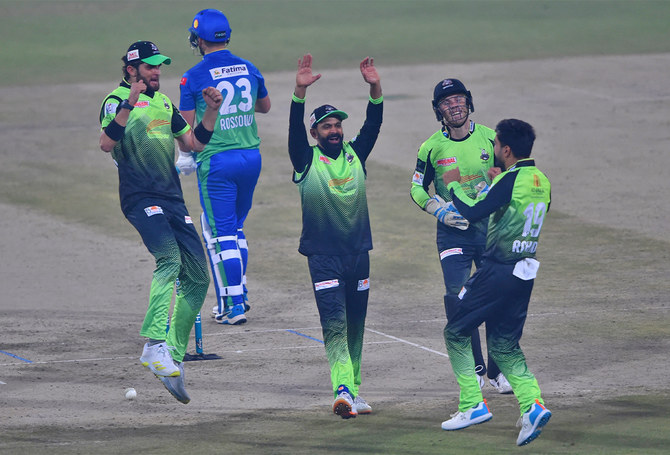
ISLAMABAD: In a major upset in the Pakistan Super League (PSL) tournament, Lahore Qalandars secured a convincing victory over defending champions Multan Sultans by 52 runs on Friday.
Confident and undefeated in their previous matches, Multan won the toss and decided to field in the second PSL7 clash in Lahore.
Qalandars lost an early wicket of Abdullah Shafique in the first over, but Fakhar Zaman (60) and Kamran Ghulam (42) stabilized their innings until the second wicket was lost on 91 in the 11th over.
After Ghulam was caught by Shahnawaz Dahani on Abbas Afridi’s delivery, Zaman could not stay on the crease for long and was sent back by Imran Tahir when Qalandars were on 118.
Mohammad Hafeez (43) and Phil Salt (26) accelerated the pace of the match, making it possible for their team to score 182 at the loss of 4 wickets at the end of the first 20 overs.
Multan could not face Lahore’s bowling attack and consistently lost wickets until all their batters were gone for 130 runs.
The PSL table-toppers were outclassed by Lahore Qalandars in every department.
As Sultans tasted their first defeat in the tournament, Fakhar Zaman was declared player of the match for his impressive performance with the bat (60 off 37 balls).
The next PSL match in Lahore will be played between Islamabad United and Quetta Gladiators on Saturday.


Lahore Qalandars outclass table-toppers Multan Sultans in another thrilling PSL match
https://arab.news/5ass4
Lahore Qalandars outclass table-toppers Multan Sultans in another thrilling PSL match

- Confident and undefeated in their previous matches, Multan won the toss and decided to field in the second PSL7 clash in Lahore
- Qalandars set a target of 183 before defeating mighty Multan by 52 runs

Pakistan PM briefs parliamentary leaders on Middle East tensions, Afghanistan fighting
- Leaders of major parties attend meeting on regional security and Pakistan’s military campaign
- Government is expected to update lawmakers on diplomatic efforts amid Gulf conflict escalation
ISLAMABAD: Prime Minister Shehbaz Sharif on Wednesday started briefing leaders of parliamentary parties on rising regional tensions, including fighting along the Pakistan-Afghanistan border and the escalating war in the Middle East, according to a statement by his office.
The meeting comes as Pakistan has intensified military operations against the Afghan Taliban and militant groups targeting its civilians and security forces along its western frontier while the wider region faces growing instability after recent US-Israeli strikes on Iran and subsequent attacks across the Gulf.
Sharif decided to convene the session to update political leaders on the security situation and Pakistan’s diplomatic outreach as tensions spread across the region.
“The prime minister will take parliamentary leaders into confidence regarding the Pakistan-Afghanistan situation and the recent tensions in the region, particularly in the Middle East and the Gulf,” Sharif’s office said in a statement.
“The meeting will also highlight Pakistan’s diplomatic efforts during the recent escalation,” it added.
Representatives of major political parties, including the ruling Pakistan Muslim League-Nawaz, Pakistan Peoples Party, Jamiat Ulema-e-Islam, Muttahida Qaumi Movement and other parliamentary groups are attending the meeting.
Pakistan has accused Afghanistan’s Taliban authorities of allowing militant groups such as the Tehreek-e-Taliban Pakistan (TTP) to operate from Afghan territory, allegations Kabul denies. Islamabad says it has targeted militant hideouts across the border after repeatedly raising the issue with Afghan officials.
The briefing also comes as the government closely monitors developments in the Middle East, where regional tensions have heightened concerns about energy supplies and broader security implications for the country.