

Government says it created 'sustainable ecosystem' for construction of low-cost housing units

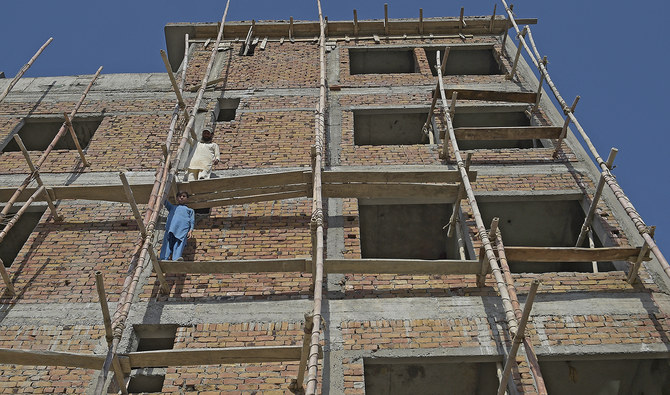
Laborers work on an under construction house on the outskirts of Islamabad, Pakistan, on June 14, 2020. (AFP/File)
Short Url
Updated 10 February 2022
Follow

Government says it created 'sustainable ecosystem' for construction of low-cost housing units

  • PM Khan tells National Coordination Committee the government's house building scheme will help create 1.2 million jobs
  • The prime minister says over 70,000 housing projects worth Rs1.4 trillion had been approved in Pakistan

ISLAMABAD: The Pakistan government has managed to create a "sustainable ecosystem" for the construction of low-cost housing units in the country, said a statement released by Prime Minister's Office on Thursday after a meeting of the National Coordination Committee on Housing, Construction and Development in Islamabad.

The meeting was chaired by Prime Minister Imran Khan who launched his administration's flagship Naya Pakistan Housing Program in April 2019 to provide shelter to financially vulnerable families.

Khan said over 70,000 housing projects worth Rs1.4 trillion had been approved in Pakistan, adding it would have an impact of Rs7.3 trillion on the construction industry and help create 1.2 million jobs.

"The meeting was briefed that for the very first time in the history of Pakistan a sustainable ecosystem for low-cost housing has been developed and implemented which has enabled the sector to achieve exponential growth," said the official statement. "The foreclosure law has been implemented in letter and spirit and long-term loans (of up to 20 years) with subsidized markup (as low as only 2 percent) are being given."

The statement added the meeting was also briefed about the transparent and automated system to receive and process applications which had resulted in targeting the needful lower- and middle-income classes.

"The Pakistan Tehreek-e-Insaf government has achieved huge milestones regarding the provision of low-cost housing to lower and middle-income classes," the prime minister told the participants of meeting. "Our government's biggest challenge was to change the elitist mindset of financial institutions and ensure facilitation of common people in getting loans."

He informed that applications worth Rs7 billion were received every week out of which Rs4 billion were approved and Rs2 billion disbursed, adding that it reflected that the system was working efficiently.

The statement maintained a total of 161,924 low-cost housing units had been approved, out of which 45,191 units were under construction and 20,898 units had been completed.

It said these numbers were significant since the construction sector "was in shambles" before the introduction of government subsidies, foreclosure law and low-cost housing scheme.

The prime minister also directed to complete the projects within their stipulated timeframes and emphasized to further improve the process of low-cost housing unit construction.


Pakistan reports current account surplus in Jan. owing to improved trade, remittances

Updated 17 February 2026
Follow

Pakistan reports current account surplus in Jan. owing to improved trade, remittances

  • Pakistan’s exports crossed the $3 billion mark in Jan. as the country received $3.5 billion in remittances
  • Last month, IMF urged Pakistan to accelerate pace of structural reforms to strengthen economic growth

ISLAMABAD: Pakistan recorded a current account surplus of more than $120 million in January, the country’s finance adviser said on Tuesday, attributing it to improved trade balance and remittance inflows.

Pakistan’s exports rebounded in January 2026 after five months of weak performance, rising 3.73 percent year on year and surging 34.96 percent month on month, according to data released by the country’s statistics bureau.

Exports crossed the $3 billion mark for the first time in January to reach $3.061 billion, compared to $2.27 billion in Dec. 2025. The country received $3.5 billion in foreign remittances in Jan. 2026.

Khurram Schehzad, an adviser to the finance minister, said Pakistan reported a current account surplus of $121 million in Jan., compared to a current account deficit of $393 million in the same month last year.

“Improved trade balance in January 2026, strong remittance inflows, and sustained momentum in services exports (IT/Tech) continue to reinforce the country’s external account position,” he said on X.

Pakistan has undergone a difficult period of stabilization, marked by inflation, currency depreciation and financing gaps, and international rating agencies have acknowledged improvements after Islamabad began implementing reforms such as privatizing loss-making, state-owned enterprises (SOEs) and ending subsidies as part of a $7 billion International Monetary Fund (IMF) loan program.

Late last month, the IMF urged Pakistan to accelerate the pace of these structural reforms to strengthen economic growth.

Responding to questions from Arab News at a virtual media roundtable on emerging markets’ resilience, IMF’s director of the Middle East and Central Asia Jihad Azour said Islamabad’s implementation of the IMF requirements had been “strong” despite devastating floods that killed more than 1,000 people and devastated farmland, forcing the government to revise its 4.2 percent growth target to 3.9 percent.

“What is important going forward in order to strengthen growth and to maintain the level of macroeconomic stability is to accelerate the structural reforms,” he said at the meeting.

Azour underlined Pakistan’s plans to privatize some of the SOEs and improve financial management of important public entities, particularly power companies, as an important way for the country to boost its capacity to cater to the economy for additional exports.

“This comes in addition to the effort that the authorities have made in order to reform their tariffs, which will allow the private sector of Pakistan to become more competitive,” the IMF official said.