

Government says it created 'sustainable ecosystem' for construction of low-cost housing units

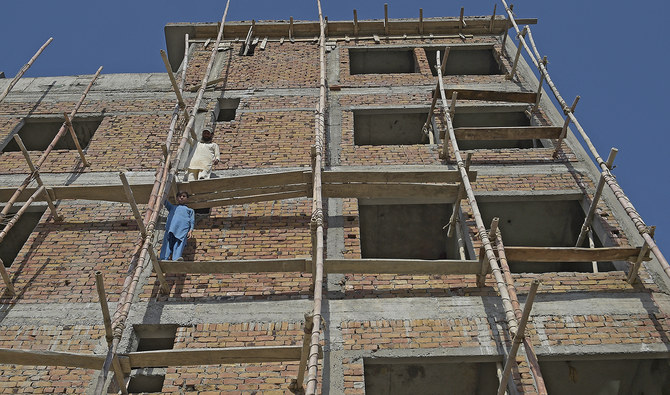
Laborers work on an under construction house on the outskirts of Islamabad, Pakistan, on June 14, 2020. (AFP/File)
Short Url
Updated 10 February 2022
Follow

Government says it created 'sustainable ecosystem' for construction of low-cost housing units

  • PM Khan tells National Coordination Committee the government's house building scheme will help create 1.2 million jobs
  • The prime minister says over 70,000 housing projects worth Rs1.4 trillion had been approved in Pakistan

ISLAMABAD: The Pakistan government has managed to create a "sustainable ecosystem" for the construction of low-cost housing units in the country, said a statement released by Prime Minister's Office on Thursday after a meeting of the National Coordination Committee on Housing, Construction and Development in Islamabad.

The meeting was chaired by Prime Minister Imran Khan who launched his administration's flagship Naya Pakistan Housing Program in April 2019 to provide shelter to financially vulnerable families.

Khan said over 70,000 housing projects worth Rs1.4 trillion had been approved in Pakistan, adding it would have an impact of Rs7.3 trillion on the construction industry and help create 1.2 million jobs.

"The meeting was briefed that for the very first time in the history of Pakistan a sustainable ecosystem for low-cost housing has been developed and implemented which has enabled the sector to achieve exponential growth," said the official statement. "The foreclosure law has been implemented in letter and spirit and long-term loans (of up to 20 years) with subsidized markup (as low as only 2 percent) are being given."

The statement added the meeting was also briefed about the transparent and automated system to receive and process applications which had resulted in targeting the needful lower- and middle-income classes.

"The Pakistan Tehreek-e-Insaf government has achieved huge milestones regarding the provision of low-cost housing to lower and middle-income classes," the prime minister told the participants of meeting. "Our government's biggest challenge was to change the elitist mindset of financial institutions and ensure facilitation of common people in getting loans."

He informed that applications worth Rs7 billion were received every week out of which Rs4 billion were approved and Rs2 billion disbursed, adding that it reflected that the system was working efficiently.

The statement maintained a total of 161,924 low-cost housing units had been approved, out of which 45,191 units were under construction and 20,898 units had been completed.

It said these numbers were significant since the construction sector "was in shambles" before the introduction of government subsidies, foreclosure law and low-cost housing scheme.

The prime minister also directed to complete the projects within their stipulated timeframes and emphasized to further improve the process of low-cost housing unit construction.


Pakistan urges concessional finance for developing nations to boost clean energy security

Updated 11 January 2026
Follow

Pakistan urges concessional finance for developing nations to boost clean energy security

  • Pakistan has emerged as one of world’s fastest growing solar markets, with 12GWs of off-grid and 6GWs of net-metered capacity in 2025
  • PM’s aide says Islamabad remains committed to Paris Agreement, looks for continued support in building a resilient and low-carbon future

ISLAMABAD: Pakistan has urged international partners to scale up concessional financing for developing countries, the country’s Press Information Department (PID) said on Sunday, citing an aide to Prime Minister Shehbaz Sharif.

The call was made by Sharif’s coordinator on climate change, Romina Khurshid Alam, while delivering Pakistan’s national statement at the 16th International Renewable Energy Agency (IRENA) Assembly in Abu Dhabi.

Pakistan has emerged as one of the world’s fastest growing solar markets, with 12 gigawatts (GWs) of off-grid and over 6GWs of net-metered solar capacity by the end of 2025. Last fiscal year, renewables accounted for a historic 53 percent of total electricity generation, according to Alam.

The prime minister’s aide stressed that affordable funding for developing nations is critical to accelerating their transition to clean energy and strengthening energy security amid rising climate and economic challenges.

“Alam reaffirmed Pakistan’s target of achieving 60 percent renewables in the power mix by 2030,” the PID said in a statement.

“In her call to action, she urged IRENA and Member States to increase concessional finance for developing nations, treat technologies such as energy storage and green hydrogen as global public goods, and strengthen regional cooperation for shared energy security.”

IRENA is a global intergovernmental agency for energy transformation that serves as the principal platform for international cooperation, supports countries in their energy transition, and provides state of the art data and analyzes on technology, innovation, policy, finance and investment. Its membership comprises 170 countries and the European Union (EU).

The 16th session of the IRENA Assembly is taking place on Jan. 10-12 in Abu Dhabi and focuses on the theme of “Powering Humanity: Renewable Energy for Shared Prosperity.” The session has gathered global leaders and energy decision-makers to discuss strategies and underline necessary actions for the acceleration of renewable energy across countries, regions, and the world, driving economic inclusion, equity, and human well-being.

Alam shared that Pakistan is taking action against energy poverty through initiatives like the Punjab Solar Panel Scheme 2026, which provides free or subsidized systems to low-income households.

She highlighted how distributed solar kits have restored power and livelihoods in flood-affected communities and offer a replicable model for climate-resilient recovery.

“Pakistan remains fully committed to the Paris Agreement and looks to IRENA for continued technical and financial support in building a resilient, inclusive, and low-carbon future,” Alam said.

Adopted in 2015 to combat climate change, the Paris Agreement binds nations to hold “the increase in the global average temperature to well below 2°C above pre-industrial levels” and pursue efforts “to limit the temperature increase to 1.5°C above pre-industrial levels.”