SpaceX satellites falling out of orbit after solar storm

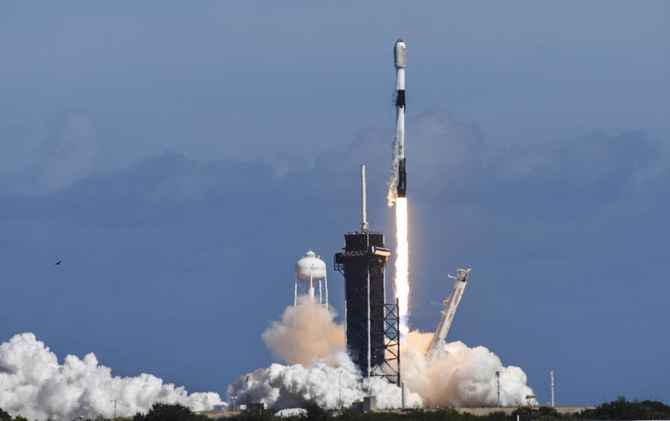
SpaceX still has close to 2,000 Starlink satellites orbiting Earth and providing internet service to remote corners of the world. They circle the globe more than 340 miles up (550 kilometers). (File/AP)
Short Url
Updated 10 February 2022
Follow

SpaceX satellites falling out of orbit after solar storm

  • SpaceX still has close to 2,000 Starlink satellites orbiting Earth and providing Internet service to remote corners of the world

CAPE CANAVERAL: SpaceX’s newest fleet of satellites is tumbling out of orbit after being struck by a solar storm.
Up to 40 of the 49 small satellites launched last week have either reentered the atmosphere and burned up, or are on the verge of doing so, the company said in an online update Tuesday night.
SpaceX said a geomagnetic storm last Friday made the atmosphere denser, which increased the drag on the Starlink satellites, effectively dooming them.
Ground controllers tried to save the compact, flat-panel satellites by putting them into a type of hibernation and flying them in a way to minimize drag. But the atmospheric pull was too great, and the satellites failed to awaken and climb to a higher, more stable orbit, according to the company.
SpaceX still has close to 2,000 Starlink satellites orbiting Earth and providing Internet service to remote corners of the world. They circle the globe more than 340 miles up (550 kilometers).
The satellites hit by the solar storm were in a temporary position. SpaceX deliberately launches them into this unusually low orbit so that any duds can quickly reenter the atmosphere and pose no threat to other spacecraft.
There is no danger from these newly falling satellites, either in orbit or on the ground, according to the company.
Each satellite weighs less than 575 pounds (260 kilograms).
SpaceX described the lost satellites as a “unique situation.” Such geomagnetic storms are caused by intense solar activity like flares, which can send streams of plasma from the sun’s corona hurtling out into space and toward Earth.
Since launching the first Starlink satellites in 2019, Elon Musk envisions a constellation of thousands more satellites to increase Internet service. SpaceX is trying to help restore Internet service to Tonga through this network following the devastating volcanic eruption and tsunami.
London-based OneWeb has its own Internet satellites up there. And Amazon plans to start launching its satellites later this year.
Astronomers are distressed that these mega constellations will ruin nighttime observations from Earth. The International Astronomical Union is forming a new center for the protection of dark skies.


Bondi Beach shooting suspect conducted firearms training with his father, Australian police say

Updated 11 sec ago
Follow

Bondi Beach shooting suspect conducted firearms training with his father, Australian police say

MELBOURNE, Australia: A man accused of killing 15 people at Sydney’s Bondi Beach conducted firearms training in an area of New South Wales state outside of Sydney with his father, according to Australian police documents released on Monday.
The documents, made public following Naveed Akram’s video court appearance from a Sydney hospital where he has been treated for an abdominal injury, said the two men recorded footage justifying the meticulously planned attack.
Officers wounded Akram at the scene of the Dec. 14 shooting and killed his father, 50-year-old Sajid Akram.
The state government confirmed Naveed Akram was transferred Monday from a hospital to a prison. Authorities identified neither facility.
The 24-year-old and his father began their attack by throwing four improvised explosive devices toward a crowd celebrating an annual Jewish event at Bondi Beach, but the devices failed to explode, the documents said.
Police described the devices as three aluminum pipe bombs and a tennis ball bomb containing an explosive, gunpowder and steel ball bearings. None detonated, but police described them as “viable” IEDs.
The pair had rented a room in the Sydney suburb of Campsie for three weeks before they left at 2:16 a.m. on the day of the attack. CCTV recorded them carrying what police allege were two shotguns, a rifle, five IEDs and two homemade Daesh group flags wrapped in blankets.
Police also released images of the gunmen shooting from a footbridge, providing them with an elevated vantage point and the protection of waist-high concrete walls.
The largest IED was found after the gunbattle near the footbridge in the trunk of the son’s car, which had been left draped with the flags.
Authorities have charged Akram with 59 offenses, including 15 counts of murder, 40 counts of causing harm with intent to murder in relation to the wounded survivors and one count of committing a terrorist act.
The antisemitic attack at the start of the eight-day Hanukkah celebration was Australia’s worst mass shooting since a lone gunman killed 35 people in Tasmania state in 1996.
The New South Wales government introduced draft laws to Parliament on Monday that Premier Chris Minns said would become the toughest in Australia.
The new restrictions would include making Australian citizenship a condition of qualifying for a firearms license. That would have excluded Sajid Akram, who was an Indian citizen with a permanent resident visa.
Sajid Akram also legally owned six rifles and shotguns. A new legal limit for recreational shooters would be a maximum of four guns.
Police said a video found on Naveed Akram’s phone shows him with his father expressing “their political and religious views and appear to summarise their justification for the Bondi terrorist attack.”
The men are seen in the video “condemning the acts of Zionists” while they also “adhere to a religiously motivated ideology linked to Islamic State,” police said, using another term for the Daesh Group.
Video shot in October shows them “firing shotguns and moving in a tactical manner” on grassland surrounded by trees, police said.
“There is evidence that the Accused and his father meticulously planned this terrorist attack for many months,” police allege.
An impromptu memorial that grew near the Bondi Pavilion after the massacre, as thousands of mourners brought flowers and heartfelt cards, was removed Monday as the beachfront returned to more normal activity. The Sydney Jewish Museum will preserve part of the memorial.
Victims’ funerals continued Monday with French national Dan Elkayam’s service held in the nearby suburb of Woollahra, at the heart of Sydney’s Jewish life. The 27-year-old moved from Paris to Sydney a year ago.
The health department said 12 people wounded in the attack remained in hospitals on Monday.