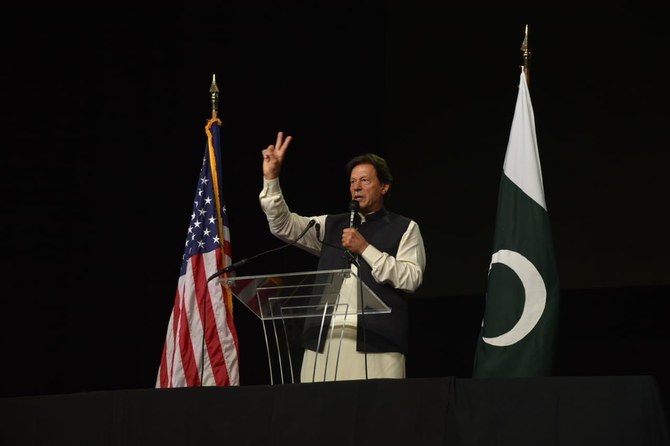

ISLAMABAD: Prime minister Imran Khan has said the United States had not been an “all weather friend” to Pakistan the way China had been, saying the US had “abandoned” Islamabad when the South Asian nation was of "no use" to the Western superpower.
Despite being allies in the war on terror, Pakistan and the US have had a complicated relationship, bound for decades by Washington’s dependence on Islamabad to supply its troops in Afghanistan but plagued by accusations that Pakistan was playing a “double game.” Pakistan denies this.
Last year, US Secretary of State Antony Blinken said Washington would be reevaluating its relationship with Pakistan to formulate what role it would want Islamabad to play in the future of Afghanistan after it was retaken by the Taliban last August. He said Pakistani had a “multiplicity of interests some that are in conflict with ours.”
On the other hand, China and Pakistan consider each other “all-weather friends” and have close diplomatic, economic and security ties. China has also pledged an estimated $60 billion for infrastructure and energy projects in Pakistan under the China-Pakistan Economic Corridor.
“United States has also been a good friend to Pakistan but it hasn’t been a sort of, like with China, an all-weather friend,” Khan said in an interview with Dr. Eric Li, the director of the advisory committee of the China Institute of Fudan University. “There have been times where the US has been very friendly but then when you know, they think Pakistan is not of use to them, then we get abandoned, and then they again sort of become friendly."
The PM also warned against a “cold war” between China and the US.
The United States and China, the world’s top two economies, are at loggerheads over a wide range of issues from Beijing’s handling of the coronavirus to its imposition of a new security law in Hong Kong and ambitions in the South China Sea.
A US call for the Quad nations of the United States, Japan, India and Australia to form a united front against China’s growing influence is a sensitive subject for its regional allies, which are reliant on China for trade.
“If it [US-China rivalry] goes into a Cold War type of situation, like we witnessed after the second world war … I think the world does not want a second Cold War,” the Pakistani PM said, referring to a period of geopolitical tension between the US and then Soviet Union and their respective allies.
Speaking about relations with neighboring India, with whom Pakistan has been engaged in an over seven-decades long dispute over the Himalayan territory of Kashmir, Khan said Pakistan’s only “issue” with India was the disputed region where Muslims were being denied their right to self determination.
“When my government came into power [in 2018], my first priority was to normalize relations with India,” the PM said. “And we have only one issue with India and that is Kashmir, where India is denying the people of Kashmir the right of self-determination which was guaranteed by the UNSC resolutions,” he added, referring to the Security Council which has adopted several resolutions on the dispute, including one that says a plebiscite should be held to determine the region's future.