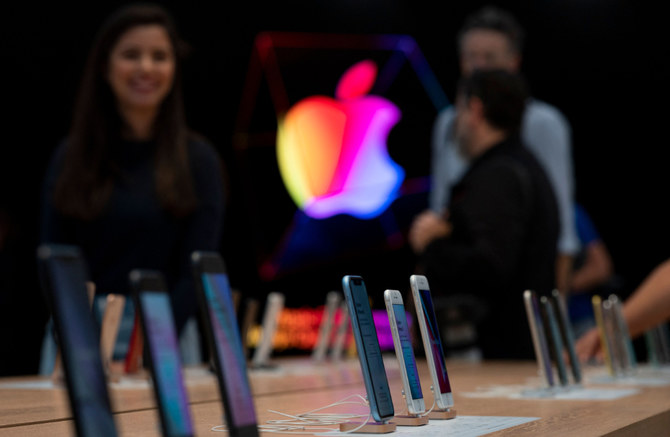
NEW YORK: Apple said Tuesday it is expanding the iPhone’s capabilities to accept contactless payments, making it easier for merchants to conduct tap-to-pay transactions without having to buy additional hardware.
It will also give Apple a competitive edge in the growing world of contactless payments, in which the iPhone, as well as Apple Pay, play a dominant role by effectively turning the iPhone into a point-of-sale terminal.
The iPhone has been used as a contactless way to pay for goods and services since Apple Pay launched in 2014. But it required merchants to have their own point-of-sale hardware in order to accept contactless payments. Shares of payment platform company Block, formerly known as Square Inc. with its well-known iPhone dongle used to accept payments, fell more than 1 percent on Tuesday after Apple’s announcement.
Those devices ranged in price from $50 for contactless payment device that sat next to a cash register, to devices that cost hundreds of dollars and would allow an employee or shop owner to accept payments anywhere in a store or restaurant. The cheaper devices often have to be kept charged and paired to an existing point-of-sale system, which can be frustrating when they fail.
Because of the cost, often only large retailers would have mobile tap-to-pay devices. Apple’s own retail employees have used a device bolted onto an iPhone to accept contactless payments in its stores, for example.
“Oftentimes our contactless reader has issues or is finicky so it’ll be great to offer this new way to pay as a backup and not have to buy new hardware to do it,” said Mimi Striplin, owner of The Tiny Tassel, jewelry store in Charleston, South Carolina.
Now the iPhone will be able to act as a payment terminal itself, without any additional hardware, Apple said. The tap-to-pay feature will use the iPhone’s existing NFC chip that was being used to transmit payments down to a payment terminal. It will be available to developers via an iOS software update this spring. It will be up to developers and payment-services companies to add the capability to their point-of-sale software.
Stripe will be the first point-of-sale company to use the iPhone as a tap-to-pay payment terminal through its Shopify app, Apple said.
Contactless, or tap-to-pay, payment systems have long been popular outside the US as the default way of paying for goods and services. But tap-to-pay has grown in popularity in the US in recent years, particularly during the pandemic when customers and merchants wanted to avoid as much physical interaction with cash and cards as possible.
Google and Samsung have unveiled Android devices that would allow merchants to use those devices as contactless payment terminals as well, but those announcements have been largely aimed at outside the US, where contactless payment habits are already well established. The new iPhone feature is aimed at the US, a much more lucrative market where contactless payments are still growing.
The feature will only be available on iPhones XS or later, Apple said, and will not be available on iPads. Just like with Apple Pay, the company said it will keep transaction data private and will not know what merchants and customers are buying.


Apple says iPhone to accept tap-to-pay without more hardware
https://arab.news/y48q9
Apple says iPhone to accept tap-to-pay without more hardware

- The iPhone has been used as a contactless way to pay for goods and services since Apple Pay launched in 2014


Foreign press group welcomes Israel court deadline on Gaza access
- Supreme Court set deadline for responding to petition filed by the Foreign Press Association to Jan. 4
- Since the start of the Gaza war in October 2023, Israeli authorities have prevented foreign journalists from independently entering the Strip
JERUSALEM: The Foreign Press Association in Jerusalem on Sunday welcomed the Israeli Supreme Court’s decision to set January 4 as the deadline for Israel to respond to its petition seeking media access to Gaza.
Since the start of the Gaza war in October 2023, sparked by Palestinian militant group Hamas’s attack on Israel, Israeli authorities have prevented foreign journalists from independently entering the devastated territory.
Israel has instead allowed, on a case-by-case basis, a handful of reporters to accompany its troops into the blockaded Palestinian territory.
The Foreign Press Association (FPA), which represents hundreds of foreign journalists in Israel and the Palestinian territories, filed a petition to the supreme court last year, seeking immediate access for international journalists to the Gaza Strip.
On October 23, the court held a first hearing on the case, and decided to give Israeli authorities one month to develop a plan for granting access.
Since then the court has given several extensions to the Israeli authorities to come up with their plan, but on Saturday it set January 4 as a final deadline.
“If the respondents (Israeli authorities) do not inform us of their position by that date, a decision on the request for a conditional order will be made on the basis of the material in the case file,” the court said.
The FPA welcomed the court’s latest directive.
“After two years of the state’s delay tactics, we are pleased that the court’s patience has finally run out,” the association said in a statement.
“We renew our call for the state of Israel to immediately grant journalists free and unfettered access to the Gaza Strip.
“And should the government continue to obstruct press freedoms, we hope that the supreme court will recognize and uphold those freedoms,” it added.
An AFP journalist sits on the board of the FPA.


