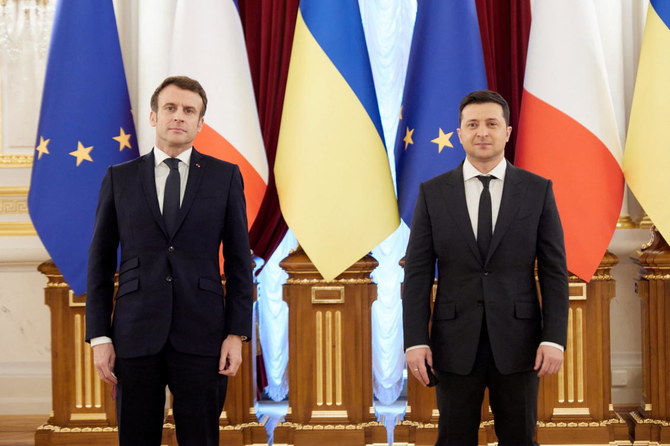
KYIV: French President Emmanuel Macron said Tuesday he had convinced Russia’s Vladimir Putin not to escalate the crisis around Ukraine, ahead of talks in Kyiv aimed at defusing fears Moscow could invade.
During a five-hour meeting over dinner in the Kremlin Monday, Macron said he offered Putin “concrete security guarantees” as the West scrambles to deal with Russia’s massive troop build-up on Ukraine’s border.
“I obtained that there will be no degradation nor escalation,” the French leader told journalists as he arrived in Kyiv for talks with Ukraine’s President Volodymyr Zelensky.
“My aim was to freeze the game, to prevent an escalation and open up new perspectives,” Macron said. “This objective for me is fulfilled.”
Putin — who has demanded sweeping security guarantees from NATO and the United States — told Macron that Moscow would “do everything to find compromises that suit everyone.”
He said several proposals put forward by Macron could “form a basis for further steps” on easing the crisis over Ukraine, but did not give any details.
At the same time as sending its military hardware to Ukraine’s borders, Moscow issued demands the West says are unacceptable, including barring Ukraine from joining NATO and rolling back alliance forces in eastern Europe.
The French presidency said Macron’s counter proposals include an engagement from both sides not to take any new military action, the launching of a strategic dialogue and efforts to revive the peace process in Kyiv’s conflict with Moscow-backed separatists in eastern Ukraine.
It also said an agreement would ensure the withdrawal of some 30,000 Russian soldiers from Belarus at the end of joint military exercises later this month.
“I didn’t think for a second that he was going to make any gestures yesterday,” Macron said of Putin.
Macron — who was the first Western leader to meet Putin since the crisis began in December — faces a tough task trying to convince a wary Zelensky to accept any compromises.
Kyiv has laid out three “red lines” that it says it will not cross to find a solution — no compromise over Ukraine’s territorial integrity, no direct talks with the separatists and no interference in its foreign policy.
Moscow is pressuring Ukraine to offer concessions to the Russian-backed rebels who have been fighting Kyiv since 2014 in a conflict that has claimed over 13,000 lives.
Putin baited Zelensky by calling him “my beauty” as he used a controversial idiom to insist Kyiv must stick to a tattered 2015 peace deal.
The Russian leader warned Macron’s talks in Kyiv would “not be easy either” and said he planned to speak again with the French leader after his meeting with Zelensky.
Ukraine says the Kremlin wants to use the two breakaway eastern regions it supports as leverage to keep the country under Moscow’s sway.
Russia has denied it is planning an invasion — but the US warns it has massed 70 percent of the forces it would need for a large-scale incursion.
The West is nervously eyeing upcoming drills starting Thursday that have seen Russia dispatch thousands of troops to Belarus to the north of Kyiv.
Ukraine’s Defense Minister Oleksiy Reznikov told local television that Kyiv was planning to hold its own parallel exercises across the country involving Western-supplied anti-tank missiles and Turkish combat drones.
As Macron sought a diplomatic solution with Kyiv, US President Joe Biden ramped up the pressure on Moscow Monday by warning he would “end” the controversial new Nord Stream 2 gas pipeline from Russia to Europe if tanks rolled into Ukraine.
Biden’s declaration at a press conference with German Chancellor Olaf Scholz was the bluntest so far on the fate of the massive pipeline, which is complete but has yet to begin funnelling natural gas.
Scholz was less direct and said only that Berlin was “united” with Washington in imposing sweeping sanctions on Russia, declining to mention the pipeline by name.
Scholz will be in Moscow and Kyiv next week for talks with Putin and Zelensky.
British Prime Minister Boris Johnson wrote in The Times that London was pushing allies to be ready with sanctions “the moment the first toecap of the first Russian soldier crosses” into Ukraine.
He said Britain was bolstering its NATO deployment in Estonia and weighing sending jets and warships “to protect southeastern Europe.”


![]()

Macron in Kyiv says no ‘escalation’ from Putin
Short Url
https://arab.news/bwgc3
Macron in Kyiv says no ‘escalation’ from Putin


Latest updates


Recommended


© 2026 SAUDI RESEARCH & PUBLISHING COMPANY, All Rights Reserved And subject to Terms of Use Agreement.