

Tragic end for bid to save 5-year-old Rayan, trapped 30 meters down well in Morocco

1 / 11
Rescuers work to reach a five-year-old boy trapped in a well in the northern hill town of Chefchaouen, Morocco on Feb. 5, 2022. (Reuters)
2 / 11
Rescuers stand near the whole of a well into which a five-year-old boy fell in the northern hill town of Chefchaouen, Morocco on Feb. 5, 2022. (Reuters)
3 / 11
A general view shows the site where rescuers are working to reach a five-year-old boy trapped in a well in the northern hill town of Chefchaouen, Morocco on Feb. 5, 2022. (Reuters)
4 / 11
Rescuers stand near the hole of a well into which a five-year-old boy fell in the northern hill town of Chefchaouen, Morocco on Feb. 5, 2022. (Reuters)
5 / 11
A view shows the site where rescuers are working to reach a five-year-old boy trapped in a well in the northern hill town of Chefchaouen, Morocco on Feb. 5, 2022. (SNRT News/Reuters)
6 / 11
Rescuers work to reach a five-year-old boy trapped in a well in the northern hill town of Chefchaouen, Morocco on Feb. 5, 2022. (Reuters)
7 / 11
A member of the Moroccan emergency services teams works on the rescue of five-year-old boy Rayan in the remote village of Ighrane in the rural northern province of Chefchaouen on Feb. 5, 2022. (AFP)
8 / 11
Moroccan emergency services teams work on the rescue of five-year-old boy Rayan in the remote village of Ighrane in the rural northern province of Chefchaouen on Feb. 5, 2022. (AFP)
9 / 11
10 / 11
A view shows the site where rescuers worked to reach Rayan Awram from the well on Feb. 5, 2022. (Courtesy of SNRT NEWS/REUTERS TV/via REUTERS)
11 / 11
Rescue workers carry the body of Rayan Awram to an ambulance after he was extracted from the well on Feb. 5, 2022. (REUTERS TV/via REUTERS)
Short Url
Updated 06 February 2022
Follow

Tragic end for bid to save 5-year-old Rayan, trapped 30 meters down well in Morocco

  • Rayan Awram was rushed to hospital as soon as he was brought to the surface from a well
  • For days, complex and risky earth-moving operation gripped residents of Morocco and beyond

JEDDAH/LONDON: The race to save a five-year-old boy who fell 32 meters down a well in Morocco ended in tragedy on Saturday when he was found dead.

The Moroccan royal palace confirmed that Rayan, who was trapped in the deep well for four days, has died.

Moroccan King Mohammed VI made a phone call to Khaled Awram and Wassima Khersheesh, Rayan’s parents, to offer his condolences to the family over the boy’s tragic passing, the palace said in a separate statement.

Millions worldwide watching a live video feed from the scene held their breath as rescuers and a medical team emerged from a tunnel carrying Rayan Awram, who had been trapped since Tuesday.
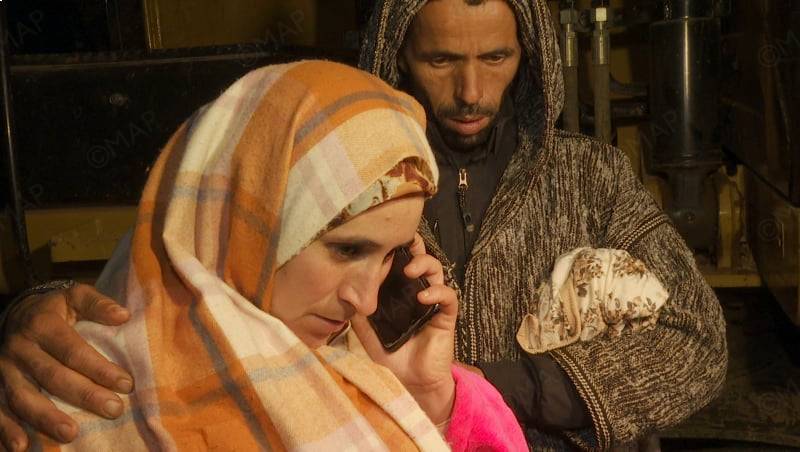


King Mohammed VI made a phone call to Khaled Awram and Wassima Khersheesh, Rayan’s parents, to offer his condolences. (MAP)

The rescue operation was constantly delayed by rocks and imperilled by the threat of landslides.

The boy was wrapped in a yellow blanket after he emerged from a tunnel dug specifically for the rescue, and was immediately taken by ambulance to a helicopter where he was transported to the nearest hospital, shortly before the palace issued the statement confirming his death.

Earlier, the king affirmed that he was closely following the developments and had issued instructions to all concerned authorities to take the necessary measures and to exhaust all efforts to save his life.
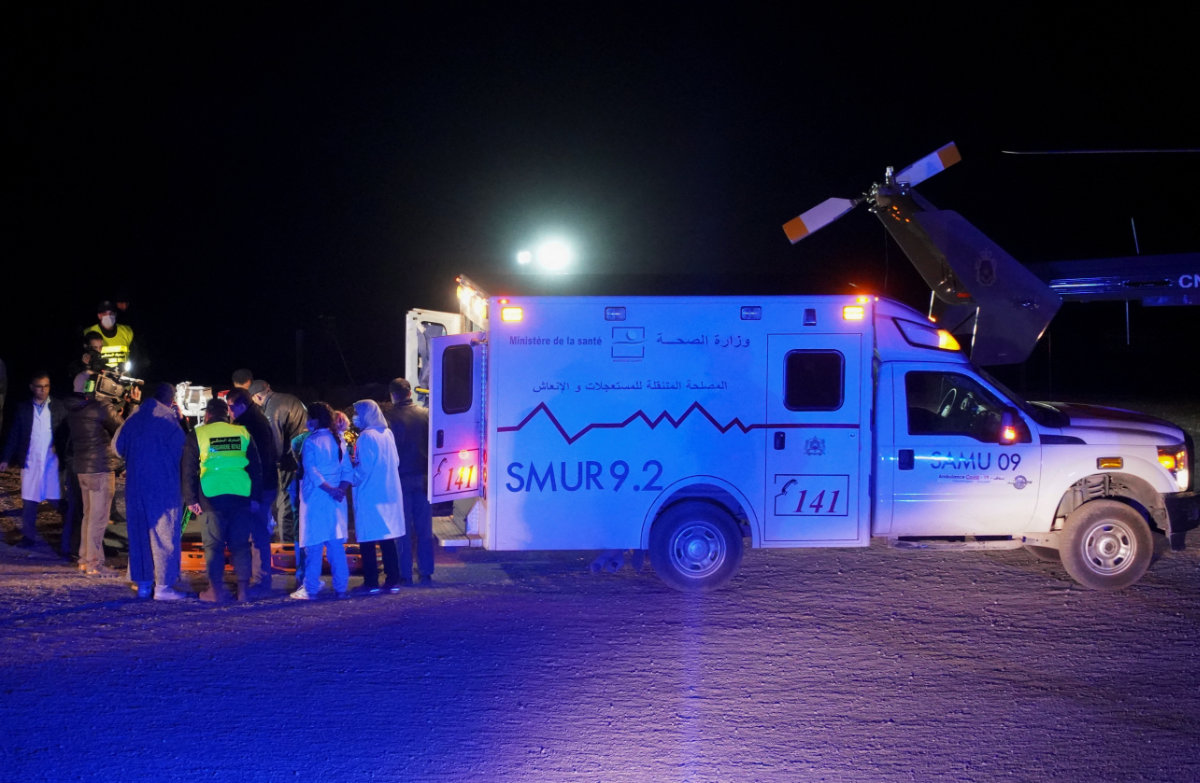


Medics and rescuers inspect the body of Rayan Awram after he was extracted from the well on Feb. 5, 2022. (REUTERS/Abdelhak Balhaki)

King Mohammed also expressed his appreciation for the tireless efforts made by the rescue teams, as well as the collective activities and strong support from various Moroccan groups and families during this painful occasion.The boy was pulled out Saturday night by rescuers after a lengthy, delicate and dangerous operation that captivated global attention.

Workers with mechanical diggers had been trying round the clock to rescue the 5-year-old child, Rayan Awram, after he fell into a 32-meter (100-foot) deep well in the hills near Chefchaouen on Tuesday.

“We hope we will not encounter rocks,” lead rescuer Abdelhadi Tamrani told reporters at the site on Saturday afternoon, while there were still several meters left to dig.
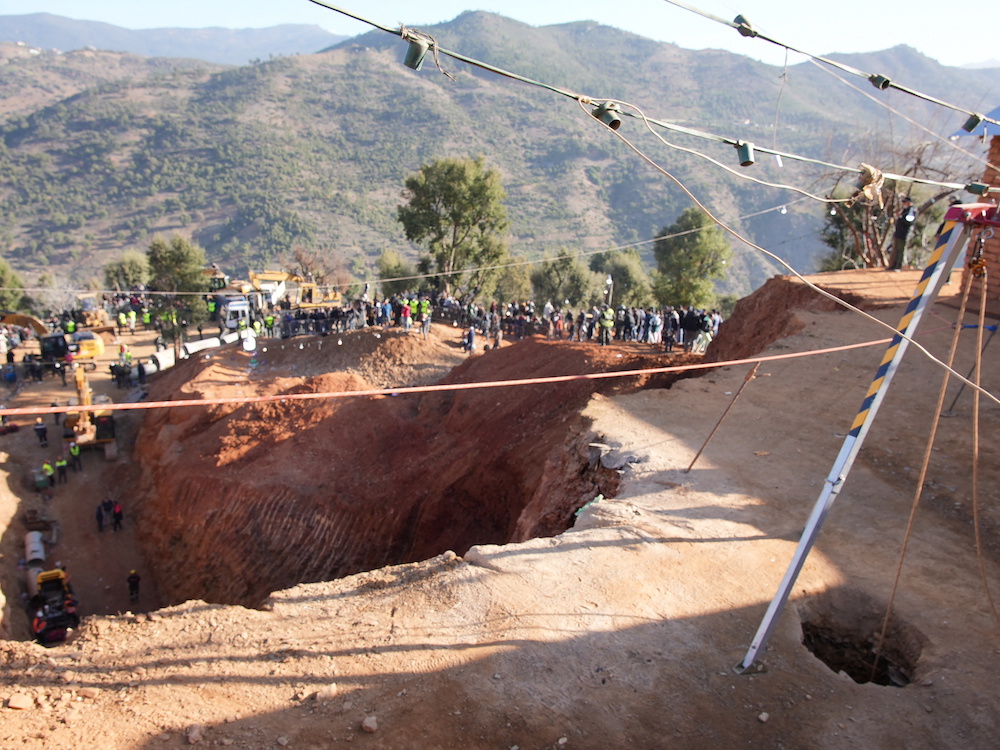


Rescuers stand near the hole of a well into which a five-year-old boy fell in the northern hill town of Chefchaouen, Morocco on Feb. 5, 2022. (Reuters)

His parents had been escorted to an ambulance before the boy emerged. His plight had captured worldwide attention.

Online messages of support and concern for the boy poured in from around the world as the rescue efforts dragged through the night.

Rescuers used a rope to send oxygen and water down to the boy as well as a camera to monitor him. By Saturday morning, the head of the rescue committee, Abdelhadi Temrani, said: “It is not possible to determine the child’s condition at all at this time. But we hope to God that the child is alive.”


Tamrani said it was difficult to determine the child’s health condition because a camera that has been dropped down the well showed him lying on his side, but he added “we hope we will rescue him alive.”

The Red Crescent also confirmed that it had been providing oxygen continuously to the little boy since Tuesday evening.
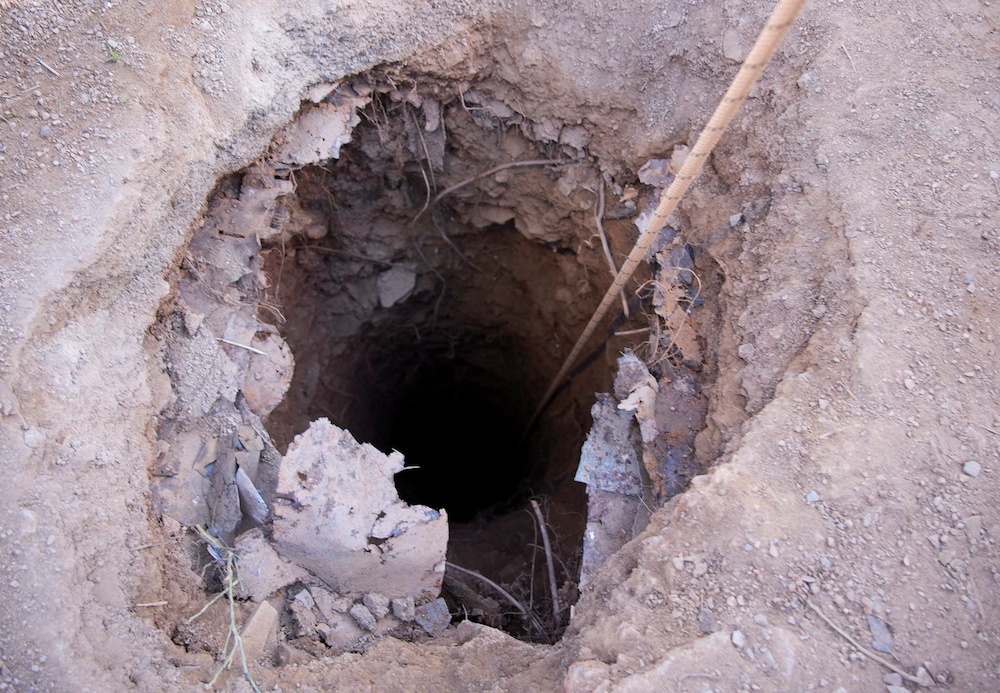


A view shows a well into which a five-year-old boy fell in the northern hill town of Chefchaouen, Morocco on Feb. 5, 2022. (Reuters)

Rescue crews, using bulldozers and front-end loaders, excavated the surrounding red earth down to the level where the boy was trapped and dug horizontally toward him, by hand.

They faced a risk of landslides, and on Saturday had to maneuver around a large rock which blocked their way.

Earlier in the darkness, crews had moved a heavy pipe into position in the area. One rescuer lugged what appeared to be a jackhammer.

A glacial cold had gripped this mountainous and impoverished region of the Rif, which is at an elevation of about 700 meters (2,300 feet).

Thousands of people had gathered and even camped in solidarity around the site in recent days and onlookers applauded to encourage the rescuers, sang religious songs or prayed, chanting in unison “Allahu akbar” (God is greatest).
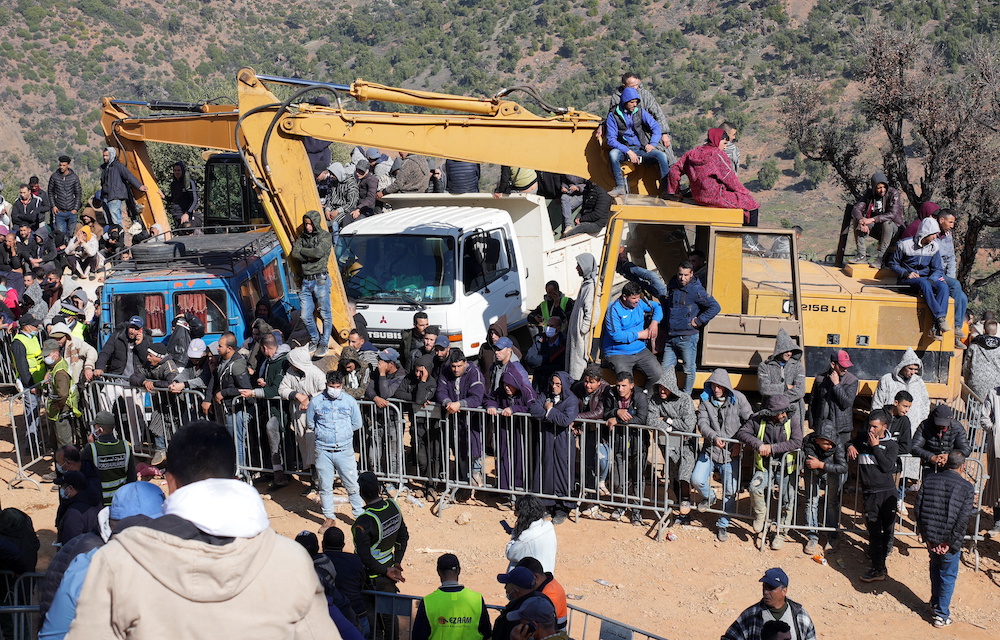


People gather as rescuers work to reach a five-year-old boy trapped in a well in the northern hill town of Chefchaouen, Morocco Feb. 5, 2022. (Reuters)

The shaft, just 45 centimeters (18 inches) across, was too narrow to reach Rayan, and widening it was deemed too risky — so earth-movers dug a wide slope into the hill to reach him from the side.

The operation has made the landscape resemble a construction site. It involves engineers and topographers, and was made more complex by the mix of rocky and sandy soils.

“I keep up hope that my child will get out of the well alive,” Rayan’s father told public television 2M on Friday evening. “I thank everyone involved and those supporting us in Morocco and elsewhere.”

He said earlier in the week that he had been repairing the well when the boy fell in.
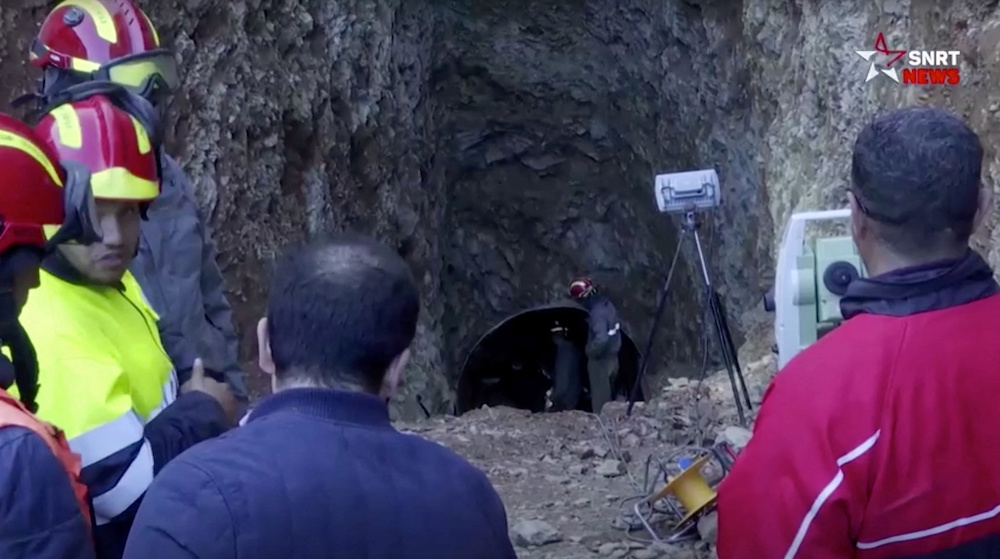


A view shows the site where rescuers are working to reach a five-year-old boy trapped in a well in the northern hill town of Chefchaouen, Morocco on Feb. 5, 2022. (SNRT News/Reuters)

The drama has sparked an outpouring of sympathy online, with the trending Arabic hashtag #SaveRayan.

“Millions of people across the world are holding their breath in the race against time to save Rayan,” one Twitter user wrote.

Another paid tribute to rescue workers working around the clock for days, saying, “they are real-life heroes.”

A male relative of the boy told Reuters TV that the family had first realized he was missing when they heard muffled crying and lowered a phone with its light and camera on to locate him.

“He was crying ‘lift me up’,” the relative said.

(With Reuters and AFP)


Foreign women linked to Daesh group in Syrian camp hope for amnesty after government offensive

Updated 8 sec ago
Follow

Foreign women linked to Daesh group in Syrian camp hope for amnesty after government offensive

  • Many of the women are either wives or widows of Daesh fighters who were defeated in Syria
  • “There were changes in the behavior of children and women. They became more hostile,” the camp’s director said

ROJ CAMP, Syria: Foreign women linked to the Daesh group and living in a Syrian camp housing more than 2,000 people near the border with Iraq are hoping that an amnesty may be on the horizon after a government offensive weakened the Kurdish-led force that guards the camp.
The women spoke to The Associated Press on Thursday in northeast Syria’s Roj camp, where hundreds of mostly women and children linked to Daesh have been held for nearly a decade.
The camp remains under control of the Kurdish-led Syrian Democratic Forces, which until recently controlled much of northeastern Syria. A government offensive this month captured most of the territory the group previously held, including the much larger Al-Hol camp, which is holding nearly 24,000 mostly women and children linked to Daesh.
Many of the women are either wives or widows of Daesh fighters who were defeated in Syria in March 2019, marking the end of what was once a self-declared caliphate in large parts of Iraq and Syria.
The most well-known resident of the Roj camp, Shamima Begum, was 15 when she and two other girls fled from London in 2015 to marry Daesh fighters in Syria. Begum married a Dutch man fighting for Daesh and had three children, who all died.
Last month, Begum lost her appeal against the British government’s decision to revoke her UK citizenship. Begum refused to speak to AP journalists at the camp.
The director of the Roj camp, Hakmiyeh Ibrahim, said that the government’s offensive on northeast Syria has emboldened the camp residents, who now tell guards that soon they will be free and Kurdish guards will be jailed in the camp instead.
“There were changes in the behavior of children and women. They became more hostile,” the camp’s director said. “It gave them hope that the Daesh group is coming back strongly.”
Since former Syrian President Bashar Assad was toppled in a lightning rebel offensive in December 2024, the country’s new army is made up of a patchwork of former insurgent groups, many of them with Islamist ideologies.
The group led by now-interim President Ahmad Al-Sharaa was once linked to Al-Qaeda although Al-Sharaa’s group and Daesh were rivals and fought for years. Since becoming president, Al-Sharaa — formerly known by the nom de guerre Abu Mohammed Al-Golani — has joined the global coalition against Daesh.
Camp residents hope for amnesty
One woman from Tunisia who identified herself only as Buthaina, pointed out that Al-Sharaa was removed from the UN and US lists of terrorists.
“People used to say that Al-Golani was the biggest terrorist. What happened to him later? He became the president of Syria. He is not a terrorist any more,” she said. “The international community gave Al-Golani amnesty. I should be given amnesty too.”
She added, “I did not kill anyone or do anything.”
The camp director said more than 2,300 people are housed in the Roj camp. They include a small number of Syrians and Iraqis, but the vast majority of them — 742 families — come from nearly 50 other countries, the bulk of them from states in the former Soviet Union.
That is in contrast to Al-Hol camp, where most residents are Syrians and Iraqis who can be more easily repatriated. Other countries have largely been unwilling to take back their citizens. Human rights groups have for years cited poor living conditions and pervasive violence in the camps.
The US military has begun moving male Daesh detainees from Syrian prisons to detention centers in Iraq, but there is no clear plan for the repatriation of women and children at the Roj Camp.
“What is happening now is exactly what we have been warning about for years. It is the foreseeable result of international inaction,” said Beatrice Eriksson, the cofounder of the children rights organization Repatriate the Children in Sweden. “The continued existence of these camps is not an unfortunate by-product of conflict, it is a political decision.”
Some women don’t want to go home
Some of the women interviewed by the AP said they want to go back home, while others want to stay in Syria.
“I did not come for tourism. Syria is a Muslim country. Germany is all infidels,” said a German woman who identified herself only as Aysha, saying that she plans to stay.
Another woman, a Belgian who identified herself as Cassandra, said she wants to get out of the camp but would like to stay in the Kurdish-controlled area of Syria.
She said that her French husband was an Daesh fighter killed in the northern city of Raqqa, once considered the de facto capital by Daesh. She said Belgium has only repatriated women who had children, unlike her. She was 18 when she came to Syria, she said.
Cassandra added that when fighting broke out between government forces and Kurdish fighters, she started receiving threats from other camp residents because she had good relations with the Kurdish guards.
Future of the camps in limbo
The government push into northeast Syria led to chaos in some of the more than a dozen detention centers where nearly 9,000 members of Daesh have been held for years.
Syrian government forces are now in control of Al-Aqtan prison near Raqqa as well as the Shaddadeh prison near the border with Iraq, where more than 120 detainees managed to flee amid the chaos before most of them were captured again.
Part of an initial ceasefire agreement between Damascus and the SDF included the Kurdish-led group handing over management of the camps and detention centers to the Syrian government.
Buthaina, the Tunisian citizen, said her husband and her son are held in a prison. She said her husband worked in cleaning and did not fight, while her son fought with the extremists.
She has been in Roj for nine years and saw her other children grow up without proper education or a childhood like other children.
“All we want is freedom. Find a solution for us,” Buthaina said.
She said the Tunisian government never checked on them, but now she hopes that “if Al-Golani takes us there will be a solution.”
She said those accused of crimes should stand trial and others should be set free.
“I am not a terrorist. The mistake I made is that I left my country and came here,” she said. “We were punished for nine years that were more like 90 years.”