

Qatar looking to invest in LNG import facility in Pakistan — energy minister

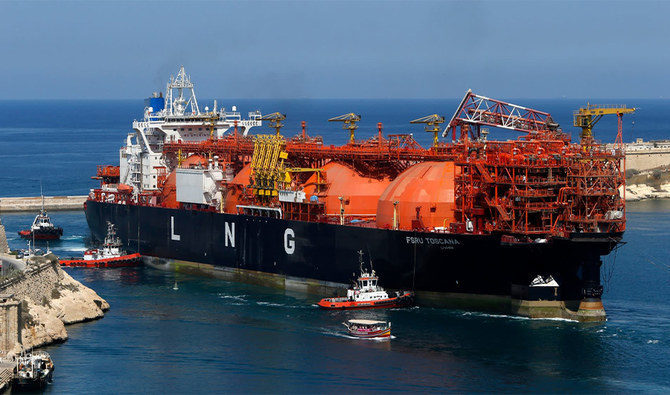
An offshore LNG regasification terminal, the FSRU Toscana, is towed into Valletta's Grand Harbour July 1, 2013. (REUTERS)
Short Url
Updated 05 February 2022
Follow

Qatar looking to invest in LNG import facility in Pakistan — energy minister

  • Says Pakistan imports LNG through two terminals, third site to be operational next year
  • Bill in parliament seeks to expand access to foreign supplies to users representing 70 percent of winter demand

ISLAMABAD: Qatar, one of the top Liquified Natural Gas (LNG) suppliers in the world, is looking to invest in an import facility in Pakistan, Pakistan’s minister for energy said on Friday. 

The South Asian country has become an emerging buyer in the international LNG market over the last few years, with an increasing gap between demand and supply of gas.

Last year, State-owned QatarEnergy said it would be a shareholder in a private sector LNG terminal being set up at Pakistan’s Port Qasim, one of Pakistan’s largest ports, which is located 28 miles south-east of the country’s largest city, Karachi.

In an interview with Bloomberg, Minister for Energy Hammad Azhar said the nation imported LNG through two terminals and he expected a third site to be operational next year. Top supplier Qatar was also looking to invest in an import facility, he said, while the government wanted to set up its own import facility by converting a portion of a state-owned liquefied petroleum gas terminal.

“The current supplies are such that we can barely even meet our current customers,” the energy minister told Bloomberg. “Gas is running low in Pakistan and we have to supplement it.”

Azhar said a bill currently in parliament sought to expand access to foreign supplies to users representing about 70 percent of winter demand. Domestic gas production has fallen by about a fifth over the past two years and the bill that will allow LNG to be supplied to local customers is set to go to the upper house for approval. As LNG is more expensive than local gas, a detailed discussion on pricing will be needed, but increases won’t be “drastic,” said the energy minister.

Pakistan imports more than half of its LNG through long-term contracts, which buffers it somewhat from spot price volatility. In recent months, there have been a spate of cancelations of cargoes.

Pakistan has borne some of the brunt of Europe’s energy crisis as the region outbid rivals in China, Japan and South Korea and traders including Eni SpA and Gunvor Group Ltd. skipped cargo deliveries to the South Asian nation in recent months. One of the traders is expected to default on a cargo this month, Azhar told Bloomberg, without giving details.

The country with a population of over 200 million has struggled with energy shortages and rising power prices, with electricity still not available to 50 million people in the country who need it, according to a 2018 World Bank report.


Pakistan eyes collaboration with Saudi Arabia, Indonesia, China for local vaccine production

Updated 5 sec ago
Follow

Pakistan eyes collaboration with Saudi Arabia, Indonesia, China for local vaccine production

  • Pakistan last week held talks with a visiting Saudi delegation on partnering to manufacture vaccines locally
  • Government working on “war footing” to ensure local production of vaccines by 2030, says health minister

ISLAMABAD: Pakistan is eyeing collaboration with Saudi Arabia, Indonesia and China to produce vaccines locally, Health Minister Syed Mustafa Kamal said on Thursday, adding that Islamabad was exploring both government-to-government and business-to-business opportunities in this regard. 

Kamal told Arab News last week that Islamabad was “very close” to an agreement with Saudi Arabia that would enable Pakistan to manufacture vaccines locally. The development took place as a Saudi delegation, led by the Kingdom’s senior adviser to the minister of industry Nizar Al-Hariri, arrived in Pakistan last week and held talks with health officials on a partnership with Pakistan which would enable it to manufacture vaccines locally. 

The efforts take place amid Pakistan’s push to strengthen its health security and industrial capacity. The country of more than 240 million currently imports all vaccines used in its national immunization campaigns, relying heavily on international partners to help cover the costs.

“Mustafa Kamal said Pakistan is exploring collaboration with Saudi Arabia, Indonesia and China for local production of these vaccines,” state broadcaster Radio Pakistan reported. 

Kamal said the government is working on a “war footing” to ensure the local production of vaccines before 2030. 

The health minister reiterated that Pakistan has the potential to locally produce raw materials of the 13 vaccines that it provides free of cost. He added that the government will also export vaccines once it starts producing them at home. 

“Mustafa Kamal said the government is exploring both government-to-government and business-to-business collaboration to achieve our objectives in vaccine production,” Radio Pakistan said. 

Pakistan’s health ministry has said it imports all 13 vaccines that it provides masses for free at an annual cost of about $400 million.

International partners currently cover 49 percent of these costs, with the remainder borne by the Pakistani government. This external support, Kamal has warned, is expected to end after 2030.