US grants sanctions relief to Iran as nuclear talks remain in balance

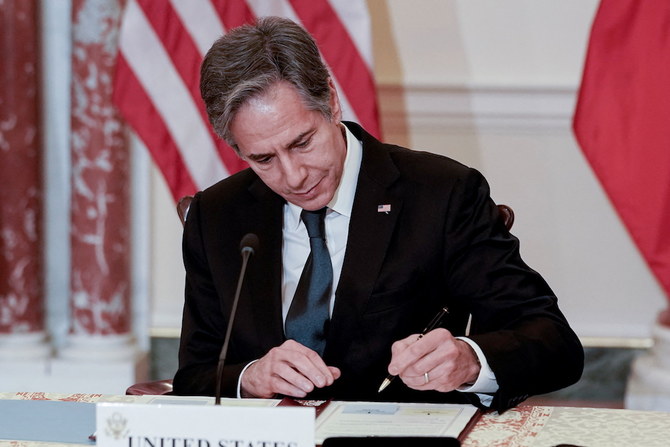
US Secretary of State Antony Blinken has signed several sanctions waivers related to Iran’s civilian nuclear activities. (Reuters/File Photo)
Short Url
Updated 05 February 2022
Follow

US grants sanctions relief to Iran as nuclear talks remain in balance

  • The waivers are intended to entice Iran to return to compliance with the 2015 deal that it has been violating since former President Donald Trump withdrew from the agreement

WASHINGTON D.C.: The Biden administration on Friday restored some sanctions relief to Iran’s atomic program as talks aimed at salvaging the languishing 2015 nuclear deal enter a critical phase.

As US negotiators head back to Vienna for what could be a make-or-break session, Secretary of State Antony Blinken signed several sanctions waivers related to Iran’s civilian nuclear activities. The move reverses the Trump administration’s decision to rescind them.

The waivers are intended to entice Iran to return to compliance with the 2015 deal that it has been violating since former President Donald Trump withdrew from the agreement in 2018 and re-imposed US sanctions.

Iran says it is not respecting the terms of the deal because the US pulled out of it first. Iran has demanded the restoration of all sanctions relief it was promised under the deal to return to compliance.

Friday’s move lifts the sanctions threat against foreign countries and companies from Russia, China and Europe that had been cooperating with non-military parts of Iran’s nuclear program under the terms of the 2015 deal, known as the Joint Comprehensive Plan of Action, or JCPOA.

The Trump administration had ended the so-called “civ-nuke” waivers in May 2020 as part of its “maximum pressure” campaign against Iran that began when Trump withdrew the US from the deal in 2018, complaining that it was the worst diplomatic agreement ever negotiated and gave Iran a pathway to developing the bomb.

As a presidential candidate, Joe Biden made a US return to the nuclear deal a priority, and his administration has pursued that goal but there has been little progress toward that end since he took office a year ago. Administration officials said the waivers were being restored to help push the Vienna negotiations forward.

“The waiver with respect to these activities is designed to facilitate discussions that would help to close a deal on a mutual return to full implementation of the JCPOA and lay the groundwork for Iran’s return to performance of its JCPOA commitments,” the State Department said in a notice to Congress that announced the move.

“It is also designed to serve U.S. nonproliferation and nuclear safety interests and constrain Iran’s nuclear activities,” the department said. “It is being issued as a matter of policy discretion with these objectives in mind, and not pursuant to a commitment or as part of a quid pro quo. We are focused on working with partners and allies to counter the full range of threats that Iran poses."

A copy of the State Department notice and the actual waivers signed by Blinken were obtained by The Associated Press.

The waivers permit foreign countries and companies to work on civilian projects at Iran's Bushehr nuclear power station, its Arak heavy water plant and the Tehran Research Reactor. Former Secretary of State Mike Pompeo had revoked the waivers in May, 2020, accusing Iran of “nuclear extortion” for continuing and expanding work at the sites.

Critics of the nuclear deal who lobbied Trump to withdraw from it protested, arguing that even if the Biden administration wants to return to the 2015 deal it should at least demand some concessions from Iran before up front granting it sanctions relief.

“From a negotiating perspective, they look desperate: we’ll waive sanctions before we even have a deal, just say yes to anything!” said Rich Goldberg, a vocal deal opponent who is a senior adviser to the hawkish Foundation for Defense of Democracies.

One senior State Department official familiar with the waivers maintained that the move is not a “concession” to Iran and was being taken “in our vital national interest as well as the interest of the region and the world.” The official was not authorized to discuss the matter publicly and spoke on condition of anonymity.


Syrian army pushes into Aleppo district after Kurdish groups reject withdrawal

Updated 55 min 21 sec ago
Follow

Syrian army pushes into Aleppo district after Kurdish groups reject withdrawal

  • Two Syrian security officials told Reuters the ceasefire efforts had failed and that the army would seize the neighborhood by force

ALEPPO, Syria: The Syrian army said it would push into the last Kurdish-held district of Aleppo ​city on Friday after Kurdish groups there rejected a government demand for their fighters to withdraw under a ceasefire deal.
The violence in Aleppo has brought into focus one of the main faultlines in Syria as the country tries to rebuild after a devastating war, with Kurdish forces resisting efforts by President Ahmed Al-Sharaa’s Islamist-led government to bring their fighters under centralized authority.
At least nine civilians have been killed and more than 140,000 have fled their homes in Aleppo, where Kurdish forces are trying to cling on to several neighborhoods they have run since the early days of the war, which began in 2011.

HIGHLIGHTS

• Standoff pits government against Kurdish forces

• Sharaa says Kurds are ‘fundamental’ part of Syria

• More than 140,000 have fled homes due to unrest

• Turkish, Syrian foreign ministers discuss Aleppo by phone

ِA ceasefire was announced by the defense ministry overnight, demanding the withdrawal of Kurdish forces to the Kurdish-held northeast. That would effectively end Kurdish control over the pockets of Aleppo that Kurdish forces have held.

CEASEFIRE ‘FAILED,’ SECURITY OFFICIALS SAY
But in a statement, Kurdish councils that run Aleppo’s Sheikh Maksoud and Ashrafiyah districts ‌said calls to leave ‌were “a call to surrender” and that Kurdish forces would instead “defend their neighborhoods,” accusing government forces ‌of intensive ⁠shelling.
Hours ​later, the ‌Syrian army said that the deadline for Kurdish fighters to withdraw had expired, and that it would begin a military operation to clear the last Kurdish-held neighborhood of Sheikh Maksoud.
Two Syrian security officials told Reuters the ceasefire efforts had failed and that the army would seize the neighborhood by force.
The Syrian defense ministry had earlier carried out strikes on parts of Sheikh Maksoud that it said were being used by the Kurdish-led Syrian Democratic Forces (SDF) to launch attacks on the “people of Aleppo.” It said on Friday that SDF strikes had killed three army soldiers.
Kurdish security forces in Aleppo said some of the strikes hit a hospital, calling it a war crime. The defense ministry disputed that, saying the structure was a large arms depot and that it had been destroyed in the resumption of strikes on Friday.
It ⁠posted an aerial video that it said showed the location after the strikes, and said secondary explosions were visible, proving it was a weapons cache.
Reuters could not immediately verify the claim.
The SDF is ‌a powerful Kurdish-led security force that controls northeastern Syria. It says it withdrew its fighters from ‍Aleppo last year, leaving Kurdish neighborhoods in the hands of the Kurdish ‍Asayish police.
Under an agreement with Damascus last March the SDF was due to integrate with the defense ministry by the end of 2025, ‍but there has been little progress.

FRANCE, US SEEK DE-ESCALATION
France’s foreign ministry said it was working with the United States to de-escalate.
A ministry statement said President Emmanuel Macron had urged Sharaa on Thursday “to exercise restraint and reiterated France’s commitment to a united Syria where all segments of Syrian society are represented and protected.”
A Western diplomat told Reuters that mediation efforts were focused on calming the situation and producing a deal that would see Kurdish forces leave Aleppo and provide security guarantees for Kurds who remained.
The diplomat ​said US envoy Tom Barrack was en route to Damascus. A spokesperson for Barrack declined to comment. Washington has been closely involved in efforts to promote integration between the SDF — which has long enjoyed US military support — and Damascus, with which the ⁠United States has developed close ties under President Donald Trump.
The ceasefire declared by the government overnight said Kurdish forces should withdraw by 9 a.m. (0600 GMT) on Friday, but no one withdrew overnight, Syrian security sources said.
Barrack had welcomed what he called a “temporary ceasefire” and said Washington was working intensively to extend it beyond the 9 a.m. deadline. “We are hopeful this weekend will bring a more enduring calm and deeper dialogue,” he wrote on X.

TURKISH WARNING
Turkiye views the SDF as a terrorist organization linked to the outlawed Kurdistan Workers’ Party and has warned of military action if it does not honor the integration agreement.
Turkish Foreign Minister Hakan Fidan, speaking on Thursday, expressed hope that the situation in Aleppo would be normalized “through the withdrawal of SDF elements.”
Though Sharaa, a former Al-Qaeda commander who belongs to the Sunni Muslim majority, has repeatedly vowed to protect minorities, bouts of violence in which government-aligned fighters have killed hundreds of Alawites and Druze have spread alarm in minority communities over the last year.
The Kurdish councils in Aleppo said Damascus could not be trusted “with our security and our neighborhoods,” and that attacks on the areas aimed to bring about displacement.
Sharaa, in a phone call with Iraqi Kurdish leader Masoud Barzani on Friday, affirmed that the Kurds were “a fundamental part ‌of the Syrian national fabric,” the Syrian presidency said.
Neither the government nor the Kurdish forces have announced a toll of casualties among their fighters from the recent clashes.