

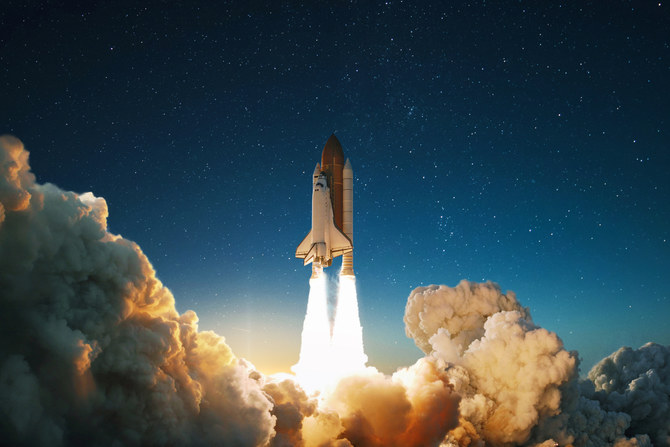

NEW YORK: The new space race is upon us, and the moon will soon be very crowded. According to the US space agency NASA, the year 2022 will be an historic one, ushering in a “new era of lunar exploration.”
“There is a moon rush” and “everyone’s going to the moon,” trilled the Economist recently. But this new moon race, while filled with hope, is fraught with concern and apprehension owing to fierce competition and superpower rivalry.
The heavy traffic in space this year, especially around the moon, is reminiscent of the 1960s and the Cold War when space was the new battleground between the competing visions of the US and the Soviet Union.
The Soviets enjoyed an early lead, putting the first satellite in orbit in 1957, the first probe on the lunar surface in 1959, and the first man in space in 1961. But with US President John F. Kennedy vowing to put a man on the moon and returning him safely before the end of the decade, the Americans soon pulled ahead.
By 1969, the US had succeeded, making Neil Armstrong the first human to set foot on the lunar surface. But in 1972, six Apollo missions later, the program was scrapped and no manned mission has returned to the moon since.
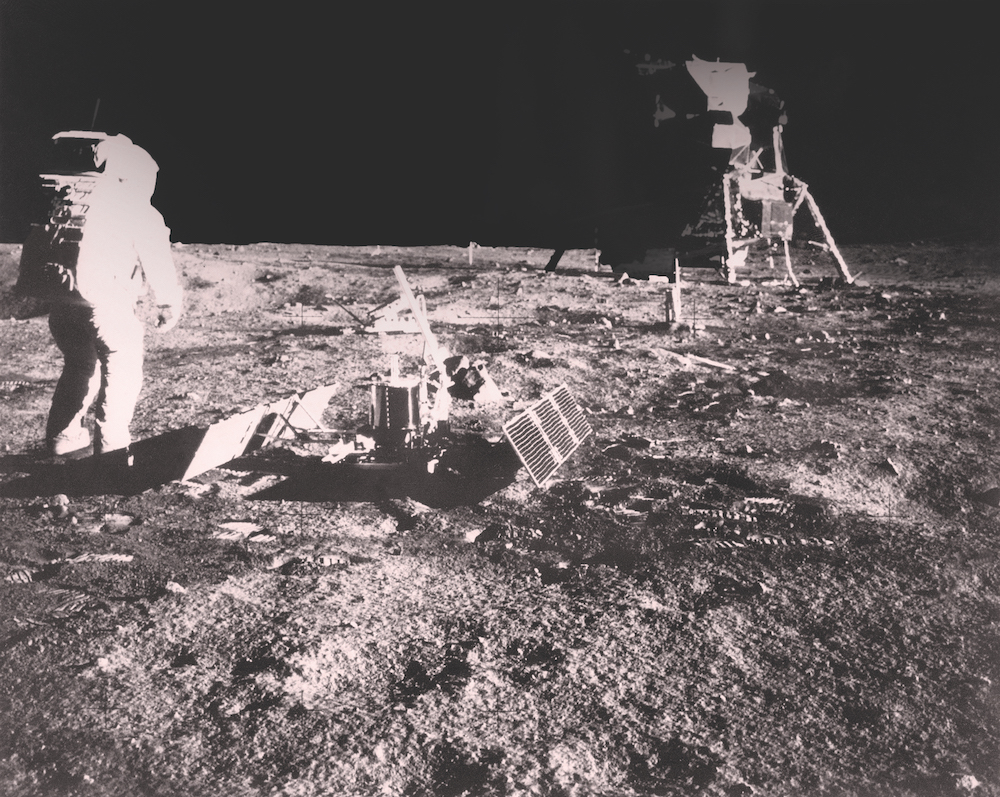
Since the historic moon landings from 1969, there have been growing calls for manned missions to return to the lunar surface and beyond. (AFP)
President Donald Trump issued a similar directive in 2017, calling on NASA to lead a human return to the moon and beyond. He also told the space agency it was high time that a woman walked on the moon.
Last year was a remarkable year for space travel, with several historic firsts. NASA succeeded in landing the Perseverance Rover on Mars, and piloting Ingenuity — the first helicopter flown on the Red Planet. The space agency also launched the James Webb Space Telescope — the largest and the most powerful ever built.
Another major development is the private sector’s emergence as a key player in the field, offering low-cost rocketry and launch facilities and even the beginnings of space tourism. NASA’s leadership now speaks of “catalyzing the space economy with public-private partnerships.”
Elon Musk’s SpaceX, Jeff Bezos’ Blue Origin and Sir Richard Branson’s Virgin Galactic have all made significant leaps over the past year, while a Japanese billionaire recently spent a week aboard the International Space Station.
However, 2022 will primarily be the year of the moon, with governments and private companies working in partnership to make their ambitions a reality.

NASA is moving away from the ISS project (above) with the upcoming Artemis station program. (Shutterstock)
NASA’s multibillion-dollar Artemis program, named after Apollo’s twin sister, the Greek goddess of the moon, is the biggest project of its kind in the world. After 20 years of multinational cooperation aboard the ISS, the US and its partners are now preparing to move beyond the aging space station and deeper into space.
The moon is thought to be rich in resources such as rare earth elements and precious metals, titanium, aluminum and — that all important ingredient for sustaining life — water. However, the moon is not viewed as the ultimate goal but as a “stepping stone” for what is considered the bigger prize: Mars and beyond.
NASA, for instance, believes “the sooner we get to the moon, the sooner we get American astronauts to Mars.”
But all of this rides on the success of the three phases of the Artemis program, which will combine the technology and expertise of the Canadian Space Agency, the European Space Agency, and the Japan Aerospace Exploration Agency. Artemis I, planned for March or April this year, will be the first unmanned flight test.
FASTFACTS
* The first observatory was built in the 8th century by Abbasid Caliph Al-Mamun ibn Al-Rashid in Baghdad.
* Saudi Arabia’s Prince Sultan bin Salman became the first Arab in space when he flew aboard the US space shuttle Discovery in 1985.
* Today, 9 Middle East countries have space programs.
* SpaceX Starlink project has more than 1,700 satellites in low-Earth orbit.
* There could be more than 100,000 satellites orbiting the Earth by 2030.
The core components of Artemis include the Space Launch System rocket, which will carry the Orion capsule to lunar orbit, and the Gateway — a space station that will orbit the moon as a “staging point” to the lunar surface and for deep space exploration.
As part of the testing phase, the unmanned Artemis I will circle the moon before returning to earth. Artemis II, which will carry a crew of four astronauts, will perform a lunar flyby, but will not land.
Finally, the fully crewed Artemis III will land near the moon’s south pole, where astronauts will search for water, study the surface, and test technologies. There they will establish “Artemis Base Camp” to support future lunar expeditions. The mission is expected to take place in 2025.
In the meantime, NASA has contracted private firms to send three robotic moon landers to conduct excavations and bring back lunar soil samples, which is already raising puzzling questions about land and resource ownership on the moon.
There are currently nine moon missions in the works led by various nations and private companies that “could try to orbit, or land on the moon” in 2022, according to The New York Times. Five of them are sponsored by NASA.
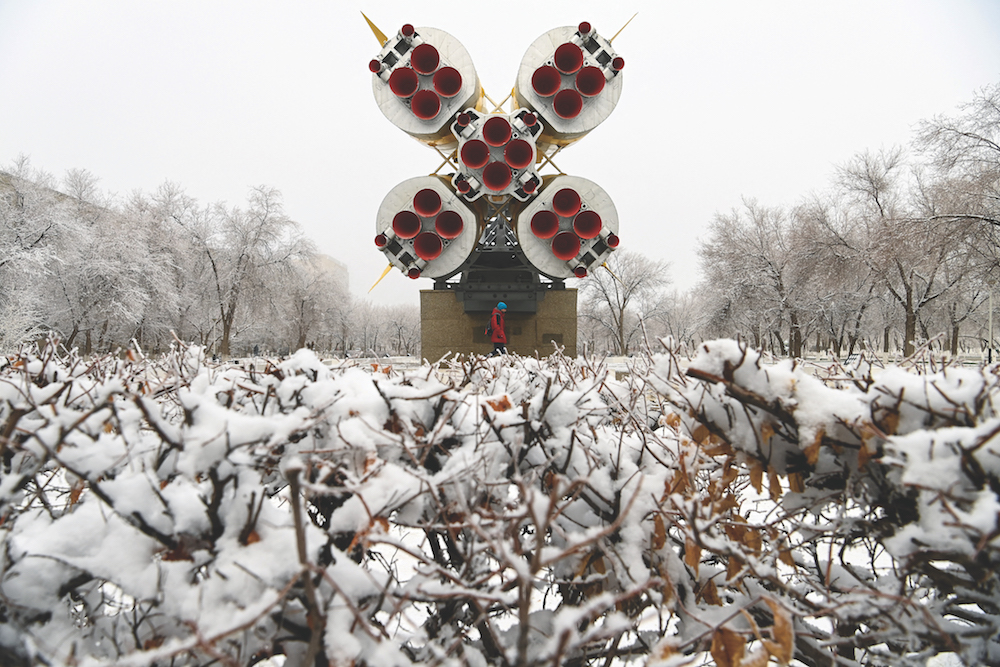
Russian rockets will send five spacecraft into orbit in 2022, including two manned missions. (AFP)
Russia plans to launch five spacecraft in 2022, two of which will include manned missions, and three cargo missions to the ISS. They are also working with China on a new space station, the International Lunar Research Station, due for launch in 2027. The collaboration is reportedly a direct response to their exclusion from the Artemis program.
Russia is expected to launch the Luna-25 lander in October, making it the first Russian moon landing since the Luna-24 in 1976. India will also try to land on the moon in the third quarter of 2022 after its failed mission in 2019 when its lander, Chandrayaan-2, crashed into the surface.
Japan, meanwhile, is planning to send its Mission 1 lander to the moon in the second half of 2022, with two robots aboard. One of them is the Rashid rover, developed by the UAE.
China started 2022 by launching a Long March 2D rocket, reported to be one of 40 Chinese Long March rocket missions scheduled for 2022. China has also committed to completing its Tiangong space station this year.
All this space traffic and competing missions to the moon will no doubt intensify existing rivalries and create new possibilities for confrontation.

“We’re at a time of transformative change in the human use of space,” says Jonathan McDowell, scientist at Harvard-Smithsonian Center for Astrophysics. (Supplied)
Currently, there are only two treaties governing the behavior of states in space. These include the Outer Space Treaty of 1967 and the Moon Treaty of 1979. Both appear worryingly out of date in an increasingly busy cosmic marketplace.
The Moon Treaty in particular has only been ratified by 18 states — four of them Arab countries. Of the big powers, only France is a signatory.
Antonio Guterres, the UN secretary general, has called for an urgent dialogue about the terms guarding human involvement in outer space. The Summit of the Future, scheduled for 2023, may provide just such an opportunity to establish a rules-based order for the heavens.
Given the speed with which nations and private firms are embracing space travel, and the bounty of business and prestige that will come with it, contenders will likely be well out of the starting block by the time the rules of the new space race have even been established.


