

Saudi Film Festival returns to Ithra this summer with Chinese cinema playing prominent role

1 / 3
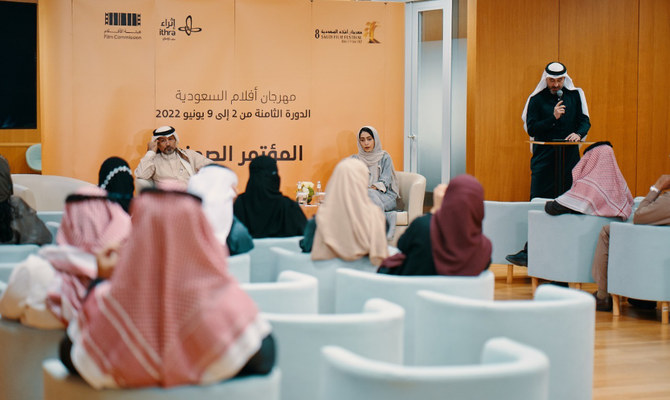
The eighth edition of the Saudi Film Festival will be coming to town from June 2-9 at Ithra in Dhahran. (Supplied)
2 / 3
The eighth edition of the Saudi Film Festival will be coming to town from June 2-9 at Ithra in Dhahran. (Supplied)
3 / 3
The eighth edition of the Saudi Film Festival will be coming to town from June 2-9 at Ithra in Dhahran. (Supplied)
Short Url
Updated 03 February 2022
Follow

Saudi Film Festival returns to Ithra this summer with Chinese cinema playing prominent role

  • In its eighth edition, the festival will honor Khalil bin Ibrahim Al-Rawaf, the first Saudi Arab filmmaker to become a Hollywood actor

DHAHRAN: The eighth edition of the Saudi Film Festival will be coming to town from June 2-9 at Ithra in Dhahran. This year’s theme will be “poetic cinema,” a homage to what the festival calls “aesthetic symbolism and philosophical connotations that stimulate the creative imagination.”

As in previous years, the festival aims to truly enrich the local cinematic scene by paying tribute to the local greats and offering seminars, advanced training workshops and screenings of Palme d’Or films, considered the films with the highest merit at the Cannes Film Festival.

Additionally, in an effort to further foster global collaboration, the festival will highlight Chinese cinema by screening a selection of films from China and publishing a set of translated knowledge books to support the festival’s role in enriching Arab content in the fields of cinema and filmmaking.

The festival details were announced at a press conference by Director of the Saudi Film Festival Ahmed Al-Mulla and Director of Programs at the King Abdulaziz Center for World Culture Ashraf Fakih. Al-Mulla stressed that the partnership between the Society for Culture and Arts in Dammam and Ithra was “one of the deepest cultural partnerships” in the Kingdom.

Both Al-Mulla and Fakih acknowledged the support of the Film Commission at the Ministry of Culture for its continuous contribution in providing substantial support for Saudi filmmakers.

In its eighth edition, the festival will honor Khalil bin Ibrahim Al-Rawaf, the first Saudi Arab filmmaker to become a Hollywood actor, and Khaled Al-Siddiq, a Kuwaiti producer, screenwriter and film director, who is considered one of the most important pioneers of the Kuwaiti cinematic movement. His film “Bas Ya Bahar,” or “The Cruel Sea,” which he produced and directed in 1972, was the first Kuwaiti film to be nominated for the Academy Award for Best Foreign Film.

Those interested in competing are invited to submit their entry via the Saudi Film Festival website through March 26. Nominees will have the opportunity to compete in seven categories in the feature film section; in four categories in the short film competition, including the Abdullah Al-Muhaisen award for a first film; and in six categories in the unexecuted script competition awards, including the Ghazi Al-Gosaibi Award for best screenplay for a Saudi novel.


In the ‘Paris of the Middle East,’ Brigitte Bardot is mourned alongside memories of a golden era

Updated 6 sec ago
Follow

In the ‘Paris of the Middle East,’ Brigitte Bardot is mourned alongside memories of a golden era

DUBAI: French film legend Brigitte Bardot’s death at age 91 has refocused attention on her life as one of the 20th century’s most captivating cultural icons — and on a remarkable, if brief, moment when her star power intersected with Lebanon’s own golden age.

In March 1967, Bardot arrived in Beirut for a four-day visit that would briefly place the French screen legend at the heart of a Middle Eastern hotspot of glamour and modernity.

Brigitte Bardot in Baalbek, Lebanon. (Instagram)

At the time, Beirut was celebrated as the “Paris of the Middle East,” known for its luxuriant hotels, lively nightlife and cosmopolitan mix of cultures. Bardot stayed in the city’s famed Phoenicia Hotel, a five-star palace where international celebrities lounged by the pool and rubbed shoulders with jet-set elites. Paparazzi captured her in relaxed celebrity mode by the poolside, emblematic of both her global appeal and Beirut’s vibrant scene.

During her short stay the actress wandered through the old Beirut souk, the bustling marketplace that was then a fusion of merchants selling jewelry, watches, and luxury goods. She visited Assaad Georges Daou, a jeweler celebrated for designing pieces for royalty and film stars alike — a testament to Beirut’s reputation as a fashion and style hub in the region.

Bardot also ventured beyond the capital to Byblos, an ancient Phoenician port city with sparkling sea views and historic ruins. There she strolled the scenic harbor and old souk, sampled local seafood and soaked up seaside leisure that mirrored the relaxed Mediterranean allure she embodied onscreen.

Her departure from Lebanon was part of a Mediterranean cruise; according to some accounts, the voyage was interrupted by mechanical trouble that stranded the vessel briefly at sea, before she continued on her way.

Bardot became a global star after appearing in "And God created Woman" in 1956, and went on to appear in about 50 more movies before giving up acting in 1973.

After retiring from her film career in 1973, Bardot dedicated over four decades to protecting animals, a mission that resonated with animal welfare groups globally, including in Lebanon.


A post shared by BETA (@betalebanon)

Beirut for the Ethical Treatment of Animals (BETA) took to social media to post a heartfelt tribute on social media, announcing her death with "immense sadness" and highlighting her "unwavering commitment" to their mission

“Today, we say goodbye to Brigitte Bardot — a legendary soul whose love for animals reshaped countless lives. From the silver screen to the front lines of animal welfare, she devoted more than four decades to protecting those who cannot speak for themselves,” the post read.

“Through the Brigitte Bardot Foundation, she turned compassion into action and inspired the world to care more deeply, love more fiercely, and stand up for the voiceless. At BETA, we extend our deepest gratitude to Brigitte Bardot and the Brigitte Bardot Foundation for their generous support and unwavering commitment. Your kindness strengthened our mission, brought hope where there was despair, and helped save so many precious lives.”

Though brief, Bardot’s 1967 visit left a lasting image of Lebanon as a centre of international style and sophistication.