

OIC committee in Pakistan launches capacity building initiative for Yemeni scientists

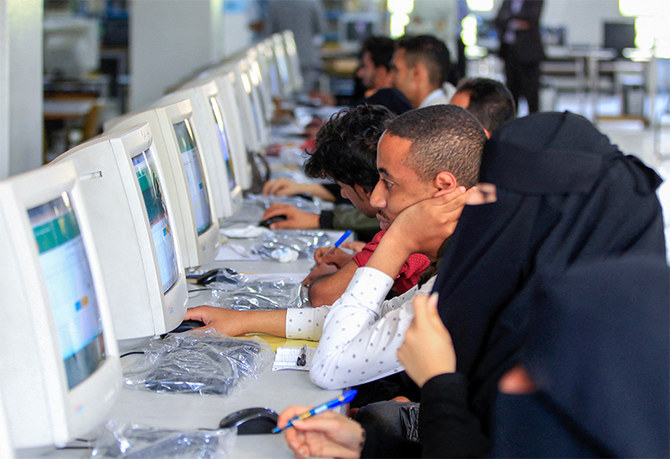
Students sit for an entrance exam at the College of Human Medicine in Sanaa, Yemen, on August 29, 2021. (AFP)
Short Url
Updated 01 February 2022
Follow

OIC committee in Pakistan launches capacity building initiative for Yemeni scientists

  • The program plans to provide training and research opportunities to 50 Yemeni professionals in Pakistani institutions
  • Yemen’s envoy to Pakistan welcomes the initiative, says it will improve professional skills of people from his country

ISLAMABAD: The Organization of Islamic Cooperation’s Standing Committee on Scientific and Technological Cooperation (COMSTECH) has launched a capacity building program for Yemeni scientists, researchers and professionals by bringing them to Pakistani institutions, said a senior official on Tuesday.

The committee was launched in 1981 during the Islamic Summit in Makkah.

It is headquartered in Pakistan and seeks to enhance the scientific capacity of OIC member states.

“We have launched the program to provide quality research opportunities and training to Yemeni nationals,” the committee’s coordinator general Professor Dr. Muhammad Iqbal Choudhary told Arab News. “This will help them serve their nation and prepare young people in their country to fend for themselves.”

He continued the project was jointly funded by COMSTECH and Pakistani institutions, adding the application to participate in the program was available on the committee’s website and Yemen’s embassy.

“The last date to apply is April 30,” he said.


Ambassador of Yemen Mohammed Motahar Alashabi (left) and Coordinator-General COMSTECH Professor Dr. M. Iqbal Choudhary (center) are pictured together in Islamabad, Pakistan, during the announcement of the program for the capacity building of Yemeni scientists on January 31, 2022. (Courtesy: COMSTECH)

Choudhary informed that Yemini nationals with masters or PhD degrees, or those currently enrolled at these levels, were eligible to apply for research fellowships.

He added the committee also wanted to provide opportunities to health professionals in the Arab state by allowing them to apply for short training programs.

“In the first phase, 50 fellowships will be provided to Yemeni nationals who want to perform research or benefit from short training courses,” he said while informing that the scope of the program would be expanded by including other fields after about a year.

For research in science and technology, he continued, about 20 fellows would get a chance to work with the International Center for Chemical and Biological Sciences at the Karachi University.

“They will be facilitated to undertake quality research in any discipline of chemical, biological and biomedical sciences,” he said.

Choudhary added the second area under the program was related to public health that included disaster management training.

“Around 15 professionals will participate in this three-month training program at the health services academy in Islamabad,” he continued.

The third area, he informed, would bring in medical technicians to help them operate hospital equipment at the University of Lahore.


Ambassador of Yemen Mohammed Motahar Alashabi (left) and Coordinator-General COMSTECH Professor Dr. M. Iqbal Choudhary (right) are pictured together in Islamabad, Pakistan, during a meeting before the announcement of the program for capacity building of Yemeni scientists on January 31, 2022. (Courtesy: COMSTECH)

“This is Pakistan’s gift through COMSTECH to our Muslim brothers and sisters in Yemen who require external support,” he said.

The OIC committee finalized the contours of the program during a meeting between the ambassador of Yemen, Mohammed Motahar Alashabi, and the COMSTECH coordinator general in Islamabad earlier this week.

Alashabi welcomed the initiative and agreed to promote it in his country.

“We appreciate this program by COMSTECH and Pakistani institutions since it will help Yemeni scientists, professionals and technicians enhance their knowledge and skills,” he told Arab News.


Pakistan, Saudi Arabia explore joint investment push in high-growth regions

Updated 29 min 10 sec ago
Follow

Pakistan, Saudi Arabia explore joint investment push in high-growth regions

  • Both sides discuss combining Pakistan’s production capacity with Saudi capital and regional market access
  • Government says Saudi side expressed interest in corporate farming in Pakistan, particularly in rice sector

KARACHI: Pakistan and Saudi Arabia are looking to jointly tap high-growth regional markets and align production and capital strengths, according to an official statement on Wednesday, following talks between Commerce Minister Jam Kamal Khan and Saudi Investment Assistant Minister Ibrahim Al-Mubarak in the Kingdom.

The two countries have long maintained close bilateral ties that have evolved into a multidimensional strategic partnership.

In October last year, the two countries launched an Economic Cooperation Framework aimed at shifting relations beyond aid toward sustainable trade, investment and development links. The framework followed the signing of a joint security agreement a month earlier, under which aggression against one would be treated as an attack on both.

“A key focus of the discussion was the joint exploration of regional markets, particularly Central Asia, Africa, and ASEAN, identified as high-growth regions offering significant opportunities for collaboration,” according to a statement circulated by Pakistan’s commerce ministry after the meeting.

“The two sides agreed that Pakistan and Saudi Arabia, by leveraging their respective strengths, can position themselves as complementary partners — combining Pakistan’s production capabilities with Saudi Arabia’s capital strength, market access, and regional connectivity,” it added.

The Saudi side expressed interest in corporate farming in Pakistan, particularly in the rice sector, with discussions covering mechanization, storage and logistics to enable consistent, long-term exports under structured arrangements.

Talks also covered broader cooperation in agriculture and food security, including rice, fodder, meat and other agri-products, with the potential involvement of Saudi financing institutions in supporting export-linked agricultural and infrastructure projects.

Corporate farming and mechanization were discussed as long-term solutions to productivity challenges in crops such as cotton, where declining yields and high manual input costs have hurt competitiveness, the statement said.

Human resource development emerged as another area of focus, with both sides noting shortages in mid-tier skills such as nurses, caregivers, technicians and hospitality staff.

The Saudi side expressed openness to replicating vocational “train-to-deploy” models in Pakistan that link training programs directly with overseas employment opportunities.

The meeting also examined opportunities in building materials, pharmaceuticals, sports goods, footwear and light manufacturing, with both sides agreeing to pursue sector-specific workshops and business-to-business engagements to translate policy alignment into tangible trade and investment flows.