


ISLAMABAD: The Pakistani government on Tuesday launched a nationwide anti-COVID vaccination drive, Planning Minister Asad Umar said, after the virus positivity ratio in the South Asian nation jumped above 10 percent last week.
The South Asian nation of 220 million is currently battling an omicron-driven fifth wave of coronavirus infections. The country reported 32 deaths in the last 24 hours, taking the overall death toll to 29,301.
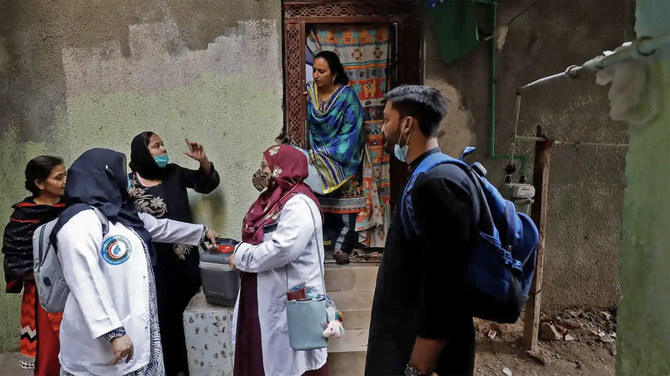
The National Command and Operation Center (NCOC), which oversees Pakistan’s pandemic response, has directed all federating units to launch “Reach Every Door” vaccination campaigns in their respective areas to inoculate the maximum eligible population.
“In the first phase that will continue for two weeks, we have set a target to administer over 30.5 million doses of vaccines, which is quite a big target but our teams are ready and have vaccine stocks,” Umar said at a media briefing on Tuesday.
“Over 55,000 mobile teams will go and carry out door-to-door vaccinations.”
The South Asian nation logged 5,327 new coronavirus cases on Tuesday, with the number of active cases rising to 105,675. Of these, 1,500 patients were in critical condition, according to official figures.
A day earlier, Dr. Mumtaz Ali Khan, a focal person at the National Institute of Health in Islamabad, told Arab News: “The mass nationwide vaccination drive will help immunize maximum people against the virus as this is the only solution to fight the pandemic.”
He said the daily positivity ratio had declined in Karachi, Lahore, Rawalpindi and Islamabad after reaching its peak. “But it’ll still take some time to see flattening of the curve.”
Khan said hospitalization of coronavirus patients and daily deaths had not seen a spike with respect to the daily infections, owing to effective vaccination.
“Vaccination of maximum population and implementation of health guidelines are helping Pakistan fight the virus,” he said.
Pakistan has so far fully vaccinated over 80.7 million people and administered at least one vaccine dose to 104.2 million, according to official figures. The country has administered 174 million vaccines doses in total, including the booster shots, till date.
Under the mass vaccination drive, the NCOC has tasked the Punjab authorities with vaccinating at least 17.3 million people next month to reach its target of 81 million fully vaccinated eligible individuals.
“First phase of this campaign will be from Feb 1 to Feb 14 while the catch-up will be from Feb 15 to Feb 27 to reach the target,” Hammad Raza Bukhari, a spokesperson for the Punjab health department, told Arab News.
Bukhari said Punjab was already leading other federating units with full vaccination of 60 percent eligible population, including those above 12 years of age.
He said the province has administered at least one dose to 75 percent eligible individuals. “We are committed to meet our vaccination target of 17.3 million individuals during the drive.”
In Sindh, Provincial Health Minister Dr Azra Pechuho inaugurated the vaccination drive, which will continue till February 14. More than 18.4 million people will be administered vaccine doses across the province, she said.
"These doses will be administered to people aged 12 and above," Dr Pechuho added.


