Islamabad calls Indian media reports of delay in appointment of US envoy 'baseless'

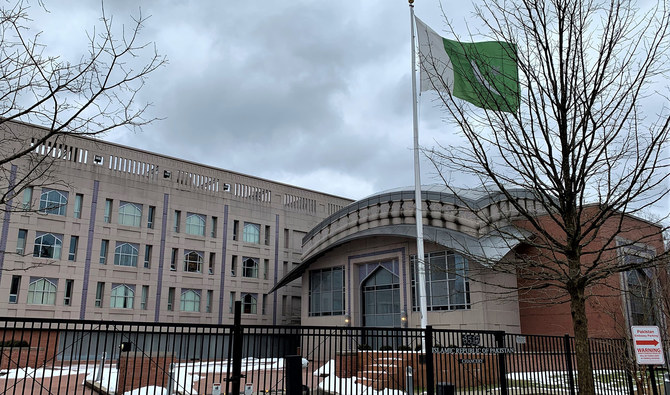
This undated file photo shows Pakistan Embassy in Washington DC, US. (Photo courtesy: social media)
Short Url
Updated 01 February 2022
Follow

Islamabad calls Indian media reports of delay in appointment of US envoy 'baseless'

  • Pakistan nominated Masood Khan its ambassador to US in November 2021
  • The nomination was supposed to be approved in up to eight-week time

ISLAMABAD: Pakistan on Tuesday rejected Indian media reports about a delay in the appointment of its envoy to the United States as "baseless," the Pakistani foreign office said, with Washington-Islamabad ties getting increasingly colder for geo-political reasons. 

The foreign office sent the nomination of Ambassador Masood Khan, who served as the Azad Kashmir president until August 2021, to Washington in November last year. His nomination was supposed to be approved in up to eight-week time, but the US State Department has sought some more time for the clearance. 


Sardar Masood Khan, President of Azad Kashmir, talking to Arab News in Islamabad on Monday, August 12, 2019. (AN photo)

Meanwhile Indian news agency ANI reported that in a letter to Joe Biden, Congressman Scott Perry urged the US president to reject Khan's appointment as it would undermine US interests in the region. 

Islamabad rejected the “scandalous claims” made by Indian media outlets in their reports. 

"This is a part of the wider Indian disinformation campaign to malign Pakistan and those who represent Pakistan, by using fake news to make scandalous claims and baseless allegations," Asim Iftikhar Ahmad, the spokesperson for the Pakistani foreign office, said in a statement. 

"Ambassador Masood Khan is a highly accomplished diplomat with 40 years of experience in both multilateral and bilateral diplomacy. His Agre’ment is being processed in the US system." 

Ambassador Khan has previously served as Pakistan’s permanent representative to the United Nations (UN) and its ambassador to China. He is to replace the outgoing Pakistani envoy in Washington Asad Majeed Khan. 

The development comes amid years of strained relations between Washington and Pakistan since US officials thought they were not getting requisite support from Islamabad to win the war in Afghanistan. 

They have suffered a greater setback after the arrival of President Joe Biden who refused to speak to Pakistan's prime minister, even as his administration continued to seek Islamabad's support in Afghanistan. 

Washington does not have the same amount of interest in Pakistan after the pullout of foreign forces from Afghanistan in August 2021. It is also critical of Islamabad's close ties with China, although Pakistan has said that it does not want to become a part of any bloc. 


World Bank approves $700 million for Pakistan’s economic stability

Updated 20 December 2025
Follow

World Bank approves $700 million for Pakistan’s economic stability

  • Of this, $600 million will go for federal programs and $100 million will ⁠support a provincial program in Sindh
  • The results-based design ensures that resources are only disbursed once program objectives are achieved

ISLAMABAD: The World Bank has approved $700 million in ​financing for Pakistan under a multi-year initiative aimed at supporting the country’s macroeconomic stability and service delivery, the bank said on Friday.

The funds will be released under the bank’s Public ‌Resources for Inclusive ‌Development — Multiphase ‌Programmatic ⁠Approach (PRID-MPA) that ‌could provide up to $1.35 billion in total financing, according to the lender.

Of this amount, $600 million will go for federal programs and $100 million will ⁠support a provincial program in ‌the southern Sindh province. The results-based design ensures that resources are only disbursed once program objectives are achieved.

“Pakistan’s path to inclusive, sustainable growth requires mobilizing more domestic resources and ensuring they are used efficiently and transparently to deliver results for people,” World Bank country director Bolormaa Amgaabazar said in a statement.

“Through this MPA, we are working with the Federal and Sindh governments to deliver tangible impacts— more predictable funding for schools and clinics, fairer tax systems, and stronger data for decision‑making— while safeguarding priority social and climate investments and strengthening public trust.”

The approval ‍follows a $47.9 ‍million World Bank grant ‍in August to improve primary education in Pakistan’s most populous Punjab province.

In November, an IMF-World Bank ​report, uploaded by Pakistan’s finance ministry, said Pakistan’s fragmented ⁠regulation, opaque budgeting and political capture are curbing investment and weakening revenue.

Regional tensions may surface over international financing for Pakistan. In May, Reuters reported that India would oppose World Bank funding for Pakistan, citing a senior government ‌source in New Delhi.

“Strengthening Pakistan’s fiscal foundations is essential to restoring macroeconomic stability, delivering results and strengthening institutions,” said Tobias Akhtar Haque, Lead Country Economist for the World Bank in Pakistan.

“Through the PRID‑MPA, we are launching a coherent nationwide approach to support reforms that expand fiscal space, bolster investments in human capital and climate resilience, and strengthen revenue administration, budget execution, and statistical systems. These reforms will ensure that resources reach the frontline and deliver better outcomes for people across Pakistan with greater efficiency and accountability.”

In Sindh, the program is expected to increase provincial revenues, enhance the speed and transparency of payments, and broaden the use of data to guide provincial decision making. The program will directly support the increase of public resources for inclusive development, including more equitable and responsive financing for primary health care facilities and more funding for schools.