Priest's killing in Pakistan reignites fear in Christian community

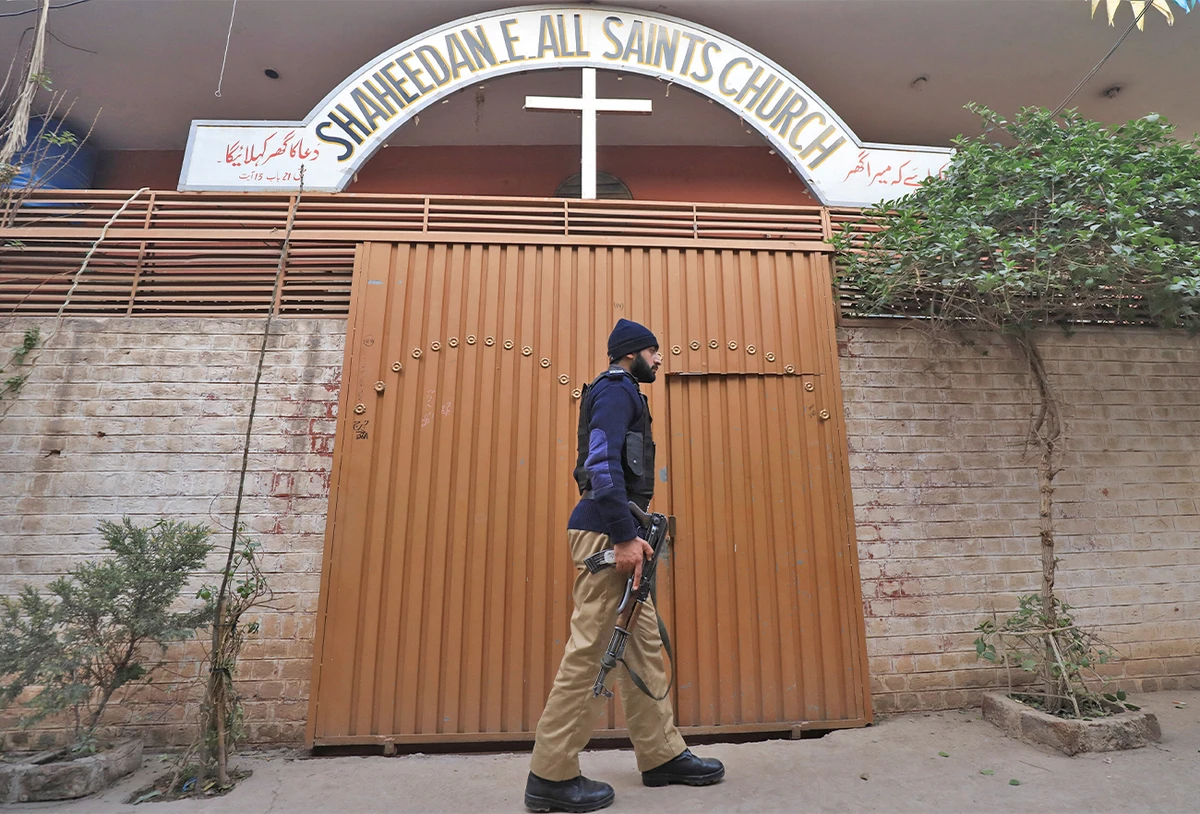
A police officer walks in front of the main entrance of Shaheedan-e-All Saints Church built in memory of people who were killed in twin bomb blasts in All Saints Church in 2013, in Peshawar, Pakistan January 31, 2022. (REUTERS)
Short Url
Updated 01 February 2022
Follow

Priest's killing in Pakistan reignites fear in Christian community

  • Pastor William Siraj, 75, was killed while on his way home after attending Sunday mass in Peshawar city
  • Pakistan's northwestern areas bordering Afghanistan have seen a rise in militant attacks in recent days

PESHAWAR: The killing of a Christian priest in the city of Peshawar has reignited fear amongst local parishioners and brought back painful memories of one of Pakistan's bloodiest attacks on the community in the same city. 

Gunmen shot and killed Pastor William Siraj and wounded another Christian cleric as they drove home from Sunday service at a small church located on the outskirts of Peshawar. 

"We felt insecure before this. The feeling of insecurity increases when these kinds of incidents take place," Naqqash Bhatti, a relative of Siraj, told Reuters at the funeral service for the slain priest on Monday. 

The service, attended by hundreds of mourners, was held at the British colonial era All Saints Church in Peshawar - the site of a twin suicide bombing that killed scores of worshippers in 2013. 

Following the bombing, a small Christian community set up a smaller discreet church on the outskirts of Peshawar in 2014 - and named it the "Martyrs of the All Saints Church" in memory of the attack. 

Siraj was targeted just after he had attended Sunday mass at the memorial church, which is nestled in a crammed brick-walled lane surrounded by the modest houses of the local Christian community - many of whom shifted there after the 2013 suicide attack. 

The intimate community and the memorial church served as a comfort zone for many who lost friends and family in the suicide attack, and struggled to get on with their lives. 

"We are poor people and work till late night in the city and then return home quite late at night," said Waheed Masih, 36, who lives across from the church, where Siraj was a regular. 

"The killing...has created panic and nobody wants to leave their homes due to fear and terror," he added. 

No one has claimed responsibility for the attack on Siraj yet, but it comes amidst a resurgence of militant attacks in Muslim-majority Pakistan, particularly along the country's western border with Afghanistan. 

Protestant Bishop Humphrey Sarfaraz, who also attended Siraj's funeral service, told Reuters he had requested the region's top police official to arrange more security for the Christian clergy and enhanced patrolling for Sunday services. 

Religious minorities in Pakistan continue to face violence as authorities fail to provide adequate protection or hold perpetrators to account, global rights watchdog Human Rights watch said in a report released this month.
EU, Pakistan sign €60 million loan agreement for clean drinking water in Karachi

Updated 17 December 2025
Follow

EU, Pakistan sign €60 million loan agreement for clean drinking water in Karachi

  • Project will finance rehabilitation, construction of water treatment facilities in Karachi city, says European Investment Bank
  • As per a report in 2023, 90 percent of water samples collected from various places in city was deemed unfit for drinking

ISLAMABAD: The European Investment Bank (EIB) and Pakistan’s government on Wednesday signed a €60 million loan agreement, the first between the two sides in a decade, to support the delivery of clean drinking water in Karachi, the EU said in a statement. 

The Karachi Water Infrastructure Framework, approved in August this year by the EIB, will finance the rehabilitation and construction of water treatment facilities in Pakistan’s most populous city of Karachi to increase safe water supply and improve water security. 

The agreement was signed between the two sides at the sidelines of the 15th Pak-EU Joint Commission in Brussels, state broadcaster Radio Pakistan reported. 

“Today, the @EIB signed its first loan agreement with Pakistan in a decade: a €60 million loan supporting the delivery of clean drinking water for #Karachi,” the EU said on social media platform X. 

Radio Pakistan said the agreement reflects Pakistan’s commitment to modernize essential urban services and promote climate-resilient infrastructure.

“The declaration demonstrates the continued momentum in Pakistan-EU cooperation and highlights shared priorities in sustainable development, public service delivery, and climate and environmental resilience,” it said. 

Karachi has a chronic clean drinking water problem. As per a Karachi Water and Sewerage Corporation (KWSC) study conducted in 2023, 90 percent of water from samples collected from various places in the city was deemed unsafe for drinking purposes, contaminated with E. coli, coliform bacteria, and other harmful pathogens. 

The problem has forced most residents of the city to get their water through drilled motor-operated wells (known as ‘bores’), even as groundwater in the coastal city tends to be salty and unfit for human consumption.

Other options for residents include either buying unfiltered water from private water tanker operators, who fill up at a network of legal and illegal water hydrants across the city, or buying it from reverse osmosis plants that they visit to fill up bottles or have delivered to their homes.

The EU provides Pakistan about €100 million annually in grants for development and cooperation. This includes efforts to achieve green inclusive growth, increase education and employment skills, promote good governance, human rights, rule of law and ensure sustainable management of natural resources.