MIAMI, US: Negotiators from the US, China and 13 other governments failed to take action to protect threatened squid stocks on the high seas off South America amid a recent surge in activity by China’s distant water fishing fleet.
The South Pacific Regional Fisheries Management Organization, or SPRFMO, is charged with ensuring the conservation and sustainable fishing off the west coast of South America.
At the SPRFMO’s annual meeting that ended Friday, Ecuador and the European Union proposed measures that would require all ships to have observers on board by 2028 and mandate they unload their catches only in ports instead of at sea to giant refrigerated vessels — both considered key tools in limiting illegal, unreported and unregulated fishing.
There were also competing proposals, one of them from China, to limit the amount of squid that could be caught.
However, none of the proposed measures were adopted during the closed-door meeting, thwarting the efforts of environmentalists and some seafood importers in the US and Europe who have been pushing for restrictions of fishing on the high seas that make up about half of the planet.
CALAMASUR, a group made up of squid industry representatives from Mexico, Chile, Peru and Ecuador, attended the four-day virtual meeting as an observer and said it was deeply disappointed by the results, which it said expose the SPRFMO to being seen as “non-cooperative” in the fight against illegal, unreported and unregulated fishing,
“This situation cannot be accepted as an outcome,” the group said in a statement.
Craig Loveridge, the executive secretary of the New Zealand-based SPRFMO, did not respond to a request for comment.
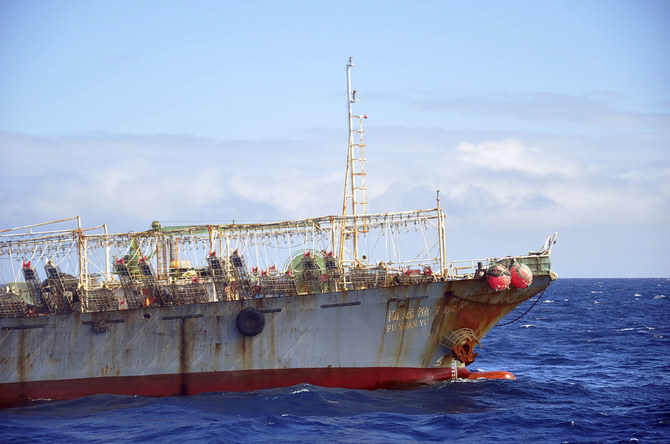
The number of Chinese-flagged vessels in the south Pacific has surged 13-fold from 54 active vessels in 2009 to 707 in 2020, according to the SPRFMO. Meanwhile, the size of China’s squid catch has grown from 70,000 tons in 2009 to 358,000.
Biologists warn that the boom has left the naturally bountiful Humboldt squid — named for the nutrient-rich current found off the west coast of South America — vulnerable to overfishing, as has occurred in Argentina, Mexico, Japan and other places where squid stocks have disappeared in the past.
An investigation by The Associated Press and Spanish-language broadcaster Univision last year revealed how the traditionally lawless area has become a magnet for some of the seafood industry’s worst offenders, many of them Chinese-flagged vessels with a history of labor abuse accusations and convictions for illegal fishing.


![]()

South America squid left exposed amid surge in China fishing
Short Url
https://arab.news/b3sbv
South America squid left exposed amid surge in China fishing
- The number of Chinese-flagged vessels in the south Pacific has surged 13-fold from 54 active vessels in 2009 to 707 in 2020, according to the South Pacific Regional Fisheries Management Organization


Latest updates


© 2026 SAUDI RESEARCH & PUBLISHING COMPANY, All Rights Reserved And subject to Terms of Use Agreement.