

Pakistan issues visa to Indian man separated from brother during partition 

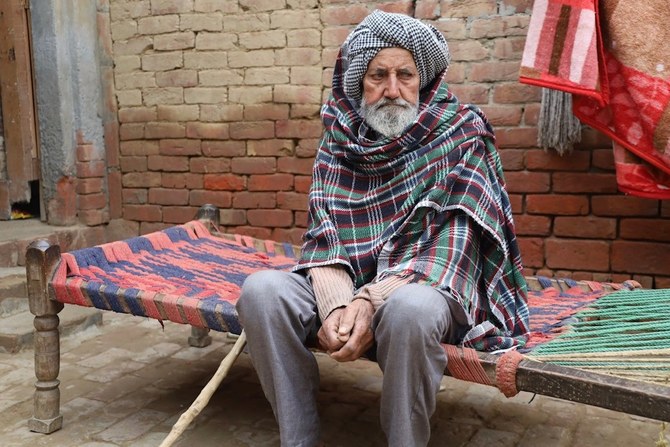
Sikka Khan sits at his home in Phulewala village, Punjab, India on January 16, 2022. (AN photo by Sanjay Kumar)
Short Url
Updated 28 January 2022
Follow

Pakistan issues visa to Indian man separated from brother during partition 

  • In 1947, Pakistan and India’s independence from Britain triggered one of the biggest forced migrations in history 
  • Brothers Sikka Khan and Sadiq Khan, who remained on opposite sides of border, met in Kartarpur, Pakistan last week 

ISLAMABAD: The Pakistani high commission in India on Friday issued visa to an Indian citizen to allow him to meet his family members in Pakistan who had been separated during the 1947 partition of the Subcontinent. 

Sikka Khan, 76, met his 84-year-old brother Sadiq Khan in Kartarpur, Pakistan on January 10. But the brothers’ reunion did not last long, as each of them had to return to their countries. For the past seven decades, India-Pakistan cross-border visits have been limited by tensions and conflict. 

Kartarpur is a border city where Pakistan, in late 2019, opened a visa-free crossing to allow Indian Sikh pilgrims access to one of the holiest sites of their religion, Gurdwara Darbar Sahib, which found itself on the Pakistani side of the border after the partition. 

“Today, Pakistan High Commission issues visa to Sika Khan to visit his brother, Muhammed Siddique and other family members in Pakistan,” the Pakistani high commission said on Twitter. 

“The two brothers, separated in 1947, were recently reunited after 74 years at Kartarpur Sahib Corridor.” 

When British India split into two independent states in August 1947, Sikka’s father and elder brother, Sadiq, left Phulewala village in what became the Indian part of Punjab and returned to their paternal village of Bogran, which found itself in Pakistan. Just two years old at the time, Sikka was too young to go and stayed behind in India with his mother. 

They got in touch in 2019, when Pakistani YouTuber Nasir Dhillon visited Bogran village, where Sadiq still lives, and heard his story. He shared the footage on social media and soon received a message from Jagsir Singh, a doctor in Phulewala, who connected him to Sikka. 

The story of the two brothers is a powerful illustration of how the historic opening of the visa-free Kartarpur corridor is bringing people living on either side of the border close to each other. 

Sikka also met with Pakistan’s Chargé d’Affaires Aftab Hasan Khan and interacted with other officials at the Pakistani high commission in New Delhi on Friday. 

“I am very happy. I have received the visa, will go and meet (my brother). I thank everyone,” he said in a video message while being at the high commission. 

Earlier an emotional video of the siblings’ reunion went viral on social media. “I told you we would meet again,” Sikka, 76, said through tears, as he embraced his 84-year-old brother when they met in Kartarpur, Pakistan. 


Pakistan says defense pact with Saudi Arabia elevated brotherly ties to ‘new heights’

Updated 6 sec ago
Follow

Pakistan says defense pact with Saudi Arabia elevated brotherly ties to ‘new heights’

  • Pakistan, Saudi Arabia signed strategic defense pact last year pledging aggression against one will be treated as attack on both
  • Deputy PM Ishaq Dar says enduring bonds with Islamic and Arab nations form vital pillar of Pakistan’s foreign policy 

ISLAMABAD: Deputy Prime Minister Ishaq Dar said on Wednesday that Pakistan’s defense pact with Saudi Arabia elevated its brotherly ties with the Kingdom to “new heights,” stressing that close ties with Arab and Islamic nations form a key pillar of Islamabad’s foreign policy. 

Pakistan and Saudi Arabia signed a Strategic Mutual Defense Agreement on Sept. 17 last year, pledging that aggression against one country would be treated as an attack on both, enhancing joint deterrence and formalizing decades of military and security cooperation.

Both nations agreed in October 2025 to launch an economic cooperation framework to strengthen trade and investment ties. 

“In the Middle East, our landmark Strategic Mutual Defense Agreement with Saudi Arabia has elevated our brotherly ties to new heights,” Dar said while speaking at the Pakistan Governance Forum 2026 event in Islamabad. 

The Pakistani deputy prime minister was speaking on the topic “Navigating International Relations Amidst Changing Geo-Politics.”

Dar noted that Pakistan has reinforced partnerships with other Middle Eastern nations such as the UAE, Qatar, Jordan, Oman, Egypt and Bahrain. He said these partnerships have yielded “concrete agreements” in investment, agriculture, infrastructure, and energy sectors. 

“Our enduring bonds with Islamic and Arab nations form a vital pillar of our foreign policy, and we will continue to expand our partnerships across Asia, Latin America, and Africa,” he said. 

Dar pointed out that the presidents of Kazakhstan, Uzbekistan and Kyrgyzstan have undertaken visits to Pakistan in recent months, reflecting Central Asian nations’ desire to boost cooperation with Islamabad.

On South Asia, the Pakistani deputy PM said Pakistan has successfully transformed its fraternal ties with Bangladesh into “a substantive partnership.”

“Similarly, the trilateral mechanism involving China, Pakistan, and Bangladesh has been launched with a view to expanding and deepening regional cooperation and synergy,” the Pakistani minister said. 

He said Islamabad has strengthened its “all-weather” partnership with China via the second phase of the multi-billion-dollar China-Pakistan Economic Corridor agreement and “unwavering support” from both sides for each other’s core interests. 

Dar said Pakistan had also reinvigorated its partnership with the US, advancing cooperation in trade, technology, investment, and regional stability. 

“This calibrated approach has enhanced our ability to navigate complexity with skill and confidence, ensuring that our national interests are served without compromising our core foreign policy principles,” he said.