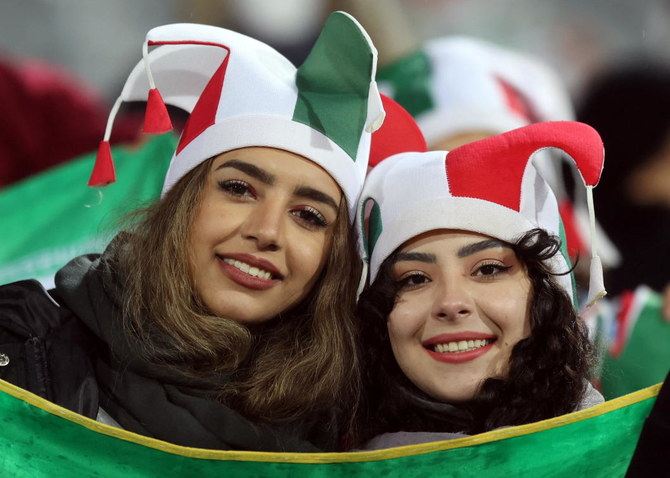
TEHRAN: Iranian women were allowed Thursday for the first time in almost three years to attend a football match of their country’s national team in a Tehran stadium.
“I am very happy. This is the first time I have attended a match at Azadi Stadium,” said a 26-year-old civil engineer who gave her name only as Mahya. She carried the national green, white and red flag, and covered her head with a grey scarf.
The Islamic republic has generally barred female spectators from football and other stadiums for around 40 years. Clerics, who play a major role in decision-making, argue women must be shielded from the masculine atmosphere and sight of semi-clad men.
World football’s governing body FIFA ordered Iran in September 2019 to allow women access to stadiums without restriction and in numbers determined by demand for tickets.
A month later women were able to attend a 2022 World Cup qualifying match between Iran and Cambodia in Azadi Stadium.
For the first match since then, 2,000 of the 10,000 tickets were exclusive to women on Thursday for the 2022 World Cup qualifier between Iran and Iraq, ISNA news agency reported.
“I bought the tickets online and got an SMS confirming it,” Mahya said, adding that “if we win, we will go celebrate the victory in the streets.”
She got her wish, witnessing a 1-0 home side win over Iraq.
“There is nothing strange or complicated” about a woman going to the stadium, said Mahya.
“It should have happened earlier,” she said. “I hope that this will continue.”
The female fans entered through a special entrance via a car park, controlled by policewomen wearing black chador robes and red badges on their arms.
“I wished to have my husband beside me but they said men and women are segregated,” said another female spectator, Golnaz Bahari, 24.
“It will be a lot better if families can come together,” said Bahari, carrying her child in one hand and a vuvuzela horn in the other.
Iran’s female fans sat behind the Iraqi goal.
Wearing thick coats against winter’s chill, some had the national colors painted on their cheeks, and many carried Iranian flags or horns in the national colors.
They sat apart from the men but united with them in supporting their side, with shouts of “Iran! Iran!” drowning out the few fans from Iraq. The two countries were at war for years in the 1980s.
The 2019 FIFA directive, under threat of Iran’s suspension, came after a fan named Sahar Khodayari died after setting herself on fire outside a court in fear of being jailed for trying to attend a match.
Dubbed “Blue Girl” because of the colors of the club she supported — Esteghlal FC — she had reportedly been detained in 2018 when she tried to enter a stadium while dressed as a boy.
Her death sparked an outcry, with many calling for Iran to be banned and matches boycotted.
Since Iran’s Islamic Revolution in 1979, women have borne the brunt of swift changes in the nation’s moral codes.
Women are subject to a strict dress code, and while deemed more liberal than that of many Arab countries, Iranian legislation since the revolution has been criticized as detrimental to women in cases of marriage, divorce and inheritance.
Women may hold high positions, including in parliament and the government, but cannot serve as judges and have not been allowed to run for president.
FIFA had been pushing for years for Iran to open its stadiums to women, but Tehran had until 2019 only allowed a limited number of them to attend matches on rare occasions.
Since October 2019, when women last attended a national match, Covid-19 restrictions put an end to attendance by any fans — until Thursday.


![]()

Women attend Iran-Iraq match in Tehran stadium
Short Url
https://arab.news/r4ajy
Women attend Iran-Iraq match in Tehran stadium
- "I am very happy. This is the first time I have attended a match at Azadi Stadium," said a 26-year-old civil engineer who gave her name only as Mahya
- "I wished to have my husband beside me but they said men and women are segregated," said another female spectator, Golnaz Bahari


Latest updates




© 2026 SAUDI RESEARCH & PUBLISHING COMPANY, All Rights Reserved And subject to Terms of Use Agreement.