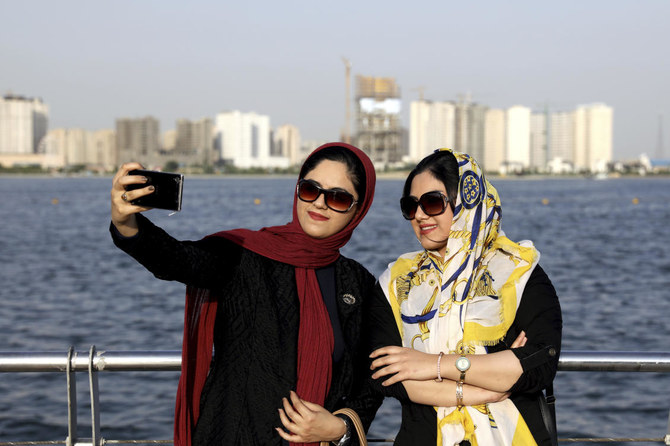
Iranian women take off their hijabs as hard-liners push back

A few daring women in Iran’s capital have been taking off their mandatory headscarves, or hijabs, in public, risking arrest and drawing the ire of hard-liners. (AP)
Updated 15 July 2019
Follow

Iranian women take off their hijabs as hard-liners push back

  • The hijab debate has further polarized Iranians at a time when the country is buckling under unprecedented US sanctions
  • The hijab controversy goes back to the mid-1930s when police forced women to take off their hijabs, part of a Westernization policy

TEHRAN, Iran: The simple act of walking has become a display of defiance for a young Iranian woman who often moves in Tehran’s streets without a compulsory headscarf, or hijab.
With every step, she risks harassment or even arrest by Iran’s morality police whose job it is to enforce the strict dress code imposed after the 1979 Islamic Revolution.
“I have to confess it is really, really scary,” the 30-year-old fire-safety consultant said in a WhatsApp audio message, speaking on condition of anonymity for fear of repercussions.
But she is also hopeful, saying she believes the authorities find it increasingly difficult to suppress protests as more women join in. “They are running after us, but cannot catch us,” she said. “This is why we believe change is going to be made.”
The hijab debate has further polarized Iranians at a time when the country is buckling under unprecedented US sanctions imposed since the Trump administration pulled out of a 2015 nuclear deal between Iran and world powers last year. It’s unclear to what extent the government can enforce hijab compliance amid an economic malaise, including a currency collapse and rising housing prices.
There’s anecdotal evidence that more women are pushing back against the dress code, trying to redefine red lines as they test the response of the ruling Shiite Muslim clergy and their security agencies.
An Associated Press reporter spotted about two dozen women in the streets without a hijab over the course of nine days, mainly in well-to-do areas of Tehran — a mall, a lakeside park, a hotel lobby.
Many other women, while stopping short of outright defiance, opted for loosely draped colorful scarves that show as much hair as they cover. Even in Tehran’s Grand Bazaar, frequented by many traditional women, most female shoppers wore these casual hijabs. Still, a sizeable minority of women was covered head-to-toe in black robes and tightly pulled headscarves, the so-called chador.
The struggle against compulsory headscarves first made headlines in December 2017 when a woman climbed atop a utility box in Tehran’s Revolution Street, waving her hijab on a stick. More than three dozen protesters have been detained since, including nine who are currently in detention, said Masih Alinejad, an Iranian activist who now lives in New York.
Despite attempts to silence protesters, public debate has intensified, amplified by social media.
Last month, a widely watched online video showed a security agent grab an unveiled teenage girl and violently push her into the back of a police car, prompting widespread criticism.
President Hassan Rouhani and Iran’s supreme leader, Ayatollah Ali Khamenei, have supported a softer attitude toward women who don’t comply with the official dress code. However, hard-liners opposed to such easing have become more influential as the nuclear deal is faltering.
They have called for harsh punishment, even lashes, arguing that allowing women to show their hair leads to moral decay and the disintegration of families. The judiciary recently urged Iranians to inform on women without hijabs by sending photos and videos to designated social media accounts.
“The more women dress in an openly sexual way, the less we’ll have social peace, while facing a higher crime rate,” Minoo Aslani, head of the women’s branch of the paramilitary Basij group, told a rally last week.
Another gathering was attended by several thousand women in chadors. One held up a sign reading, “The voluntary hijab is a plot by the enemy.”
Reformist lawmaker Parvaneh Salahshouri said coercion does not work. “What we see is that the morality police have been a failure,” said Salahshouri, who wears a headscarf out of religious belief.
Changing hijab rules through legislation is unlikely because of the constraints on parliament, she said.
Instead, women should engage in non-violent civil disobedience, Salahshouri said. She cautioned that it’s a slow, difficult road, but that “Iranian women have not given up their efforts.”
The hijab controversy goes back to the mid-1930s when police forced women to take off their hijabs, part of a Westernization policy by then-Shah Reza Pahlavi. Under his son and successor, women could choose. Western apparel was common among the elite.
A 2018 survey by a parliament research center indicates that most women wear a casual hijab and only 13% opt for a chador.
Attitudes have changed. In 1980, two-thirds believed women should wear hijabs. Today, fewer than 45% approve of government intervention in the issue, the research said.
Iran has seen waves of anti-government protests, including an outcry after a 2009 election many contended was stolen by hard-liners. Those with economic grievances frequently protest.
Alinejad, the activist, argued the campaign against forced hijabs carries symbolic weight, saying that mandatory headscarves were “the symbol that the Iranian government used to take the whole society hostage.”
In recent years, she has posted videos and photos of activists, including of women filming themselves as they walk in the streets without a headscarf. Alinejad said she receives more than 20 images a day, but posts only some.
The activists in Iran take risks.
In March, human rights lawyer Nasrin Sotoudeh, who has represented female protesters, was sentenced to 38.5 years in prison, of which she must serve 12, according to her husband.
In April, activists Yasaman Aryani, her mother Monireh Arabshahi and Mojgan Keshavarz were arrested after posting a video showing them without headscarves in the Tehran metro. In the video, they distributed flowers to female passengers and spoke of a day when women have the freedom to choose.
Others have pushed boundaries more gradually.
The 30-year-old fire-safety consultant said she tries to avoid policemen when she walks the streets without a hijab. She said she grudgingly complies with the dress code when she delivers lectures or sings in a mixed choir — activities she would otherwise be barred from.
At the high-end Palladium Mall in northern Tehran, several shoppers casually ignored a sign reminding customers that the hijab is mandatory. One woman only pulled up her scarf, which was draped around her shoulders, when she stepped into an elevator and found herself next to a security guard.
Nearby, 20-year-old Paniz Masoumi sat on the stone steps of a plaza. She had dyed some of her hair blue, but kept that funky patch hidden under a loose scarf.
She said police recently impounded her car for two weeks, fining her amid claims that a traffic camera snapped her with a below-standard hijab.
If hijabs were voluntary, she’d throw off hers, Masoumi said. But for now, “I am not looking for trouble.”


Analysis: The risks of carving up Yemen

Updated 5 sec ago
Follow

Analysis: The risks of carving up Yemen

  • Yemen’s government and regional powers warn unilateral moves in the south could push country toward breaking point
  • Analysts say the STC’s rapid expansion risks provoking rival Yemeni factions, deepening instability

RIYADH: Concern is mounting that Yemen is sliding toward a de-facto partition, with rival authorities consolidating control over separate regions.

In the south, the Southern Transitional Council has expanded its footprint, while Iran-backed Houthi forces remain firmly entrenched in the north.

Those fears have intensified in recent weeks, driven by the STC’s latest military operation and the widening Red Sea conflict. Together, they raise a central question: Will Yemen’s decade-long war end in reconciliation, or fracture into competing statelets?

On Dec. 23, Rashad Al-Alimi, head of the Presidential Leadership Council, the executive body of Yemen’s internationally recognized government, warned that unilateral actions by the STC were pushing the country toward a dangerous tipping point.

Rashad Mohammed Al-Alimi, president of the Presidential Leadership Council of Yemen, speaks during the United Nations General Assembly at UN headquarters on September 25, 2025 in New York City. (AFP)

Speaking to Yemeni diplomats, Al-Alimi said the group’s actions threatened internal stability and undermined the security of neighboring states, according to the state-run SABA news agency.

“These actions reached a dangerous stage this week,” he said at the time, citing pressure on state institutions to endorse the division of the country and adopt political positions beyond their authority.

Such steps, he added, jeopardize the unity of decision-making and the state’s legal standing.

Al-Alimi stressed that “under no circumstances can partnership in governance turn into rebellion against the state or an attempt to impose reality by force.”

The STC has expanded control in Hadramout and Al-Mahra, moves widely seen as advancing its longstanding push for autonomy. (AFP file photo)

He also warned that the STC’s moves could complicate regional security commitments and international efforts to protect maritime corridors, energy supplies and commercial shipping in the Arabian Sea, the Red Sea and the Gulf of Aden.

Saudi Arabia echoed those concerns. On Dec. 25, the Kingdom said recent STC military movements were carried out unilaterally, resulting in an “unjustified escalation” that harmed the interests of Yemenis, the Southern cause and the coalition’s efforts.

In a statement carried by the Saudi Press Agency, the foreign ministry said Riyadh has consistently prioritized Yemen’s unity and spared no effort to pursue peaceful solutions in the affected governorates, Hadramout and Al-Mahra.

Within that framework, the statement said, Saudi Arabia worked with the UAE, Al-Alimi and the Yemeni government to contain the situation.

A joint Saudi-Emirati military team was dispatched to Aden to arrange the return of STC forces to their previous positions outside the two governorates and to hand over camps to the Nation Shield Forces and local authorities under coalition supervision.

Saudi Defense Minister Prince Khalid bin Salman said on Saturday that in response to the request of Yemen’s legitimate government, the Kingdom has “brought together brotherly countries to participate in a coalition supporting legitimacy” to restore “the Yemeni state’s control over all of its territory.”

In a post on X, Prince Khalid urged the STC to respond to Saudi-Emirati mediation efforts and withdraw from the two southern governorates and “hand them over peacefully to the forces of the National Shield and local authorities.”

“The southern issue will remain present in any comprehensive political settlement and must be resolved through consensus, honouring commitments and building trust among all Yemenis, not through adventurism that serves only the enemy of all,” he added.

For his part, UN chief Antonio Guterres said that a resumption of fighting in Yemen could reverberate across the Red Sea, the Gulf of Aden, and the Horn of Africa.

“Unilateral actions will not clear a path to peace,” he said on Dec. 17. “They deepen divisions, harden positions, and raise the risk of wider escalation and further fragmentation.”

Until recently, Yemen’s battle lines had largely stayed frozen. Major frontlines had been stable since a nationwide ceasefire in 2022. Although the truce formally expired after six months, large-scale fighting did not resume.

But that balance shifted on Dec. 2, when the STC launched a military offensive in the south and clashed with Yemeni government units and tribal-aligned forces.

Within days, the group seized control of two non-Houthi governorates that together account for nearly half of Yemen’s territory — Wadi Hadramout and Al-Mahra.

Hadramout borders Saudi Arabia and holds an estimated 80 percent of Yemen’s oil reserves, while Al-Mahra borders Oman. Both regions had largely escaped direct clashes between government forces and the Houthis for more than a decade.

The offensive was a turning point. By extending its authority over most of the territory that once formed South Yemen — an independent state until unification in 1990 — the STC, despite being part of the internationally recognized government, appeared to move closer to its longstanding goal of independence.

The latest development has deepened concerns in the region that Yemen’s conflict is hardening into a divided reality that may be difficult to reverse.

“With every crisis, calls for secession between southern and northern Yemen resurface,” a seasoned analyst of Middle East politics told Arab News. “The current phase is decisive, as the STC is taking concrete steps to prepare for the separation of the south.”

In response, the analyst said, the PLC has warned against the creation of a parallel authority and the division of the country.

That position, he added, has found open support among politicians and officials affiliated with the STC, particularly in Hadramout and Al-Mahra, who have aligned themselves behind STC President Aidarous Al-Zubaidi, who also serves as a vice president of the PLC.

The analyst noted that some observers see parallels with the Houthis’ consolidation of power in northern Yemen, arguing that the STC’s approach risks repeating the same model of domination.

“This requires a political proposal that reassures the rest of Yemenis, as well as the most important neighbor, Saudi Arabia,” the analyst said, noting that Yemen’s fate has historically not been determined without Riyadh’s involvement.

Some Yemeni media outlets have reported that the STC’s secessionist moves were coordinated with the Houthis under an alleged arrangement that would leave the south to the STC and the north, including Sanaa, to the Iran-aligned group.

“While such claims remain unverified, analysts broadly agree that Yemen is heading toward deeper division — a prospect widely feared across the country,” the analyst said.

Rather than signaling an end to the conflict, he added, partition could lead to renewed flare-ups and the emergence of new actors, “particularly given that STC-controlled areas such as Hadramout and Al-Mahra are oil-rich regions holding the bulk of Yemen’s natural resources,” which is “likely to intensify competition rather than stabilize the country.”

In a widely discussed recent column, Abdulrahman Al-Rashed, former general manager of Al Arabiya and former editor-in-chief of Asharq Al-Awsat, used the term “geographic determinism” to describe what he said continues to shape Yemen’s trajectory.

“Forces in the south, and likewise in the north, cannot succeed in their political projects without the major northern neighbor — even if they succeed temporarily,” he said. “This has been true since the 1960s and remains so today.”

Even the Houthis, he argued, operate within structural limits despite Iranian backing. “They are an Iranian proxy with an ideological project, not a national Yemeni component,” Al-Rashed wrote, adding that the militia has begun to realize that its reliance on Tehran could threaten its survival.

Strategically, he added, geography and demography favor long-term regional influence. More than two million Yemenis live in Saudi Arabia — a vital economic and social lifeline that will shape Yemen’s future for decades.

The STC’s rise, he warned, threatens not only to divide Yemen, but also to fragment the south itself, which has experienced multiple state entities over the past century.

“Its rapid, unilateral expansion, particularly into Hadrami areas, risks provoking rival southern forces and deepening instability, mirroring the dynamics that empowered the Houthis,” Al-Rashed said.

Al-Rashed said the STC’s vision of restoring an independent southern state can succeed only under two conditions: broad Yemeni acceptance through an inclusive political project; and Saudi support.

“Without that,” he wrote, “the Transitional Council will not go far or last long and may ultimately undermine the very idea of southern unity that depends on its relationship with Riyadh.”

Yemen has endured decades of civil war. The Houthis control much of the populous northwest, including the capital, Sanaa.

The conflict has killed thousands and triggered one of the world’s gravest humanitarian crises, according to the UN, leaving an estimated 21 million people, nearly half the population, dependent on aid and more than 4.5 million displaced.

Amid the political turmoil, the Houthis and the Yemeni government reached an agreement on Dec. 23 to conduct a large-scale prisoner exchange, a rare humanitarian step aimed at de-escalation.

Abdulqader Hasan Yahya Al-Murtadha, head of the Houthi National Committee for Prisoners’ Affairs, said the deal included the release of 1,700 Houthi detainees in exchange for 1,200 prisoners held by the other side.

Saudi Arabia and the European Union welcomed the prisoner exchange deal reached in Muscat, Oman, and hailed the role of the UN special envoy for Yemen and the International Committee of the Red Cross.

While the Houthi war with the Yemeni government and rival factions has largely stalled, it has drawn renewed international attention since October 2023, when the militia escalated attacks on Israel and commercial shipping in the Red Sea in response to the war in Gaza.

In response, the US and Israel carried out strikes in Sanaa, reportedly killing dozens of civilians and political figures as they sought to curb Houthi attacks. This added yet another layer of volatility to an already fractured country.