

FSO Safer tanker disaster could leave Suez Canal unpassable: Greenpeace

1 / 2
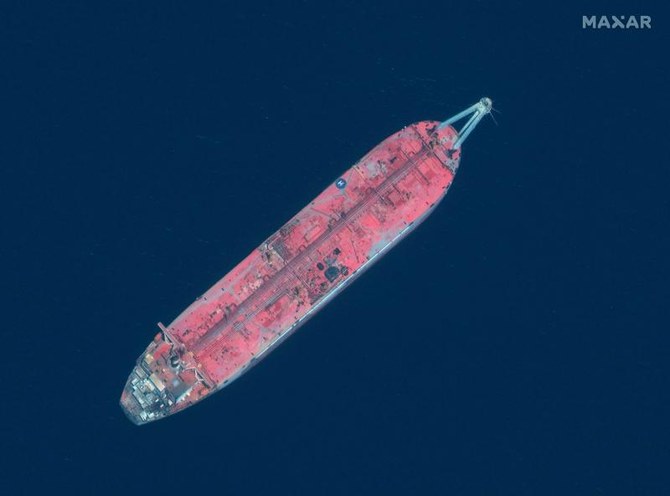
A satellite picture shows the FSO Safer tanker moored off Ras Issa port, in Yemen. (AFP)
2 / 2
The FSO Safer threatens to devastate the surrounding area in the event of a spill or explosion. (AFP)
Short Url
Updated 27 January 2022
Follow

FSO Safer tanker disaster could leave Suez Canal unpassable: Greenpeace

  • It would also have ‘catastrophic’ environmental, humanitarian consequences for millions
  • Iran-backed Houthi militia has repeatedly refused UN pleas for access to secure tanker

LONDON: Environmental activist group Greenpeace has warned of “catastrophic” humanitarian and environmental consequences if the FSO Safer tanker, currently under the control of the Iran-backed Houthi militia off the Yemeni coast, is not drained of its oil.

An oil spill or explosion from the tanker could also block the Suez Canal, costing the world nearly $10 billion per day, Greenpeace said at a press conference attended by Arab News on Thursday.

The tanker was abandoned in the Red Sea off the Yemeni coast in 2017. It holds 1.1 million barrels of oil, or around 140,000 tons, which Greenpeace said could spill into the sea “at any moment” or spread as a result of an explosion on board.

The vessel’s firefighting system is also inoperative, meaning a fire on the ship could spread vast quantities of pollution into the air if the crude ignites.

Paul Horsman, who leads Greenpeace International’s Safer Response Team, said: “Unless action is taken to make the tanker secure, there’s a real danger of a major oil spill, or possibly worse, an explosion.”

Either outcome would be “severe and long-lasting. In a worst-case scenario, the oil could drift to neighboring countries, to Djibouti, to Eritrea and Saudi Arabia,” he added.

“It could potentially disrupt shipping routes in the Suez Canal, it could impact any future tourism. If the Suez Canal is unable to function because ships can’t get out of the Red Sea, we all remember what happened when the Ever Given was blocked there — it was estimated that trade through the Suez Canal lost about $9 billion per day during that time.”

The Houthis have repeatedly refused international access to secure the FSO Safer despite multiple pleas by the UN.

According to a report released on Thursday by Greenpeace on the risks posed by the tanker, a spill would have a devastating humanitarian impact on millions of Yemenis. Perhaps most notably, access to clean water would be drastically curtailed.

“The desalination plants on Yemen’s coast at Hudaydah, Salif and Aden could be affected and that, combined with disrupted fuel supply, could disrupt the drinking water supply for up to 10 million people,” said the report.

“Yemeni fisheries (as well as those of neighboring countries) could be completely closed by an oil spill. These fisheries support 1.7 million people and closures would be necessary to ensure that no contaminated commercial fish enter the human food chain … the most serious risks are to the livelihoods of the fishing communities.”

Yemen, the poorest country in the Middle East, is already facing a humanitarian crisis following years of conflict sparked by the Houthis seizing the capital from the internationally recognized government.

While a spill or explosion appears imminent, Greenpeace stressed that action could be taken immediately to avert a disaster.

Horsman said a barrier could immediately be placed around the ship that would mitigate some of the immediate harm caused by the imminent spill.

He added that the technology exists to transfer the oil on board — still technically owned by the internationally recognized government — into another vessel. The problem, he said, is a “lack of political will” to solve the issue.


Spain highlights importance of Gaza reconstruction

Palestinian prime minister, Mohammed Mustafa, and the Spanish foreign minister, Jose Manuel Albares. (AP)
Updated 02 January 2026
Follow

Spain highlights importance of Gaza reconstruction

  • Spain officially recognized Palestine as a state in May 2024, in a coordinated move alongside Ireland and Norway

RAMALLAH: The Palestinian prime minister, Mohammed Mustafa, and the Spanish foreign minister, Jose Manuel Albares, on Friday discussed the latest developments in the West Bank and Gaza Strip.
During their telephone conversation they emphasized the need to intensify international efforts to end the Israeli occupation and halt attacks and settler violence, and to secure the release of Palestinian funds held by Israeli authorities.
They affirmed the importance of ongoing efforts relating to plans for the reconstruction of Gaza, and Europe’s significant role in this process. Mustafa and Albares highlighted the need to unify Palestinian institutions in Gaza with those in the West Bank, with the aim of establishing a Palestinian state in line with international resolutions, including last year’s New York Declaration.
They also discussed coordination between their countries, and the strengthening of Spain’s political, diplomatic and financial support for Palestine, and Mustafa thanked Spain for its ongoing support.
Spain officially recognized Palestine as a state in May 2024, in a coordinated move alongside Ireland and Norway. Estephan Salameh, the Palestinian finance and planning minister, is set to visit Spain this month to discuss enhanced cooperation, particularly in the areas of development and reconstruction. Meanwhile, Israel continues operating in the occupied West Bank.
The Palestinian Prisoners media office said on Friday that Israel carried out numerous raids across the territory, including the major cities of Ramallah and Hebron, according to The Associated Press.
Nearly 50 people were detained, following the arrest of at least 50 other Palestinians on Thursday, most of those in the Ramallah area.
As 2026 begins, the shaky 12-week-old ceasefire between Israel and Hamas has largely ended large-scale Israeli bombardment of Gaza. 
But Palestinians are still being killed by Israeli fire, especially along the so-called Yellow Line that delineates areas under Israeli control, and the humanitarian crisis is compounded by frequent winter rains and colder temperatures.
On Friday, American actor and film producer Angelina Jolie visited the Rafah border crossing between Egypt and the Gaza Strip. 
The only crossing between the territory and a country other than Israel, it remains closed despite Palestinian requests to reopen it to people and aid.
Jolie met with members of the Red Crescent on the Egyptian side of the Rafah border crossing and then visited a hospital in the nearby city of Arish to speak with Palestinian patients on Friday, according to Egyptian officials.
Aid groups say not enough shelter materials are getting into Gaza during the truce.