

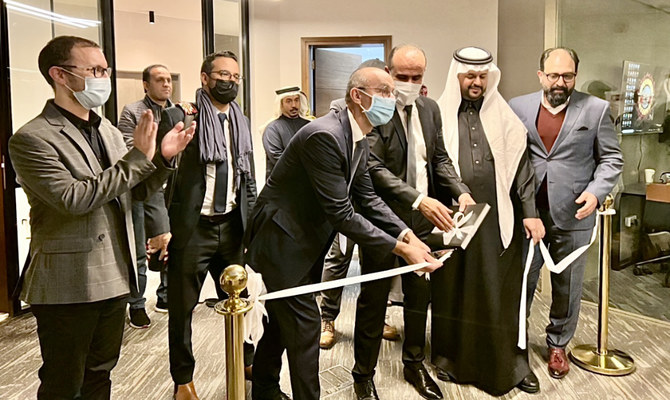
French construction design firm Clestra Hauserman opens regional HQ in Riyadh

1 / 2
Laurent Estrade, head of the economic department at the French embassy of KSA, alongside Farid Habbas, ME director of Clestra Hauserman, cut the ceremonial ribbon on the opening of the firm's regional headquarters in Riyadh. (AN photo/Zaid Khashogji)
2 / 2
Clestra Hauserman opens their regional headquarters in Riyadh on Tuesday, Jan. 25, 2022. (AN photo/Zaid Khashogji)
Short Url
Updated 27 January 2022
Follow

French construction design firm Clestra Hauserman opens regional HQ in Riyadh

  • Today, the Clestra Hauserman Group has offices in Saudi Arabia, the UAE, Qatar, Kuwait and Oman

RIYADH: A French construction and design firm opened its regional headquarters in Riyadh on Tuesday, in a 50-50 partnership deal with Saudi holding company, Zuhair Al-Habib Group.

Known internationally for their eco-friendly partitions, Clestra Hauserman’s decision to open a regional office in the capital city comes one year after Crown Prince Mohammed bin Salman announced the Riyadh Strategy 2030 plan. 

“Saudi Arabia is our biggest market and as of this year I can say that 80 percent of our business comes from here,” said Farid Habbas, Middle East Director of Clestra Hauserman.

“It was a natural move for the firm that we were happy and ready for. Our firm will now have direct access to the local economy, which will help us gain financial and geographic opportunities,” he told Arab News.

Clestra Hauserman, which had been based in Dubai, joins more than 40 multinational companies that are moving to Riyadh.

The plan includes a policy stating that government and state-backed institutions will no longer sign any contracts with foreign entities from 2024 unless their regional headquarters are based in the Kingdom.

The policy, which paved way for a regional headquarters attraction program, aims to help make “Riyadh one of the ten largest city economies” in the world.

Founded in 1913, the French firm has had a regional presence for more than 40 years, specializing in the manufacture and installation of prefabricated demountable partitions. Its first project in Saudi Arabia was with Aramco in the 1970s and the firm extended its regional presence via the undertaking of airport projects and numerous educational buildings and corporate offices all over the Gulf area.

Today, the Clestra Hauserman Group has offices in Saudi Arabia, the UAE, Qatar, Kuwait and Oman.

“At Clestra, we develop and design our products from scratch, then completely fit out empty buildings from zero to completion,” Habbas told Arab News. “Our work extends to maintenance and after-sales services for all our clients, where we can be on-site for any adjustments needed within 24 hours.”

Habbas said what makes their products special is their move-and-removability, and likened it to the moveable block system made by Lego — the size of partitions can easily be adjusted by adding or removing panels.

“We’re not just selling a product, we’re selling a solution. We believe that Saudi Arabia is in need of the type of flexibility we can bring with our products and expertise, and not to mention the sustainable aspect of reusing our partitions again and again.”

One of their notable projects is at King Saud University, which has more than 200 kilometers of partitions made by the French firm that have been in use for more than 40 years — which speaks to the durability of the product, the secret of which lies in steel and aluminum.

Habbas added that the firm has plans to open a small factory in the first stage, followed a by a larger one in the second, in addition to carrying out workshops that aims to provide knowledge, expertise and training to employees, a move that should provide many jobs.

Fahad Al-Rasheed, CEO of the Royal Commission for Riyadh City said that by 2030 the regional headquarters program will contribute $18 billion to the local economy and create around 30,000 new jobs.

Since the announcement of the Saudi Vision 2030, as well as plans such as the Riyadh Strategy 2030 and the National Investment Strategy, the metropolis has flourished into a regional hub for businesses, trade and plentiful investment opportunities.


From barrels to bytes: How AI is powering Saudi Arabia’s industrial transformation

Updated 08 January 2026
Follow

From barrels to bytes: How AI is powering Saudi Arabia’s industrial transformation

  • Inside the Kingdom’s drive to merge energy expertise with digital intelligence

RIYADH: Artificial intelligence is moving beyond concept to become a cornerstone of Saudi Arabia’s energy sector, reshaping how oil, gas, and power systems are managed and optimized.

Industry giants like Saudi Aramco are embedding smart systems into their operations to boost efficiency, reliability, and sustainability—key pillars in the Kingdom’s efforts to modernize its industrial base and diversify its economy.

According to the International Energy Agency, oil and gas companies were among the first to adopt digital technologies. The agency estimates that applying AI to power plant operations and maintenance could save up to $110 billion annually by 2035 through reduced fuel consumption and maintenance costs.

For Saudi Arabia, this technological momentum offers both a blueprint and an opportunity. Under Vision 2030, integrating data and intelligent automation is transforming how energy is explored, refined, and delivered.

At the heart of Saudi Aramco’s operations is a digital transformation strategy centered on artificial intelligence, big data, and the industrial Internet of Things. These technologies are applied at every stage of production—from mapping reservoirs and optimizing drilling to improving efficiency and safety.

AI also underpins Aramco’s Digital Transformation Program, which develops in-house smart tools and data-driven platforms designed to cut emissions, reduce costs, and enhance performance while ensuring a reliable energy supply.

A prime example is the Upstream Innovation Center, where engineers have implemented AI solutions that reduce fuel gas use in boilers, improve efficiency, and detect potential leaks through fiber-optic monitoring. At the Khurais oil field, more than 40,000 sensors monitor approximately 500 wells via an Advanced Process Control system—the first of its kind for a conventional oil field at Aramco. Digitization at Khurais has increased production by around 15 percent, doubled troubleshooting speed, and lowered both costs and environmental impact.

These advances illustrate how Aramco’s network is evolving into a connected, adaptive model, blending traditional engineering expertise with digital intelligence.

DID YOU KNOW?

• AI could save up to $110 billion a year in global power plant fuel and maintenance costs by 2035.

• Advanced Process Control enables real-time monitoring of hundreds of oil wells in the Kingdom.

• AI-powered simulations now replace weeks of manual analysis, enabling faster operational decisions.

As Saudi Arabia develops an AI-driven energy economy, the King Abdullah University of Science and Technology is bridging the gap between digital innovation and industrial application. 

Bernard Ghanem, chair of the Center of Excellence for Generative AI, said the university is working with Saudi Aramco to develop AI systems that predict the chemical properties of materials and accelerate research into direct air capture technologies for carbon dioxide removal.

He told Arab News that KAUST is partnering with SABIC and ACWA Power to apply AI in process optimization and materials discovery, turning lab-scale research into practical solutions for the energy sector.

Ghanem said KAUST’s generative AI materials program combines a robotic chemistry lab with its AI Chemist foundation model, a system that accelerates the development of catalysts, battery materials, and membranes for clean energy applications.

“This is our lab of the future, automating experimentation and speeding up energy innovation,” he said.

Opinion

This section contains relevant reference points, placed in (Opinion field)

Mani Sarathy, professor of chemical engineering at KAUST, noted that AI-based reinforcement learning tools are already improving efficiency in hydrocarbon refineries by enhancing simulations and shortening analysis cycles.

“AI is helping energy companies run complex simulations that once took weeks, enabling faster and more precise operational decisions,” he told Arab News.

Sarathy added that the next phase will combine automation with expert oversight. Hybrid human-AI control systems, he explained, are likely to become standard in critical operations, balancing digital autonomy with safety and reliability as Saudi industries expand AI deployment.

These efforts highlight KAUST’s growing role in transforming AI from an academic discipline into a driver of industrial innovation in Saudi Arabia’s energy sector under Vision 2030.

Meanwhile, Skeleton Technologies is bringing AI-driven energy storage solutions to Saudi partners, solutions that are already reshaping industrial systems across Europe and beyond. In Europe, the company combines artificial intelligence and advanced materials to reduce energy use and improve efficiency in data centers, electricity grids, and defense systems.

“Our solutions allow AI infrastructure to consume less electricity and reduce grid connection needs, making AI operations more energy efficient,” Arnaud Castaignet, vice president of government affairs and strategic partnerships at Skeleton, told Arab News.

Inside its factories, Skeleton uses AI-driven digital twin models, created with Siemens Digital Industries, to simulate production, optimize operations, and enable predictive maintenance, Castaignet said. At the core of its technology is curved graphene, a proprietary carbon material that gives Skeleton’s supercapacitors exceptional conductivity.

“It allows our supercapacitors to charge and discharge within microseconds, around 12 microseconds, something batteries cannot do,” Castaignet said.

The company’s flagship Graphene GPU system, built on these supercapacitors, cuts energy use in AI data centers by up to 40 percent and reduces grid requirements by 45 percent while boosting computing performance. The devices are free of lithium, nickel, and cobalt, relying instead on graphene derived from silicon carbide—essentially sand—processed entirely in Germany.

“To build sustainable AI infrastructure, you need energy-saving hardware as well as renewable power,” Castaignet added. “Our Graphene GPU shows both can work together.”

As Saudi Arabia continues linking engineering expertise with digital intelligence, its industrial progress is measured not only in barrels of oil but also in bytes, data, and the smart systems shaping its energy future.