GENEVA: FIFA President Gianni Infantino linked his plan for biennial World Cups on Wednesday to giving more hope to Africans who risk their lives crossing the sea to Europe.
In a speech to European lawmakers, Infantino said soccer was being dominated by the few who “have everything” and it needed to be more global and inclusive.
“We need to find ways to include the entire world, to give hope to Africans so that they don’t need to cross the Mediterranean in order to find, maybe, a better life but more probably death in the sea,” Infantino told the Parliamentary Assembly of the Council of Europe at Strasbourg, France.
He spoke on the day Spanish authorities said at least 18 people died and more than 300 were rescued from several boats trying to reach the Canary Islands from North Africa.
“We need to give dignity, not by giving charity but by allowing the rest of the world as well to participate,” Infantino told lawmakers at a session he attended with Arsène Wenger, FIFA’s director of global development.
FIFA and Wenger have been strongly resisted across European soccer since launching a formal proposal in September to organize men’s and women’s World Cups every two years instead of four.
Infantino has said organizing more editions of the World Cup will lead to more countries qualifying and fuel interest there. It would also raise billions of dollars for FIFA and increase funding for its 211 member federations to develop soccer.
Though Infantino was a longtime staffer at UEFA before being elected to FIFA in 2016, a constant theme of his presidency has been countering Europe’s dominance of the World Cup — Italy, Spain, Germany and France won the past four tournaments — and its clubs hiring the best players from other continents.
One of Infantino’s first big projects at FIFA was adding 16 nations to the World Cup for a 48-team competition from 2026, when Africa will have nine entries instead of five. Europe will get 16.
“In Europe, there is no need for additional possibilities and events,” Infantino told lawmakers at the 47-nation Council of Europe which promotes human rights, democracy and the rule of law.
Soccer must not effectively tell the world to hand over its money and best players “but watch us on TV,” Infantino said. “We have to make (football) truly global, we have to make it truly inclusive such as the values that have built Europe and we are bringing as well all over the world.”
Infantino acknowledged “maybe the World Cup every two years is not the answer.”
FIFA’s push for biennial World Cups has been uncertain since it stalled ahead of a December online meeting of its members where a vote had once been expected but was not called.
Leaders of UEFA and South American soccer body CONMEBOL have threatened to boycott biennial World Cups. They said more World Cups risk disrupting the balance between national and club team soccer and damaging continental competitions such as the Champions League, European Championship and Copa America.
Star players such as Kylian Mbappé, a 2018 World Cup winner with France, have said doubling the number of World Cups would dilute its prestige and overload them in an already congested fixture schedule.
The International Olympic Committee has also publicly criticized FIFA’s plan which could put the World Cup in direct competition with the Summer Games by 2032.
The IOC also rallied other sports to challenge Infantino in December over soccer’s plan to acquire more space and commercial income in the global schedule.


![]()
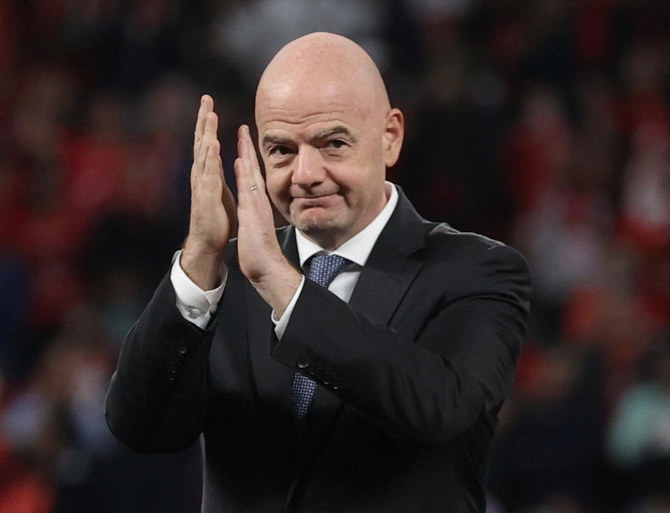
FIFA links more World Cups to averting migrant deaths at sea
Short Url
https://arab.news/p4c7v
FIFA links more World Cups to averting migrant deaths at sea
- In a speech to European lawmakers, Infantino said soccer was being dominated by the few who “have everything” and it needed to be more global and inclusive
- “We need to give dignity, not by giving charity but by allowing the rest of the world as well to participate,” Infantino told lawmakers


Latest updates


Recommended


© 2026 SAUDI RESEARCH & PUBLISHING COMPANY, All Rights Reserved And subject to Terms of Use Agreement.