

Sales tax to increase solar panel rates in Pakistan by 30% — stakeholders

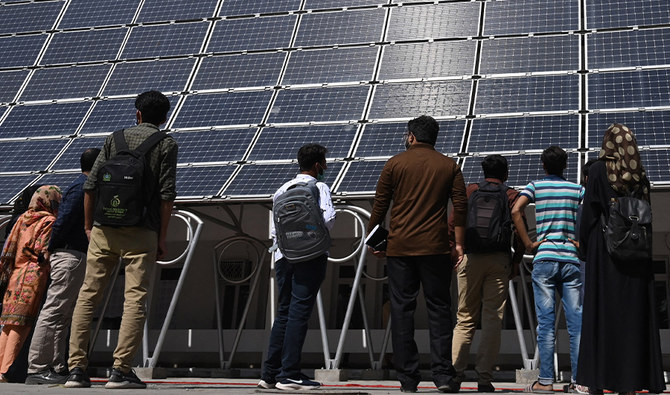
Students look at the facade of a building made with solar panels producing some 148 Kilowatts during its inauguration at the University of Engineering and Technology in Lahore on October 12, 2020. (AFP/FILE)
Short Url
Updated 26 January 2022
Follow

Sales tax to increase solar panel rates in Pakistan by 30% — stakeholders

  • PM Khan wants to reduce carbon emissions by adding 30 percent clean energy to the country’s power mix by 2030
  • Dealers and importers warn the imposition of sales tax can undermine the government’s own renewable energy policy

KARACHI: The imposition of sales tax on the import of solar panels in Pakistan would increase their price by about 30 percent, said dealers and importers on Tuesday, adding it would also make it difficult to add clean power to the country’s energy mix in the coming years.
Pakistan levied sales tax on nearly 150 items, including solar panels, through a supplementary finance bill that was approved by the National Assembly earlier this month to meet one of the conditions of the International Monetary Fund (IMF) for the revival of a stalled $6 billion loan program.
“After the implementation of this tax, the price of solar panels will increase from Rs55 per watt to Rs70 per watt. This is almost a 30 percent surge,” Naveed Karar, vice chairman of the Pakistan Solar Association (PSA), said while addressing a joint news conference with the Karachi Electronic Dealers Association (KEDA).
“If the government will not take this decision back, its impact will be devastating for solarization and industry,” he added.
Pakistan is pursuing Prime Minister Imran Khan’s policy to reduce carbon emissions and decrease its reliance on imported fossil fuel, as it hopes to add 30 percent clean energy to its power mix by the end of this decade.
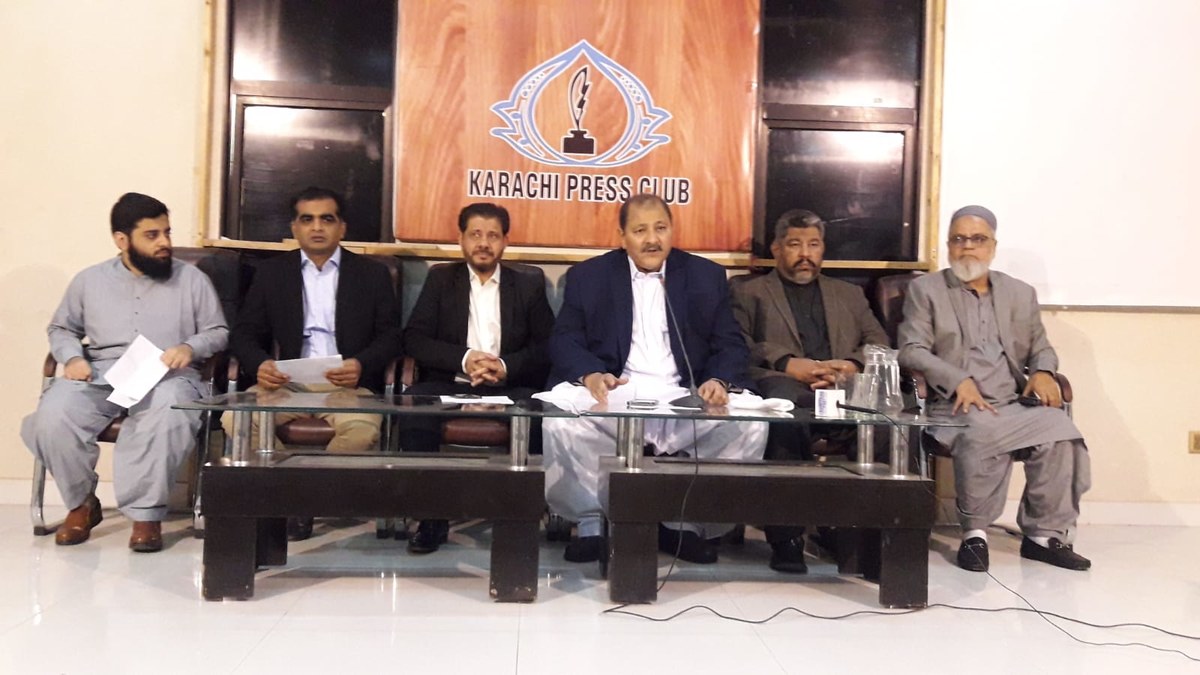


Saleem Memon, senior vice president of the Karachi Electronic Dealers Association, can be seen with the officials and representatives of the Pakistan Solar Association at a news conference in Karachi, Pakistan, on January 25, 2022. (AN Photo)

Dealers said the recent move to tax solar panels would undermine that vision.
“The imposition of sales tax on the import of solar panels will definitely discourage the government’s efforts to increase the share of renewable energy to the total power mix,” Karar said, adding the decision had been taken despite assurances from the finance minister that the product would not be taxed.
Saleem Memon, senior vice president of KEDA, said sales tax would increase the rate by about Rs12,000 per panel of 540 watts.
“This will be beyond the purchasing power of people who live in the country’s remote areas and frequently rely on this technology,” he added.
Memon said the sales tax would be over and above the freight costs and other charges which were already too high.
“Freight charges have been increased from $800 per container to $6,000,” he said, adding: “The allied products of solar panels, including inverters and batteries, have also been taxed.”
Muhammad Zakir Ali, member of the PSA executive committee, informed that 80 percent solar panels were used by people who did not have direct access to electricity in Pakistan.
He informed that people had imported about 2,380 megawatts of solar panels in 2021 and were planning to increase the quantum further.
“The decision will discourage the use of solar power system in the country since there is no local production of these panels,” Ali said, adding: “The government should have taken the stakeholders into confidence before taking this decision.”
The installation of a solar system is a one-time investment which provides continuous power supply for more than 25 years without additional costs when compared to other power plants that need costly fuels, he added.


Islamic military coalition, Pakistan to deepen cooperation to combat ‘terrorism’ — Pakistani military

Updated 02 February 2026
Follow

Islamic military coalition, Pakistan to deepen cooperation to combat ‘terrorism’ — Pakistani military

  • Islamic Military Counter Terrorism Coalition is a 43-member alliance that includes Pakistan, Saudi Arabia, Egypt, Jordan, UAE and other nations
  • The Pakistani military statement comes after a meeting between IMCTC secretary-general and the chief of Pakistani defense forces in Rawalpindi

ISLAMABAD: Pakistan and the Islamic Military Counter Terrorism Coalition (IMCTC) have reaffirmed their commitment to deepening cooperation, including intelligence sharing and capacity building, to jointly combat “terrorism” and “extremism,” the Pakistani military said on Monday.

The IMCTC is a 43-member military alliance that was formed on Saudi Arabia’s initiative in Dec. 2015 to consolidate Muslim countries’ efforts in countering “terrorism.”

A 17-member IMCTC delegation is visiting Pakistan from Feb. 2-6 to conduct a training at National University of Sciences and Technology on “Re-integration and Rehabilitation of Extremist Elements,” according to the Pakistani military.

On Monday, IMCTC Secretary-General Maj. Gen. Mohammed bin Saeed Al-Moghedi held a meeting with Chief of Pakistani Defense Forces Field Marshal Asim Munir to discuss cooperation among IMCTC member states.

“During the meeting, matters of mutual interest were discussed, with particular emphasis on regional security dynamics and enhanced cooperation in counter-terrorism efforts,” the Inter-Services Public Relations (ISPR), the Pakistani military’s media wing, said in a statement.

“Both sides reaffirmed their shared commitment to combating terrorism and extremism through collaborative strategies, intelligence sharing, and capacity building among member states.”

The IMCTC features Pakistan, Saudi Arabia, Türkiye, Afghanistan, Egypt, Jordan, Qatar, Palestine, UAE, Bangladesh and other nations. In 2017, Pakistan’s former army chief Gen. (retd) Raheel Sharif was appointed as the IMCTC commander-in-chief.

During discussions with Major General Al-Moghedi, Field Marshal Munir appreciated the role of IMCTC in fostering stability and promoting coordinated counterterrorism initiatives across the Islamic world, according to the ISPR.

The IMCTC secretary-general acknowledged Pakistan’s significant contributions and sacrifices in the fight against militancy and lauded the professionalism of Pakistan’s armed forces.

“The meeting underscored the resolve of both sides to further strengthen institutional collaboration for peace, stability, and security in the region,” the ISPR added.

Pakistan enjoys cordial ties with most Muslim countries around the world, particularly Gulf Cooperation Council countries. In Sept. 2025, Pakistan signed a landmark defense pact with Saudi Arabia according to which an act of aggression against one country will be treated as an act of aggression against both.