

Bahrain’s king condemns Houthi attack on UAE during Abu Dhabi visit

1 / 4
Abu Dhabi Crown Prince Sheikh Mohammed bin Zayed receives Bahrain’s King Hamad. (BNA)
2 / 4
Abu Dhabi Crown Prince Sheikh Mohammed bin Zayed receives Bahrain’s King Hamad. (BNA)
3 / 4
Abu Dhabi Crown Prince Sheikh Mohammed bin Zayed receives Bahrain’s King Hamad. (BNA)
4 / 4
Abu Dhabi Crown Prince Sheikh Mohammed bin Zayed receives Bahrain’s King Hamad. (BNA)
Short Url
Updated 25 January 2022
Follow

Bahrain’s king condemns Houthi attack on UAE during Abu Dhabi visit

  • Sheikh Mohammed briefed the king on the details of Monday’s attack

LONDON: Bahrain’s King Hamad arrived in Abu Dhabi on Tuesday to hold talks with Crown Prince Sheikh Mohammed bin Zayed, Bahrain’s new agency reported.

His visit comes a day after the Iran-backed houthi militia in Yemen renewed their attack on Abu Dhabi and two ballistic missiles were intercepted with the help of US forces based in the city, scattering debris.

The two sides held a meeting, where Sheikh Mohammed briefed the king on the details of Monday’s attack and the measures taken by the UAE within the framework of its right to respond.

King Hamad said Bahrain condemned and denounced the terrorist attack, and stands by the UAE against all threats to its sovereignty, security and stability, due to the firm bonds and historical ties that unite the two countries.

He renewed his country’s full support for all the measures taken by the Emirates to confront the Houthi attacks and preserve the safety of its citizens and residents, adding that both countries rely the interdependence of their security and stability and that any attack on the UAE is an attack on Bahrain.

Sheikh Mohammed expressed his thanks and appreciation to Bahrain for its continuous support in various circumstances, wishing the kingdom and its people continued progress, development and prosperity under the king’s leadership.


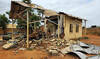
RSF destroying evidence of atrocities in Sudan: report

Updated 6 sec ago
Follow

RSF destroying evidence of atrocities in Sudan: report

  • Humanitarian Research Lab said the group “destroyed and concealed evidence of its widespread mass killings” in the North Darfur state capital
  • In the aftermath of the takeover, it had identified 150 clusters of objects consistent with human remains

PORT SUDAN: Sudan’s paramilitary Rapid Support Forces group has undertaken systematic mass killing and body disposal in the overrun Darfur city of El-Fasher, a new report has found.
Yale University’s Humanitarian Research Lab (HRL), which has used satellite imagery to monitor atrocities since the RSF’s war with the army began, said on Tuesday the group “destroyed and concealed evidence of its widespread mass killings” in the North Darfur state capital.
The RSF’s violent takeover of the army’s last holdout position in the Darfur region in October led to international outrage over reports of summary executions, systematic rape and mass detention.
The HRL said that in the aftermath of the takeover, it had identified 150 clusters of objects consistent with human remains.
Dozens were consistent with reports of execution-style killings, and dozens more with reports of the RSF killing civilians as they fled.
Within a month, nearly 60 of those clusters were no longer visible, while eight earth disturbances appeared near the sites of mass killing, the HRL said.
It said the disturbances were not consistent with civilian burial practices.
“Largescale and systematic mass killing and body disposal has occurred,” the report determined, estimating the death toll in the city to be in the tens of thousands.
Aid groups and the UN have repeatedly demanded safe access to El-Fasher, where communications remain cut and an estimated tens of thousands of survivors are trapped, many detained by the RSF.
There is no confirmed death toll from the Sudan war which began in April 2023, with estimates at more than 150,000.
Sudan’s de facto leader General Abdel Fattah Al-Burhan leads the army while the RSF is headed by his former deputy, Mohamed Hamdan Dagalo.
The fighting has also displaced millions of people, and created the world’s largest hunger and displacement crises.
Efforts to end the war have repeatedly faltered.