‘Horror scenes’ in Syrian refugee camps amid ‘extremely cold winter’: UN official

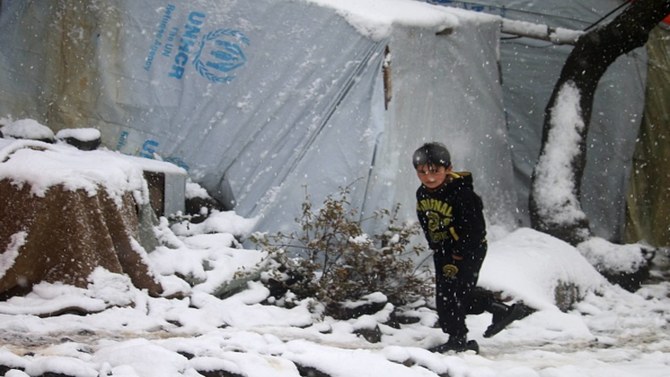
Snowstorms have brought increased suffering to Syrian refugees. (Getty Images)
Short Url
Updated 24 January 2022
Follow

‘Horror scenes’ in Syrian refugee camps amid ‘extremely cold winter’: UN official

  • ‘No one should have to live in these conditions,’ Mark Cutts tells briefing attended by Arab News
  • Nearly 3m people internally displaced in northern Syria, most of them women and children

LONDON: Brutal winter conditions in northern Syria have ushered in mass-scale suffering for 2.8 million internally displaced persons, a top UN humanitarian official warned on Monday.

“We’re extremely concerned about the situation there,” Mark Cutts, the UN’s deputy regional humanitarian coordinator for Syria, said in a briefing attended by Arab News.

The IDPs, he added, are “some of the most vulnerable people in the world,” the majority of them living in temporary camps and tents.

“During this extremely cold weather, we’ve seen some real horror scenes in the last few days — about 1,000 tents have either collapsed completely or been very badly damaged as a result of heavy snow,” said Cutts, adding that temperatures have dropped to as low as -7 degrees centigrade.

About 100,000 people have been affected by the heavy snow, while 150,000 more have been affected by freezing conditions and heavy rain.

“These are people who’ve been through a lot in the past few years. They’ve fled from one place to another. The bombs have followed them. Many of the hospitals and schools in northwest Syria have been destroyed in the 10 years of war,” said Cutts, adding that what he and his team are seeing in camps now is a “real disaster zone.”

He said: “Our humanitarian workers have been pulling people out from under their collapsed tents … They’ve been clearing snow from tents with their bare hands.”

Children, the elderly and the disabled are suffering the most from the conditions, added Cutts, who appealed to the international community to “do more, to recognize the scale of the crisis, to help us get these people out of tents and into safer, more dignified temporary shelter.”

In a final plea, he said: “It’s absolutely unacceptable that you’ve got 1.7 million people living in camps in these appalling conditions — most of them are women and children and elderly people.

“These civilians are stranded in a warzone, and now, on top of that, they’re dealing with temperatures below zero. No one should have to live in these conditions.”



Lebanon PM publishes long-awaited banking law draft

Updated 4 sec ago
Follow

Lebanon PM publishes long-awaited banking law draft

  • The law stipulates that each of the state, the central bank, commercial banks and depositors will share the losses accrued as a result of the financial crisis.
  • Depositors with a limit of $100,000, over the course of four years

BEIRUT: Lebanese Prime Minister Nawaf Salam published on Friday a long-awaited banking draft bill, which distributes losses from the 2019 economic crisis between banks and the state.
The draft law is a key demand from the international community, which has conditioned economic aid to Lebanon on financial reforms.
In a televised speech, Salam said “this draft law constitutes a roadmap to getting out of the crisis” that still grips Lebanon.
The draft will be discussed by the Lebanese cabinet on Monday before being sent to parliament, where it could be blocked.
The law stipulates that each of the state, the central bank, commercial banks and depositors will share the losses accrued as a result of the financial crisis.
Depositors, who lost access to their funds after the crisis, will be able to retrieve their money, with a limit of $100,000, over the course of four years.
Salam said that 85 percent of depositors had less than $100,000 in their accounts.
The wealthiest depositors will see the remainder of their money compensated by asset-backed securities.
“I know that many of you are listening today with hearts full of anger, anger at a state that abandoned you,” Salam said.
“This bill may not be perfect... but it is a realistic and fair step toward restoring rights, halting the collapse.”

- ‘Banks are angry’ -

The International Monetary Fund, which closely monitored the drafting of the bill, had previously insisted on the need to “restore the viability of the banking sector consistent with international standards” and protect small depositors.
The Associations of Banks in Lebanon criticized the draft law on Monday, saying in a statement that it contains “serious shortcomings” and harms commercial banks.
“Banks are angry because the law opens the door to them sharing any part of the losses,” said Sami Zougheib, researcher at The Policy Initiative, a Beirut-based think tank.
He told AFP that banks would have preferred that the state bear full responsibility.
The text provides for the recapitalization of failing banks, while the government’s debt to the Central Bank will be converted into bonds.
Salam said that the bill aims to “revive the banking sector” which had collapsed, giving free rein to a parallel economy based on cash transactions, which facilitate money laundering and illicit trade.
According to government estimates, the losses resulting from the financial crisis amounted to about $70 billion, a figure that is expected to have increased over the six years that the crisis was left unaddressed.
Since assuming power, Salam and President Joseph Aoun have pledged to implement the necessary reforms and legislation.
In April, Lebanon’s parliament adopted a bank restructuring law, as the previous legislation was believed to have allowed a flight of capital at the outbreak of the 2019 crisis.
The new bill stipulates that politically exposed persons and major shareholders who transferred significant capital outside the country from 2019 onwards — while ordinary depositors were deprived of their savings — must return them within three months or face fines.
The draft law could still be blocked by parliament even if the cabinet approves it.
“Many lawmakers are directly exposed as large depositors or bank shareholders, politically allied with bank owners, and unwilling to pass a law that either angers banks or angers depositors,” Zougheib said.
Politicians and banking officials have repeatedly obstructed the reforms required by the international community for Lebanon to receive financial support.