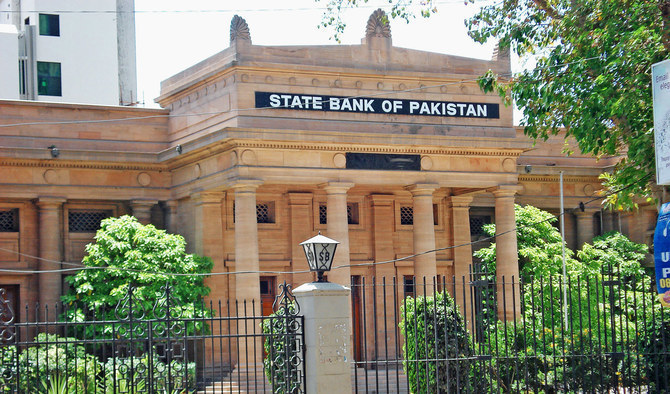

KARACHI: Pakistan’s central bank decided to keep the key policy rate unchanged at 9.75 percent amid improved inflationary outlook, its governor announced on Monday, saying there was no need of further monetary tightening at present.
The State Bank of Pakistan (SBP) had increased policy interest rate by 100 basis points from 8.75 percent to 9.75 percent in December 2021 to counter inflationary pressure amid rising current account deficit.
“At today’s meeting, the Monetary Policy Committee (MPC) decided to maintain the policy rate at 9.75 percent. It is in line with the forward guidance provided in the last monetary policy statement,” SBP governor Reza Baqir said at a press conference in Karachi.
“There is no need for further monetary tightening at present due to fiscal policy measures of the government.”

Dr Reza Baqir, governor of the State Bank of Pakistan (SBP), addresses a press conference in Karachi, Pakistan on January 24, 2022. (AN Photo)
The central bank has taken various measures to lower inflation and keep the ongoing economic recovery sustainable. The measures include a cumulative 275 basis point increase in the policy rate, higher bank cash reserve requirements, regulatory tightening of consumer finance and curtailment of non-essential imports.
Baqir said several developments since the last MPC meeting suggested that the demand-moderating measures were gaining traction and had improved the outlook for inflation.
“Recent economic growth indicators are appropriately moderating to a more sustainable pace,” he added.
The governor said the year-on-year headline inflation was high and would likely remain so in the near term due to base effects and energy prices, while the momentum in inflation had slowed with the month-on-month inflation flat in December compared to a significant rise of 3 percent in November.
“Inflation expectations of businesses have also declined considerably,” the SBP governor said. “The current account deficit appears to have stopped growing since November and the non-oil current account balance is expected to achieve a small surplus for FY22.”
Responding to a recently passed mini-budget, he said the Finance (Supplementary) Act, 2022 represented significant additional fiscal consolidation compared to the budget and has lowered the outlook for inflation in FY23.
Commenting on the forward guidance stance of the bank, Baqir said the MPC was of the view that current real interest rates (REER) on a forward-looking basis were appropriate to guide inflation to the medium-term range of 5-7 percent, support growth and maintain external stability.
“If future data outturns require a fine-tuning of monetary policy settings, the MPC expected that any change would be relatively modest,” he added.
The SBP governor said that economic recovery continued in the country, with its pace moderating from a rebased estimate of 5.6 percent in FY21.
“Prospects remain favorable in agriculture, with an improved Rabi crop outlook offsetting reports of lower cotton output. Overall, growth in FY22 is expected around 4.5 percent,” Baqir said.
Previously, the central bank had projected the economic growth toward the upper end of 5 percent. However, the central bank expected lower growth than previous expectations in light of moderating demand indicators and higher base effects from the upward revision in last year’s growth rate.
The SBP expected the current account deficit to decline through the remainder of FY22, as import growth slows in response to a normalization of global commodity prices and the fuller impact of demand-moderating measures. The current account projection was subject to risks on both sides, according to the SBP governor.
“On the one hand, the deficit could be larger if global commodity prices take longer to normalize. On the other, it could be smaller if the fiscal consolidation associated with the Finance (Supplementary) Act has a faster and more pronounced impact on demand,” Baqir noted.