

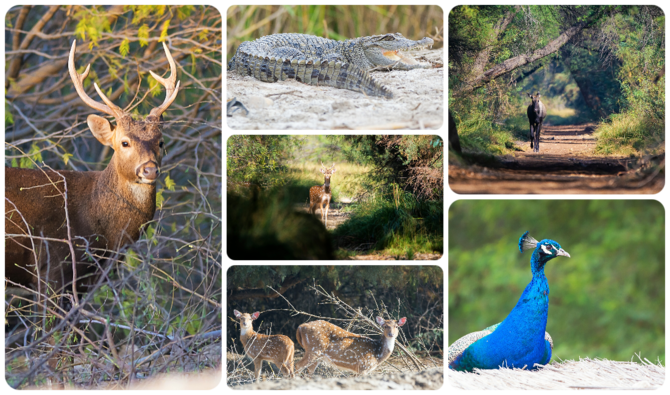

Ghotki, Sindh: A wildcat walks in the bushes, a hog deer drinks water from a pond, peacocks dance under a grove of trees — an unfamiliar sight in most Pakistani wildlife sanctuaries, but not at a safari park in Ghotki, where animals can roam the place freely.

A peacock is seen at Sufi Anwer Shah Safari Park in Ghotki, Sindh, Pakistan. (AN photo by Yasir Pechuho)
Pakistani zoos and parks have for years made headlines for the poor treatment of animals they shelter. In 2020, a high court ordered the closure of Islamabad Zoo after international condemnation for its treatment of the "world's loneliest elephant," Kaavan, who was later relocated to a sanctuary in Thailand.
Last year, another zoo, in Karachi, was forced by a court order to receive an international team of vets after video footage showed its elephant in bad condition. A Syrian brown bear at the zoo was moved to a bigger cage, when petitioners moved the Sindh High Court after a video of the animal, in which social media users said she looked "exhausted," went viral.
At Sufi Anwer Shah Safari Park, in Ghotki district of the southern Sindh province, no such sight can be found as animals are not caged. Established on 2,400 acres of land, it gives animals their natural habitats, and is home to dozens of species native to the region, such as such hog deer, black bucks, blue bulls, chinkara, pea fowl, and grey and black partridges.

Spotted deer roam free at Sufi Anwer Shah Safari Park in Ghotki, Sindh, Pakistan. (AN photo by Yasir Pechuho)
The park was opened in 2008, under a partnership between the Sindh Forest Department and the United Nations Environment Program. It is "scientifically managed" and it is ensured that animals get their natural environment, Javed Mehar, chief of the Sindh Wildlife Department, told Arab News on Sunday.

A blue bull at Sufi Anwer Shah Safari Park in Ghotki, Sindh, Pakistan. (AN photo by Yasir Pechuho)
"The park is not only home to over 90 animals including mammals, reptiles and birds of Sindh, it also has 56 different types of wild plants."

A marsh crocodile at Sufi Anwer Shah Safari Park in Ghotki, Sindh, Pakistan. (AN photo by Yasir Pechuho)
He added that as the park has become a success story, more such initiatives are planned in other parts of the province: "The Sindh government intends to set up such nature parks at each district level in the province. Inauguration of Bahman Forest Park, near Larkana shall be made very soon."
Sufi Anwer Shah Safari Park also serves as a learning center.
“Every year hundreds of students from schools, colleges and universities visit this place for educational purposes," Mehar said. "Many locals and tourists from home and abroad also come here and take a walk in the forest and enjoy forest therapy."


