President Arif Alvi emphasizes preventive healthcare in Pakistan

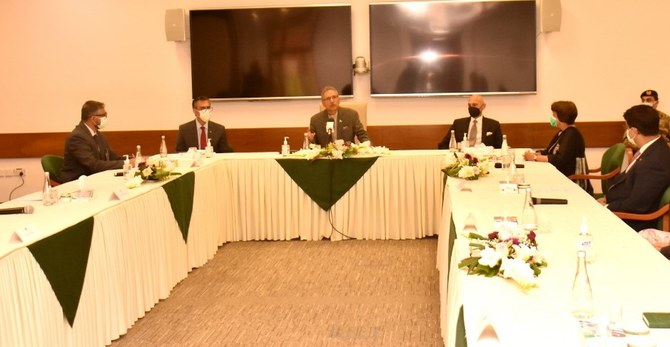
Pakistan's President Dr. Arif Alvi chairing a meeting with the senior management of Agha Khan University in Karachi, Pakistan, on January 22, 2022. (PID Photo)
Short Url
Updated 23 January 2022
Follow

President Arif Alvi emphasizes preventive healthcare in Pakistan

  • Says a large number of people do not visit hospitals due to expensive treatment in Pakistan
  • The president also advocates online medical courses ‘to increase the quantum of nursing staff in our country’

ISLAMABAD: President Dr. Arif Alvi emphasized the importance of preventive healthcare in Pakistan while addressing a conference in Karachi on Saturday.

Preventive healthcare is a concept used by many developed nations which advocates a proactive approach while dealing with health concerns.

It involves awareness among people regarding their physical well-being, a healthy lifestyle and regular check-ups to avoid serious medical issues.

From a policy perspective, preventive healthcare removes unnecessary burden from hospitals and clinics while allowing a more efficient utilization of healthcare system.

Addressing senior officials at Aga Khan University Hospital, the president said the country "should focus on preventive side of health rather than curative," reported the state-owned Associated Press of Pakistan (APP) news agency.

"While highlighting importance of preventive side of healthcare, President Dr. Arif Alvi said that many people in our country avoided to visit hospitals, particularly private hospitals, due to expensiveness of treatment," the APP said. "So, our hospitals, including AKU, need to look into this trend and focus on promoting the preventive aspect of healthcare."

The president emphasized the importance of relying on technological developments to further strengthen the healthcare sector.

He added that several nursing courses and programs could be taken online "to increase the quantum of nursing staff in our country."

Alvi admired China for developing a robust healthcare system despite being the most densely populated country in the world.

He also described Aga Khan University Hospital as a leading medical facility in Pakistan.


Pakistan denies role in Afghan regime change, says military operation will continue

Updated 6 sec ago
Follow

Pakistan denies role in Afghan regime change, says military operation will continue

  • Pakistan, Afghanistan have been embroiled in military conflict since last week after Afghan forces launched retaliatory attacks against Islamabad
  • Pakistan not targeting indiscriminate sites but specific infrastructure, installations being used to support “terrorist groups,” says security official

ISLAMABAD: Islamabad is not seeking a regime change in Afghanistan, state media reported this week quoting a senior security official, who vowed that Pakistan’s military operation against Afghan forces will continue until the Taliban government stops facilitating militants. 

The statement comes in response to the ongoing military conflict between Afghanistan and Pakistan, which began after Afghan forces on Thursday launched attacks in retaliation for Pakistani airstrikes earlier this month.

Since then, Pakistan has carried out military operations along the border, with Information Minister Attaullah Tarar claiming the killing of 435 Afghan forces and the capture of 31 Afghan positions. Afghanistan, on the other hand, has also claimed capturing several Pakistani military posts along the border and carrying out strikes targeting military bases in Pakistan. Arab News could not independently verify these claims.

“He clarified that Pakistan has nothing to do with any change of government in Afghanistan, calling it an internal choice of the Afghan people,” state broadcaster Radio Pakistan reported on Monday, citing a senior security official who spoke on condition of anonymity.

Islamabad accuses the Afghan Taliban government of sheltering militants, particularly the Tehreek-e-Taliban Pakistan (TTP) in Afghanistan and facilitating their attacks against Pakistan.

Afghanistan has denied these charges and urged Pakistan to focus on resolving its security challenges internally without blaming Kabul.

The official said the Afghan Taliban will have to either pick sides between Pakistan or the “terrorist groups” operating from their soil.

“A senior Pakistani security official has said that ‘Operation Ghazab Lil-Haq’ will continue until the Afghan Taliban government provides verifiable assurances to Pakistan that it will stop facilitating Fitna Al-Khwarij and Fitna Al-Hindustan,” Radio Pakistan reported.

Pakistan’s government and military use the terms “Fitna Al-Khwarij” for the TTP and “Fitna Al-Hindustan” for separatist militant outfits that operate mostly in southwestern Balochistan province. Islamabad accuses its chief rival India of supporting these militant groups, charges that New Delhi has always denied. 

The security official rejected Afghanistan’s claims Pakistan has killed numerous civilians in its operations. 

“He stressed that Pakistan is not targeting indiscriminate sites but only specific infrastructure and installations being used to support terrorist groups,” the state broadcaster said. 

The latest cross-border fighting ended a ceasefire brokered by Qatar and Turkiye in October. The two sides failed to reach a permanent agreement during talks in Istanbul.

Despite the ongoing tensions, Pakistan’s President Asif Ali Zardari on Monday reiterated Islamabad’s calls for talks with Afghanistan. 

“We have never walked away from dialogue,” he said.