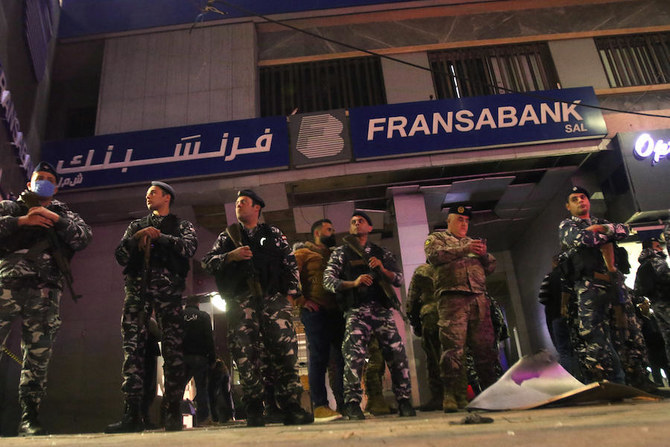
BEIRUT: Bank staff in Lebanon have called for extra security measures after a man took hostages and threatened to blow up a branch in Bekaa Valley this week.
Lebanese security forces arrested Abdullah Al-Saii on Tuesday after the incident at the Bank of Beirut and Arab Countries branch in Jeb Jannine as he attempted to withdraw $50,000 of his own money.
Armed with a gun, a grenade and bottles of benzene when he stormed into the bank, Al-Saii said the bank staff had rejected his requests to withdraw his money on previous occasions, blaming it on the economic crisis in the country.
Al-Saii held more than 10 of the bank’s staff and customers hostage for several hours, demanding he be allowed to withdraw the money. He said he would blow up the branch if his demands were not met. The building was cordoned off and the standoff was resolved following negotiations.
The incident has triggered fear among banking staff in Lebanon, who have called for beefed-up safety.
Lebanese bank clerk Hana Saleem was asked by her parents to quit her banking job or work remotely following the incident.
“After bank staff and clients were taken hostage at a bank in Bekaa Valley, my folks felt scared for my life, so they’ve begged me to quit,” she told Arab News.
Another bank employee, Dalia Hassan, believes the BBAC incident is just one in a litany of similar situations, which have put banking employees’ lives at risk.
“Since the financial crisis started over two years ago, banks have been subject to numerous attacks by armed clients, bulldozers and even angry customers carrying Molotov bombs,” she said, confirming that she feels scared whenever an agitated client yells inside her workplace.
“Whenever an angry client shouts, my co-workers and I hide under our desks or inside washrooms fearing the client might be armed and shoot at us,” said Hassan, who confirmed that the Hamra branch where she works has only employed two private security guards.
Extra policemen and security guards must be stationed inside and outside banks for “protection and safety,” she added.
Wael Imad, a branch manager, told Arab News that when banks cannot fulfill a request for a withdrawal from a customer, it is the staff and not management who are at the forefront facing angry clients.
He blamed the banks for the often reckless actions carried out by irate clients and said: “Banks are responsible when clients resort to illegal methods in, what I believe to be, a rightful bid to access their deposits.”
He said banks are supposed to protect their staff who feel unsafe in their work environments.
“Last year, I was beaten by a group of angry clients. Police arrived late to our branch before the assailants were held off,” recalled Imad.

Lebanese bank staff want security beefed up after hostage standoff
Short Url
https://arab.news/vw6vy
Lebanese bank staff want security beefed up after hostage standoff
- Employees are holding banks responsible for angry customers’ occasionally criminal behavior
- Family scared for daughter’s life ask her to quit banking job or work remotely
US transfers thousands of Daesh detainees from Syria to Iraq
BAGHDAD: The United States Central Command said it has completed the transfer of more than 5,700 detained Daesh group suspects from Syria to Iraq.
The detainees from some 60 countries had for years been held in Syrian prisons run by Kurdish-led forces before the recapture of surrounding territory by Damascus prompted Washington to step in.
CENTCOM said it “completed a transfer mission following a nighttime flight from northeastern Syria to Iraq on Feb 12 to help ensure Daesh detainees remain secure in detention facilities.”
“The 23-day transfer mission began on Jan 21 and resulted in US forces successfully transporting more than 5,700 adult male Daesh fighters from detention facilities in Syria to Iraqi custody,” it added in a statement.
The US had previously announced it would transfer around 7,000 detainees.
Daesh swept across Syria and Iraq in 2014, committing massacres and forcing women and girls into sexual slavery.
Backed by US-led forces, Iraq proclaimed the defeat of Daesh in the country in 2017, and the Kurdish-led Syrian Democratic Forces (SDF) ultimately beat back the group in Syria two years later.
The SDF went on to jail thousands of suspected jihadists and detain tens of thousands of their relatives in camps.
- 61 countries -
Last month, Syrian troops drove Kurdish forces from swathes of northern Syria, sparking questions over the fate of the Daesh prisoners.
Lingering doubts about security pushed Washington to announce it would transfer them to Iraq to prevent “a breakout” that could threaten the region.
“We appreciate Iraq’s leadership and recognition that transferring the detainees is essential to regional security,” said head of CENTCOM Admiral Brad Cooper.
“Job well done to the entire Joint Force team who executed this exceptionally challenging mission on the ground and in the air,” he added.
Iraq’s National Center for International Judicial Cooperation (NCIJC) said 5,704 Daesh detainees of 61 nationalities have arrived in Iraq.
They include 3,543 Syrians, 467 Iraqis, and another 710 detainees from other Arab countries.
There are also more than 980 foreigners including those from Europe, Asia, Australia and the United States.
The NCIJC said Iraq’s judiciary will interrogate the detainees before taking legal action against them.
Many prisons in Iraq are already packed with Daesh suspects.
Iraqi courts have handed down hundreds of death sentences and life terms to those convicted of terrorism offenses, including foreign fighters.
Under Iraqi law, terrorism and murder offenses are punishable by death, and execution decrees must be signed by the president.
The detainees in Syria were transferred to Baghdad’s Al-Karkh prison, once a US Army detention center known as Camp Cropper, where former ruler Saddam Hussein was held before his execution.
To make space for the newcomers, authorities moved thousands of prisoners from the Karkh prison to other facilities, a lawyer and an inmate told AFP on condition of anonymity.
- Repatriation -
Iraq has issued calls for countries to repatriate their nationals among the Daesh detainees, though this appears unlikely.
For years, Syria’s Kurdish forces also called on foreign governments to take back their citizens, but this was done on a small scale limited to women and children held in detention camps.
Most foreign families have left northeast Syria’s Al-Hol camp, which holds relatives of Daesh fighters, since the departure of Kurdish forces who previously guarded it, humanitarian sources told AFP on Thursday.
Last month, the Syrian government took over the camp from Kurdish forces who ceded territory as Damascus extended its control across swathes of Syria’s northeast.
The detainees from some 60 countries had for years been held in Syrian prisons run by Kurdish-led forces before the recapture of surrounding territory by Damascus prompted Washington to step in.
CENTCOM said it “completed a transfer mission following a nighttime flight from northeastern Syria to Iraq on Feb 12 to help ensure Daesh detainees remain secure in detention facilities.”
“The 23-day transfer mission began on Jan 21 and resulted in US forces successfully transporting more than 5,700 adult male Daesh fighters from detention facilities in Syria to Iraqi custody,” it added in a statement.
The US had previously announced it would transfer around 7,000 detainees.
Daesh swept across Syria and Iraq in 2014, committing massacres and forcing women and girls into sexual slavery.
Backed by US-led forces, Iraq proclaimed the defeat of Daesh in the country in 2017, and the Kurdish-led Syrian Democratic Forces (SDF) ultimately beat back the group in Syria two years later.
The SDF went on to jail thousands of suspected jihadists and detain tens of thousands of their relatives in camps.
- 61 countries -
Last month, Syrian troops drove Kurdish forces from swathes of northern Syria, sparking questions over the fate of the Daesh prisoners.
Lingering doubts about security pushed Washington to announce it would transfer them to Iraq to prevent “a breakout” that could threaten the region.
“We appreciate Iraq’s leadership and recognition that transferring the detainees is essential to regional security,” said head of CENTCOM Admiral Brad Cooper.
“Job well done to the entire Joint Force team who executed this exceptionally challenging mission on the ground and in the air,” he added.
Iraq’s National Center for International Judicial Cooperation (NCIJC) said 5,704 Daesh detainees of 61 nationalities have arrived in Iraq.
They include 3,543 Syrians, 467 Iraqis, and another 710 detainees from other Arab countries.
There are also more than 980 foreigners including those from Europe, Asia, Australia and the United States.
The NCIJC said Iraq’s judiciary will interrogate the detainees before taking legal action against them.
Many prisons in Iraq are already packed with Daesh suspects.
Iraqi courts have handed down hundreds of death sentences and life terms to those convicted of terrorism offenses, including foreign fighters.
Under Iraqi law, terrorism and murder offenses are punishable by death, and execution decrees must be signed by the president.
The detainees in Syria were transferred to Baghdad’s Al-Karkh prison, once a US Army detention center known as Camp Cropper, where former ruler Saddam Hussein was held before his execution.
To make space for the newcomers, authorities moved thousands of prisoners from the Karkh prison to other facilities, a lawyer and an inmate told AFP on condition of anonymity.
- Repatriation -
Iraq has issued calls for countries to repatriate their nationals among the Daesh detainees, though this appears unlikely.
For years, Syria’s Kurdish forces also called on foreign governments to take back their citizens, but this was done on a small scale limited to women and children held in detention camps.
Most foreign families have left northeast Syria’s Al-Hol camp, which holds relatives of Daesh fighters, since the departure of Kurdish forces who previously guarded it, humanitarian sources told AFP on Thursday.
Last month, the Syrian government took over the camp from Kurdish forces who ceded territory as Damascus extended its control across swathes of Syria’s northeast.
© 2026 SAUDI RESEARCH & PUBLISHING COMPANY, All Rights Reserved And subject to Terms of Use Agreement.


