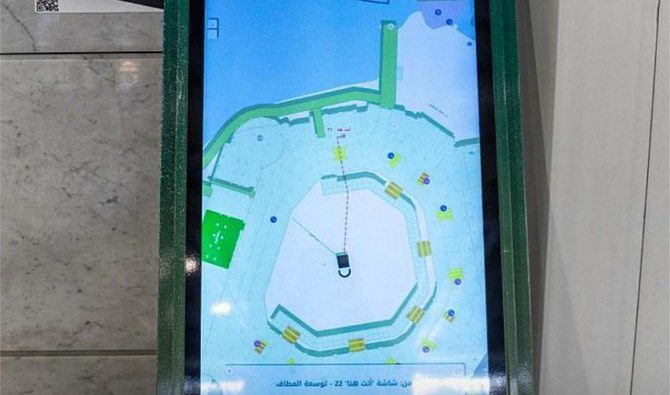
Interactive screens guide visitors at Makkah’s Grand Mosque

1 / 4
It aims to facilitate access to ritual sites as well as key locations, including the Mataf. (SPA)
2 / 4
It aims to facilitate access to ritual sites as well as key locations, including the Mataf. (SPA)
3 / 4
It aims to facilitate access to ritual sites as well as key locations, including the Mataf. (SPA)
4 / 4
Short Url
Updated 22 January 2022
Follow

Interactive screens guide visitors at Makkah’s Grand Mosque

  • The interactive screens display data in six major languages and provide a QR code

MAKKAH: As part of its plan to develop and upgrade the quality of the guidance system, the General Presidency for the Affairs of the Two Holy Mosques has launched a new service for worshippers, providing them with interactive screens that display the guidance map of the Grand Mosque and its facilities.
It aims to facilitate access to ritual sites as well as key locations, including the Mataf (the area for circumambulation around the Holy Kaaba) and Mas’a building, through providing direct movement paths from the location of the user to the destination.
The interactive screens also display data in six major languages and provide a QR code so that the routes can be viewed via personal devices. 


Saudi wildlife center releases 140 wild animals into royal reserve

The initiatives aim to enhance ecological balance and restore biodiversity in natural habitats. (SPA)
Updated 54 min 14 sec ago
Follow

Saudi wildlife center releases 140 wild animals into royal reserve

  • This milestone reflects significant progress in the management and governance of wildlife across the Kingdom, supporting the goals of the Saudi Green Initiative and aligning with the objectives of Saudi Vision 2030

RIYADH: The National Center for Wildlife released 140 wild animals into the King Salman bin Abdulaziz Royal Reserve as part of ongoing programs to reintroduce endangered species. The initiatives aim to enhance ecological balance and restore biodiversity in natural habitats.

The release, carried out in cooperation with the King Salman bin Abdulaziz Royal Reserve Development Authority, included 30 Arabian oryx, 70 reem gazelles (sand gazelles), and 40 houbara bustards, the SPA reported on Thursday. 

The initiative forms part of efforts to reintroduce species to their natural habitats and establish stable, self-sustaining wildlife populations capable of breeding, contributing to improved ecosystem functioning and sustainability.

The NCW continues to implement its strategic plans for wildlife development, with the total number of animals reintroduced through its specialized programs now exceeding 10,000.

This milestone reflects significant progress in the management and governance of wildlife across the Kingdom, supporting the goals of the Saudi Green Initiative and aligning with the objectives of Saudi Vision 2030.