

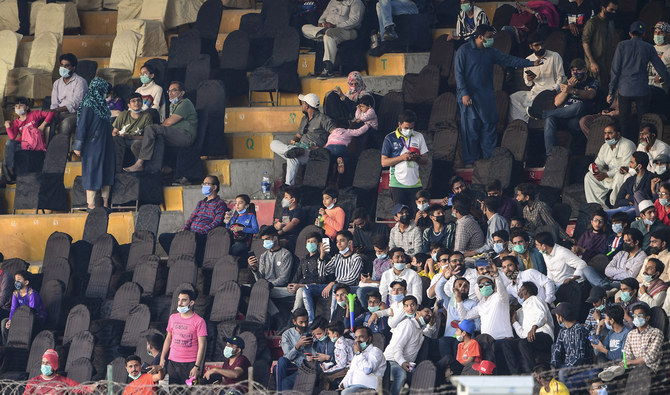
Pakistan allows 25 percent spectators in Karachi stadium during PSL matches

People watch the Pakistan Super League (PSL) T20 cricket match between Islamabad United and Quetta Gladiators at the National Stadium in Karachi on March 2, 2021. (AFP/File)
Short Url
Updated 20 January 2022
Follow

Pakistan allows 25 percent spectators in Karachi stadium during PSL matches

  • The country's cricket authority says spectators will only be able to enter the stadium under strict COVID-19 protocols
  • Last year, the Pakistan Super League tournament was postponed for a few months due to the coronavirus pandemic

ISLAMABAD: The Pakistan Cricket Board (PCB) announced on Wednesday a limited number of people would be able to watch the first phase of a popular Twenty20 cricket tournament by going to the venue after the government allowed 25 percent of the total stadium capacity during the matches in Karachi.

The Pakistan Super League (PSL) brings together some of the best cricket talent from across the world and has a major following in Pakistan and the rest of the region.

However, the competition had to be postponed for a few months last year after a number of players tested positive for COVID-19.

Pakistan is witnessing another increase in the number of new coronavirus infections while Karachi - where the first few PSL matches are scheduled to be played - has an alarmingly high positivity ratio.

"The National Command and Operation Center (NCOC) has approved 25 per cent crowd attendance for the HBL Pakistan Super League 2022 Karachi-leg matches, which will be played at the National Stadium from 27 January to 7 February," the PCB said in a statement on its website. "The decision means around 8,000 spectators will be allowed inside the venue each match day."


The country's cricket board added that the spectators' entry would be subject to strict coronavirus protocols.

"Individuals above the age of 12 years must be fully vaccinated," it continued. "Valid vaccination certificates must be shown while gaining access to the stadium."

The PCB informed it was also mandatory for all spectators to wear protective face masks, adding that anyone violating the official healthcare guidelines would be "evicted from the stadium."

PCB Chief Operating Officer Salman Naseer welcomed the development, saying: "Spectators are the essence of any sport event and in this background, we now hope to set the stage with 25 per cent crowds to attend the Karachi matches of the HBL PSL 2022. As a responsible organization, we completely understand our obligations in relation to health and safety of the fans and will leave no stone unturned in strictly implementing the NCOC guidelines."

He also requested the spectators to abide by the COVID-19 protocols to enjoy the matches in a safe and secure environment.

The PCB said the country's central pandemic response body would take a decision regarding other matches of the tournament ahead of the next phase beginning in Lahore.

Pakistan reports current account surplus in Jan. owing to improved trade, remittances

Updated 17 February 2026
Follow

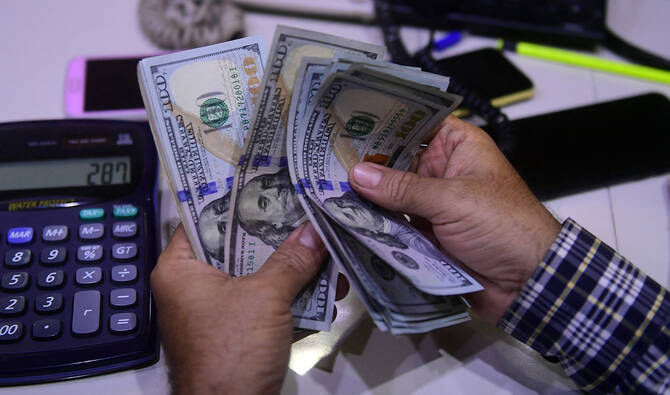
Pakistan reports current account surplus in Jan. owing to improved trade, remittances

  • Pakistan’s exports crossed the $3 billion mark in Jan. as the country received $3.5 billion in remittances
  • Last month, IMF urged Pakistan to accelerate pace of structural reforms to strengthen economic growth

ISLAMABAD: Pakistan recorded a current account surplus of more than $120 million in January, the country’s finance adviser said on Tuesday, attributing it to improved trade balance and remittance inflows.

Pakistan’s exports rebounded in January 2026 after five months of weak performance, rising 3.73 percent year on year and surging 34.96 percent month on month, according to data released by the country’s statistics bureau.

Exports crossed the $3 billion mark for the first time in January to reach $3.061 billion, compared to $2.27 billion in Dec. 2025. The country received $3.5 billion in foreign remittances in Jan. 2026.

Khurram Schehzad, an adviser to the finance minister, said Pakistan reported a current account surplus of $121 million in Jan., compared to a current account deficit of $393 million in the same month last year.

“Improved trade balance in January 2026, strong remittance inflows, and sustained momentum in services exports (IT/Tech) continue to reinforce the country’s external account position,” he said on X.

Pakistan has undergone a difficult period of stabilization, marked by inflation, currency depreciation and financing gaps, and international rating agencies have acknowledged improvements after Islamabad began implementing reforms such as privatizing loss-making, state-owned enterprises (SOEs) and ending subsidies as part of a $7 billion International Monetary Fund (IMF) loan program.

Late last month, the IMF urged Pakistan to accelerate the pace of these structural reforms to strengthen economic growth.

Responding to questions from Arab News at a virtual media roundtable on emerging markets’ resilience, IMF’s director of the Middle East and Central Asia Jihad Azour said Islamabad’s implementation of the IMF requirements had been “strong” despite devastating floods that killed more than 1,000 people and devastated farmland, forcing the government to revise its 4.2 percent growth target to 3.9 percent.

“What is important going forward in order to strengthen growth and to maintain the level of macroeconomic stability is to accelerate the structural reforms,” he said at the meeting.

Azour underlined Pakistan’s plans to privatize some of the SOEs and improve financial management of important public entities, particularly power companies, as an important way for the country to boost its capacity to cater to the economy for additional exports.

“This comes in addition to the effort that the authorities have made in order to reform their tariffs, which will allow the private sector of Pakistan to become more competitive,” the IMF official said.