



JEDDAH: The Saudi National Center for Wildlife has rescued and rehabilitated five turtles found on the coasts of Saudi Arabia.
According to the center, the world’s oceans include seven species of sea turtles, five of which have been discovered in the Kingdom’s territorial waters of the Red Sea and Arabian Gulf.
For more than 100 million years, sea turtles have crossed great distances across the world. They play a vital role in maintaining the health and balance of the marine ecosystem.
The Kingdom has recorded sightings of green, hawksbill, loggerhead, olive ridley and leatherback turtles.
According to the center, during nesting season, sea turtles lay 60 to 160 eggs at once. This can be repeated up to six times over the course of a nesting season. In some cases, turtles have been seen to return to the same areas that they were born in more than 40 years later.
FASTFACT
For more than 100 million years, sea turtles have crossed great distances across the world.
The islands of Karan and Jurayad along the Kingdom’s coasts on the Arabian Gulf are found to be primary nesting sites for both the hawksbill and green turtles.
And on the Red Sea, Ra’s Baridi, Farasan Island, Shakir Islands, Ras Al-Shaaban, Jabal Hassan and Sanafir Island are also important locations for the two species.
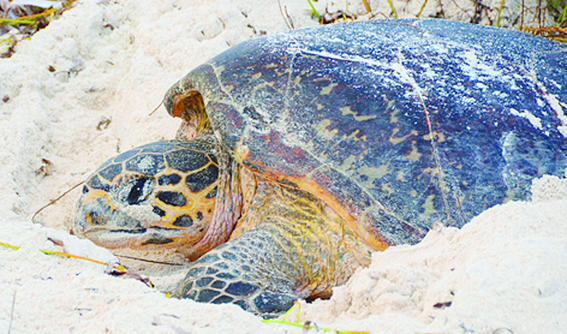
Sea turtles are facing many threats, including overfishing, pollution, climate change and habitat destruction, mainly due to development in coastal areas and the wildlife trade. (Shutterstock)
Sea turtles are facing many threats, including overfishing, pollution, climate change and habitat destruction, mainly due to development in coastal areas and the wildlife trade.
The World Wildlife Fund has listed the hawksbill and green turtles as “endangered,” while loggerhead, olive ridley and leatherback turtles are classified as “vulnerable.”
Through rehabilitation programs and research studies, the Saudi National Center for Wildlife aims to protect nesting sites of endangered sea turtles to maintain an environment in which they can thrive.
The Kingdom is committed to preserving and restoring its marine biodiversity through initiatives.
Among the many projects to restore and protect marine life, NEOM has launched programs to protect endangered species such as the hawksbill sea turtle and hammerhead shark.
The Red Sea Development Company also works towards implementing initiatives to protect marine life and endangered sea turtles in the Kingdom.
The company, in cooperation with King Abdullah University of Science and Technology, early last year worked on the rehabilitation of two hawksbill turtles.
The turtles were safely returned to the waters of Waqadi Island, which will remain untouched and undeveloped as a protected area overseen by the The Red Sea Development Company.
The Saudi National Center for Wildlife continues to set standards for sustainable development initiatives to lay the foundation for marine protection in all future development plans.


