

Houthis reject UN call to release hijacked UAE-flagged ship

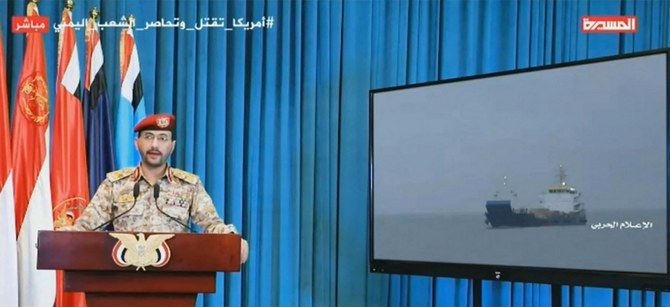
This image grab taken from a video broadcast by pro-Huthi Al-Masirah TV on January 3, 2022, shows Huthi military spokesman Yahya Saree giving a press briefing about the Emirati-flagged vessel "Rwabee" in the Red Sea. (Fille/AFP)
Short Url
Updated 15 January 2022
Follow

Houthis reject UN call to release hijacked UAE-flagged ship

  • Houthis seized the vessel carrying medical supplies from Yemeni island of Socotra to Jazan
  • Coalition announced killing at least 345 Houthis, destroying 37 militia vehicles in 60 airstrikes in past 24 hours

AL-MUKALLA: The Houthis on Saturday criticized the UN Security Council for demanding they release a hijacked UAE-flagged ship.

Militia official Hussein Al-Azzi Houthi rejected the UN’s calls to free the ship and repeated claims it had been carrying weapons for the Coalition to Support Legitimacy in Yemen.

“The ship was also not loaded with dates or children's toys, but was loaded with weapons,” he tweeted, accusing the UN of “misleading public opinion.”

The Houthis seized the vessel, which was carrying medical supplies from the remote Yemeni island of Socotra to the Saudi port of Jazan, on Jan. 3. 

Their defiance came as government troops, backed by coalition air support, on Friday and Saturday took control of new mountainous locations south and west of the city of Marib.

Yemen’s Defense Ministry and local media reports said there were intensified attacks on pockets of Houthis fighting in Hareb district, south of Marib.

Troops also pushed almost 10 km into Houthi-controlled territory in Juba district, mainly in the Al-Balaq Al-Sharqi mountain range.

The Houthis have suffered massive setbacks since the start of this year, when troops took control of three districts in the oil-rich province of Shabwa and later advanced into Hareb district.

The coalition on Saturday urged Yemenis not to drive through main roads linking Marib and Al-Bayda with Hareb, Bayhan and Ouselan districts, declaring them “areas of operations” amid fighting on the ground and coalition airstrikes.

The coalition also announced killing at least 345 Houthis and destroying 37 militia vehicles in 60 airstrikes over the past 24 hours in the provinces of Al-Bayda and Marib.

Yemeni Landmine Records, which documents victims of mines or unexploded ordnances, said Friday that Houthi landmines had killed 38 government fighters and civilians since earlier this month in Shabwa and Marib provinces.

Landmine specialist Musa Abdullah Al-Harethi was killed on Saturday while defusing a device planted by the Houthis in Ouselan district. Two children were killed in a blast caused by a landmine in Al-Khoka, south of Hodeidah province, the organization said.


Netherlands returns 3,500-year-old looted sculpture to Egypt

Updated 2 sec ago
Follow

Netherlands returns 3,500-year-old looted sculpture to Egypt

THE HAGUE: The Netherlands on Thursday returned a 3,500-year-old sculpture to Egypt after ​the looted artefact resurfaced at a Dutch art fair in 2022.
An investigation by Dutch police and cultural heritage inspectorate confirmed in 2025 the sculpture had been plundered and unlawfully removed from Egypt, most likely during the Arab Spring unrest of 2011, ‌before appearing ‌on the international art market.
Experts ‌believe ⁠the ​artefact, ‌a stone head that was originally part of a block statue, originated from Luxor in southern Egypt. It depicts a senior official from the reign of Pharaoh Thutmose III (1479–1425 BC).
It was confiscated in 2022 at an art ⁠fair in the Dutch city of Maastricht. Art dealer ‌Sycomore Ancient Art, which had acquired ‍the piece but ‍had doubts about its provenance, voluntarily surrendered ‍it following the inquiry.
“Our policy is to return what doesn’t belong to us and to return it always to the rightful cultural group ​or country,” Dutch Culture Minister Gouke Moes said in handing over the artefact to ⁠the Egyptian ambassador.
Egyptian Ambassador Emad Hanna said his country tracks artefacts that appear in exhibitions or auctions.
“It means a lot to us when it comes to tourism and economy, because at the end of the day, when tourists come to Egypt to see these things, it definitely makes a difference,” Hanna said.
Egypt’s plans to display the ‌sculpture were not yet clear.