Noor Mukadam’s father seeks capital punishment for Zahir Jaffer in court testimony

Policemen escort Zahir Jaffer (C), a Pakistani-American man who went on trial accused of raping and beheading Noor Mukadam, after his court hearing in Islamabad, Pakistan, on October 20, 2021. (AFP)
Short Url
Updated 16 January 2022
Follow

Noor Mukadam’s father seeks capital punishment for Zahir Jaffer in court testimony

  • Mukadam was found beheaded at a residence in Islamabad’s upscale F-7/4 neighborhood last July
  • The court has summoned investigation officer in the case on Monday to record his statement

ISLAMABAD: Shaukat Mukadam, the father of 27-year-old Noor Mukadam who was murdered in Islamabad in July 2021, on Saturday demanded capital punishment for the prime suspect, Zahir Jaffer, as he recorded his statement before an Islamabad court. 
Noor Mukadam, the daughter of a former Pakistani diplomat, was found beheaded at a residence in Islamabad’s upscale F-7/4 neighborhood, in a case that has sparked public outrage and grabbed media attention unlike any other recent crime against women. The key suspect, Zahir Jaffer, was arrested from the crime scene on the day of the murder. 
Others charged in the case include Zahir’s parents, Zakir Jaffer and Asmat Adamjee, their three household staff, Iftikhar, Jan Muhammad and Jameel, and six workers from Therapy Works, a counselling center from where Jaffer had received certification to become a therapist and where he had been receiving treatment in the weeks leading up to the murder. 
The case is now in the concluding stage in the Islamabad district court, where Additional Sessions Judge Atta Rabbani has been conducting the hearings. Eyewitnesses have been recording their statements in the case and defense attorney cross-examining their testimonies. 
In Saturday’s hearing, Shaukat Mukadam recorded his statement in the court, saying he had no “personal enmity” with anybody. 
“My daughter has been killed unlawfully,” he said. “Zahir Jaffer should be handed down death sentence.” 
Recounting the unfortunate day’s events when her daughter was killed, Shaukat said he and his wife were not home on July 19 and upon their return, they didn’t find their daughter. He said they got worried and telephoned Noor, but her mobile phone was switched off. 
“I started searching for her,” he said. “When she picked up [the call], she asked me not to worry and that she was going to Lahore with some friends.” 
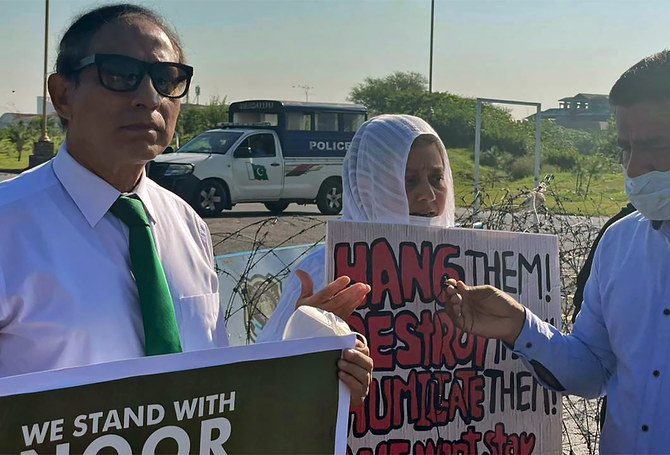


Noor Mukadam's mother is holding a placard during a protest demonstration in Islamabad, Pakistan, on October 20, 2021. Mukadam, daughter of a former Pakistani diplomat, was brutally murdered in the country's federal capital on July 20. (Photo courtesy: Justice for Noor)

On July 20, Shaukat said Zahir Jaffer called him and informed that Noor was not with him. He said he knew the Jaffer family well. 
Shaukat said around 10pm the same day, he received a telephone call from the Kohsar police station and was informed that his daughter had been murdered. 
“The police took me to Zahir Jaffer’s home where I saw my daughter brutally killed and decapitated,” he informed the court. 
Shaukat said Noor’s mobile phone was recovered from a closet in the house, which showed the accused had snatched it from the victim. 
After Shaukat recorded his statement, advocate Basharatullah Khan, who is representing Zahir’s father in the case, cross-examined him to verify the facts. 
Shaukat said he had no information about any other suspects in the case except the Jaffer family. 
Zahir’s lawyer, Sikandar Zulqarnain, did not show up for the hearing and a junior counsel informed the court that he was infected with COVID-19. 
Advocate Shah Khawar, who is representing the Mukadam family, said they wanted transparent and open hearings in the case, therefore Zahir’s lawyer could cross examine his client on Monday. 
The court summoned investigation officer in the case to record his statement and adjourned the proceedings till Monday. 


Pakistan raises fuel prices by Rs55 per liter as Middle East conflict drives oil surge

Updated 10 sec ago
Follow

Pakistan raises fuel prices by Rs55 per liter as Middle East conflict drives oil surge

  • Government says adequate fuel stocks in place despite global energy shock
  • Oil prices jump from about $78 to over $106 per barrel amid regional conflict

ISLAMABAD: Pakistan on Friday increased petrol and diesel prices by Rs55 ($0.20) per liter each as escalating conflict in the Middle East sent global oil prices sharply higher and disrupted energy supply routes, officials said.

Global oil markets have been rattled since coordinated strikes by the United States and Israel against Iran began last week, triggering retaliatory attacks across the region, raising fears of disruption to key energy shipping routes and pushing petroleum prices sharply upward.

The price adjustment in Pakistan was announced after a joint press conference by Finance Minister Muhammad Aurangzeb, Deputy Prime Minister and Foreign Minister Ishaq Dar and Petroleum Minister Ali Pervaiz Malik, who said the government was monitoring international energy markets and domestic supply conditions amid the crisis.

“So, the decision we have made by changing the levy a little bit is that we are going ahead with increasing the price of both fuels, petrol and diesel, by Rs55 ($0.20),” Malik told reporters. 

“And as soon as this matter settles, we will revise the prices downward with the same speed and take steps on how to increase people’s income and purchasing power.”

He said Pakistan entered the crisis with “comfortable energy reserves” due to earlier planning but rising global prices had forced the government to adjust domestic fuel rates to maintain supply continuity.

He said international petrol prices had climbed from roughly $78 per barrel on March 1 to around $106.8 per barrel, while diesel prices had risen to about $150 per barrel.

Malik added that the government had taken steps to minimize the burden on consumers, noting diesel plays a critical role in agriculture, transportation and public mobility.

Malik also warned that authorities would take strict action against anyone attempting to hoard fuel or manipulate supply for profiteering.

The minister said Pakistan was working with international partners to secure additional energy supplies, including arrangements with Saudi Aramco and the use of Pakistan National Shipping Corporation vessels to transport crude oil imports.

Finance Minister Aurangzeb said a high-level government committee formed by Prime Minister Shehbaz Sharif had been meeting daily to review developments in global petroleum markets and their potential impact on Pakistan’s economy.

“Pakistan currently maintains adequate energy stocks and macroeconomic stability,” Aurangzeb said, adding that the government’s response was based on preparedness rather than panic.

He said the committee, which includes senior ministers, the governor of the State Bank of Pakistan and other officials, was assessing short-, medium- and long-term implications of the crisis for inflation, foreign exchange reserves and broader economic indicators.

Deputy PM Dar said the regional conflict had significantly disrupted global energy markets, with international petroleum prices rising by as much as 50–70 percent in recent days.

The deputy prime minister added that Pakistan was also engaged in diplomatic efforts aimed at de-escalating tensions and restoring stability in the region.

Petroleum prices will now be reviewed more frequently, potentially on a weekly basis, and any reduction in global oil prices would be passed on to consumers.

Pakistan, which relies heavily on imported fuel to meet its energy needs, is particularly vulnerable to global oil price shocks that can quickly feed into inflation and pressure the country’s external accounts.